Linaria vulgaris

Yellow Toadflax Identification & Control

Yellow Toadflax, botanically known as Linaria vulgaris and commonly nicknamed 'Butter-and-Eggs', is an exceptionally aggressive, highly persistent perennial broadleaf weed in the Plantaginaceae family. Native to Europe but thoroughly invasive globally, it is a severe threat to rangelands, pastures, and residential garden borders. It features upright stems densely covered in narrow, linear, pale-green leaves, and produces showy spikes of bright yellow, snapdragon-like flowers with a prominent orange throat. It spreads aggressively via a massive network of deep, creeping lateral roots that release allelopathic compounds, outcompeting native forage and containing toxic glucosides that are highly unpalatable to livestock.


Sunlight Icon
Sunlight Full Sun
Watering Icon
Watering Tolerance Low to Moderate
Soil Mix Icon
Soil Adaptability Gravel / Sandy Loam / Sterile Soil / Clay
Temperature Icon
Growth Temp 8°C - 35°C
Toxicity Danger Icon
Danger / Toxicity Toxic to Livestock / Deep Sprawling Roots
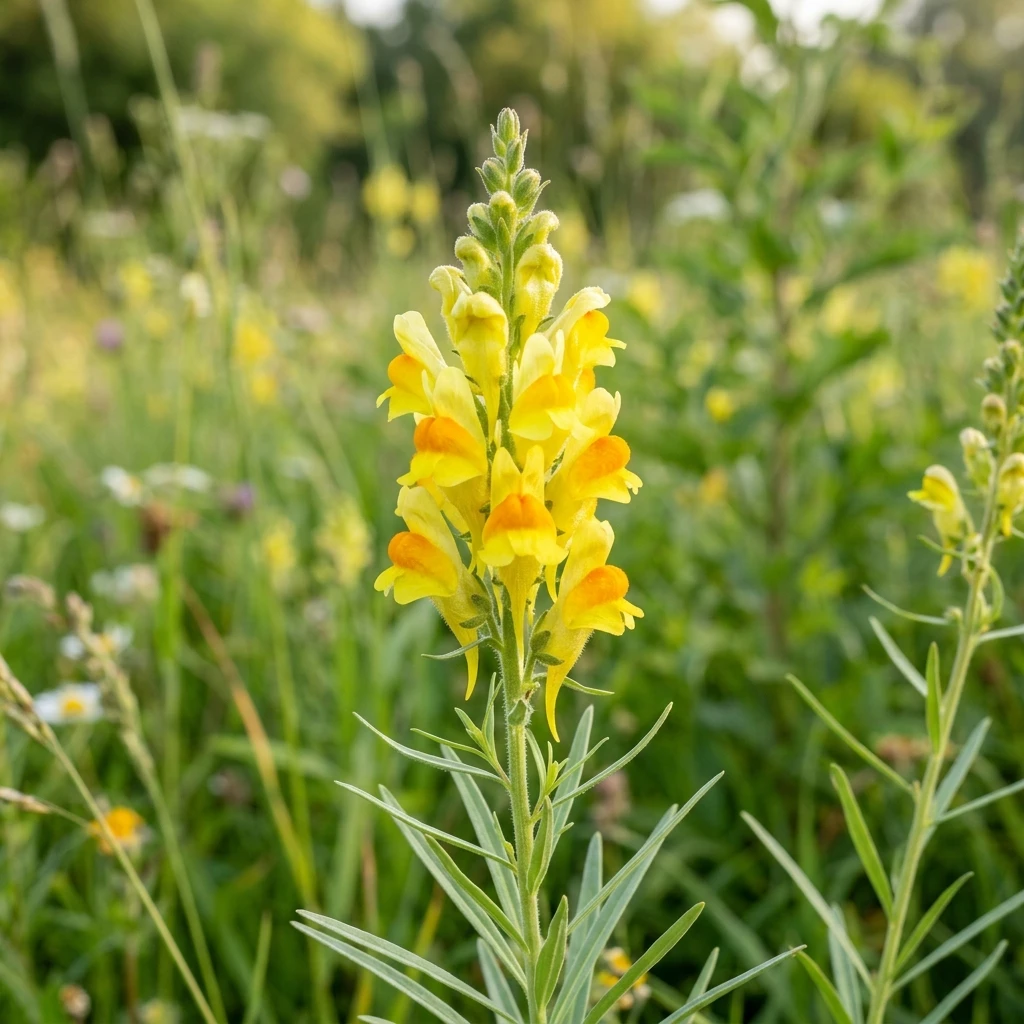
Botanical macro photography of Yellow Toadflax (Linaria vulgaris) - Plant AI care and control database

How to Identify Yellow Toadflax

An upright perennial with narrow linear leaves, and dense spikes of snapdragon-like, bright yellow flowers showing orange throats.

  • Snapdragon-Like Flowers: Showy flowers (2 cm long) have a bright yellow tube with exactly two lips and a prominent waxy orange throat cushion ('butter-and-eggs').
  • Narrow Linear Leaves: Numerous pale-green, smooth, narrow linear leaves (2 to 6 cm long) are arranged alternately and densely along the upright stems.
  • Upright Smooth Stems: Stems are erect, smooth, hollow (growing up to 2.5 feet tall), and occasionally branched at the top.
💡 Bumblebee Flower: Only heavy-bodied bumblebees (*Bombus* species) are strong enough to physically push open the tightly closed snapdragon-like flower lips to reach the nectar spur at the base, acting as the exclusive pollinator.

Complete Care & Management Guide

Access highly technical, scientific management directives to control or cultivate Yellow Toadflax effectively.

Extremely drought-tolerant once established. It thrives during hot, dry summer baking that wilts garden crops by drawing water from deep sub-soils.
Resistant to mowing. Regular mowing will clip the tall stems but the plant will quickly shoot up new seedheads close to the ground, adapting its growth habit.
Highly aggressive. It actively steals high levels of nitrogen and soil nutrients, severely stunting neighboring garden crops and turf grasses.
Requires Full Sun. It cannot tolerate shade and will fail to grow under trees, beneath thick garden shrubs, or in dense, shaded lawns.
Adapts to dry sandy loam, compacted poor clay, roadsides, and disturbed fields. It struggles in wet, saturated organic bogs.
Spreads aggressively by creeping stolons and seeds. Stems root at every node touching the soil, while mature seed heads produce thousands of durable seeds.
Extremely heat-tolerant perennial. Stems die back and turn completely straw-brown with winter frost, but the deep black rhizomes sprout fresh shoots in spring.
Features an exceptionally deep, sprawling network of creeping horizontal white rhizomes. Excavation requires slicing the root crown deep below the soil.
Occasionally targeted by aphids, but pests rarely slow its aggressive colonization.
Subject to **Bacterial Wilt** and **Tobacco Mosaic Virus**, serving as a dangerous disease reservoir for garden tomatoes and peppers.
To control Yellow Toadflax organically, manually dig up young rosettes in spring before they flower, use a hoe to scrape seedlings, and mulch garden beds heavily to block seed light.

Are your pasture borders showing bright yellow snapdragon-like flowers?

Moisten soil and dig up the creeping white lateral roots deep, check for linear green leaves, and prune before seed heads form.

Diagnose Weed Instantly

Common Diseases & Treatment

Glycoside Pasture Avoidance

Symptoms: Symptoms: Pastures are heavily invaded by yellow toadflax because cattle refuse to graze the toxic, highly bitter leaves, leading to forage starvation.

Action: Action: Hand-pull or dig out the weed in spring. Plant competitive native grasses and ensure balanced pasture rotation.

Deep Lateral Spreading

Symptoms: Symptoms: Toadflax patches expand in circular mats in garden beds, returning vigorously despite shallow hand-pulling.

Action: Action: Excavate the soil using a garden spade. Pull the long, white lateral root chains completely intact without breaking them.

Frequently Asked Questions

Why is it nicknamed 'Butter-and-Eggs'?

It is named after its highly unique yellow and orange flower color scheme. The waxy bright-yellow petals resemble butter, while the waxy orange central bulge resembles an egg yolk.

Is Yellow Toadflax poisonous to cattle?

Yes. It contains toxic glucosides that are highly bitter and toxic to livestock. Grazing cattle, horses, and sheep avoid it, allowing the weed to quickly dominate pastures.

How do these flowers pollinate?

The snapdragon lips are closed so tightly that only heavy-bodied bumblebees are strong enough to push open the waxy lips and reach the deep nectar spur.

What is the best way to get rid of it?

Excavate the white lateral root chains completely using a garden spade in early summer, and mow repeatedly to prevent seed production.

No more dying plants. Grow healthy greens today!

Get Started for Free