Cyperus esculentus

Yellow Nutsedge Identification & Control

Yellow Nutsedge, also popularly known as Nutgrass or Chufa, is an exceptionally aggressive, difficult-to-eradicate perennial weed. Although it resembles a grass, it is actually a sedge in the Cyperaceae family. Famous for its light yellow-green, glossy leaves and triangular stems, it grows rapidly in poorly drained, wet lawn soils. Its underground network features creeping rhizomes that terminate in small, fleshy tubers (nutlets), making physical pulling highly dangerous as it triggers massive tuber regrowth.


Sunlight Icon
Sunlight Full Sun to Partial Shade
Watering Icon
Watering Tolerance Moderate to High
Soil Mix Icon
Soil Adaptability Wet Clay / Poorly Drained Loam
Temperature Icon
Growth Temp 12°C - 40°C
Toxicity Danger Icon
Danger / Toxicity Pet Safe / Edible Nutlets
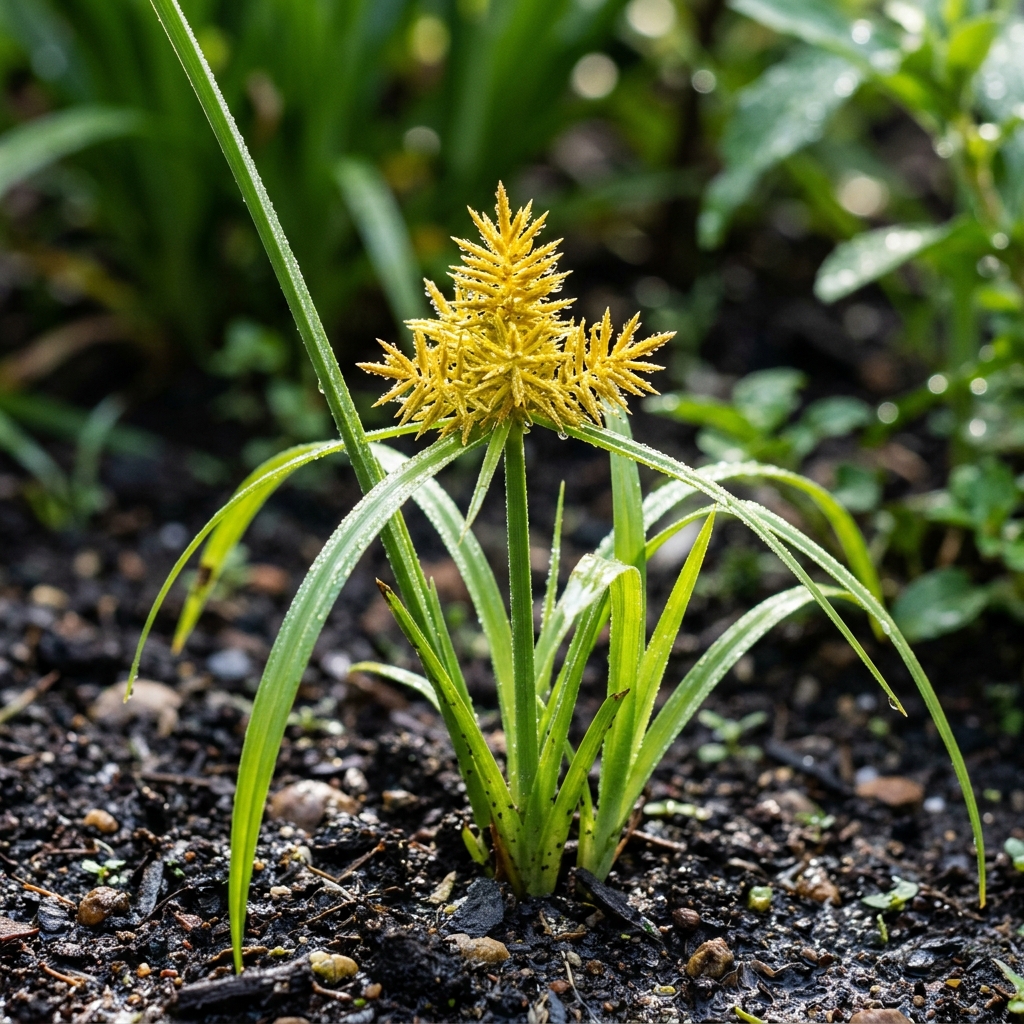
Botanical macro photography of Yellow Nutsedge (Cyperus esculentus) - Plant AI care and control database

How to Identify Yellow Nutsedge

An erect, grassy perennial with distinct triangular stems (sedges have edges), glossy light yellow-green V-shaped leaves, and golden-yellow bottle-brush flower heads.

  • Triangular Stem (Sedges Have Edges): Stems are strictly triangular in cross-section with solid cores, unlike grasses which have round, hollow stems.
  • Glossy Yellow-Green Leaves: Thick, stiff, V-shaped leaf blades that have a shiny, waxy coat, growing significantly faster than surrounding lawn grass.
  • Golden Bottle-Brush Flowers: Clusters of golden-brown or yellow-brown spikelets resembling a miniature bottle-brush, surrounded by long leaf-like bracts.
⚠️ Eradication Warning: Never pull Yellow Nutsedge by hand! Hand-pulling snaps the roots, which alerts the underground tubers (nutlets) to detach. A single pulled nutsedge can trigger up to 10 new shoots to sprout!

Complete Care & Management Guide

Access highly technical, scientific management directives to control or cultivate Yellow Nutsedge effectively.

Thrives in moist, wet, poorly drained soils. It is a major indicator of overwatering or low-lying areas with poor drainage in your lawn. Reducing watering helps slow its growth.
Extremely resistant to mowing. It grows up to twice as fast as turf grass in warm weather, making lawn heights look highly uneven just 2 days after mowing.
Adapts to poor soils. It aggressively extracts moisture and nitrogen, leaving turf grasses starved. Improving lawn drainage is key to weakening this sedge.
Prefers Full Sun but exhibits high tolerance for partial shade. It easily establishes in irrigated garden borders and damp lawn edges beneath trees.
Prefers damp, poorly drained clay, heavy wet loam, and swampy garden soils. It struggles heavily in dry, sandy soils with low water tables.
Spreads aggressively via underground creeping rhizomes and fleshy tubers (nutlets). A single plant can produce hundreds of tubers that survive in soil for over 10 years.
A perennial. The upright yellow-green foliage dies back completely with winter frosts, but the underground tubers survive deep freezing easily, sprouting fresh shoots in late spring.
Features a complex network of fibrous roots, horizontal rhizomes, and marble-sized tubers located 2 to 10 inches deep. Complete root removal requires deep soil digging.
Occasionally targeted by billbugs, but pests rarely cause significant damage to this exceptionally resilient perennial sedge.
Subject to **Nutsedge Rust Fungus**, which causes orange spots on leaf blades, though it is rarely severe enough to kill the underground tubers.
To control yellow nutsedge organically, improve lawn drainage, reduce watering, and apply a specialized sedge-killer (selective herbicide like Halosulfuron-methyl) if infestation is severe. Do not hand-pull.

Are your damp lawn areas showing fast-growing yellow-green triangular clumps?

Improve lawn drainage, avoid hand-pulling to prevent tuber split, and apply selective sedge-killers.

Diagnose Weed Instantly

Common Diseases & Treatment

Nutsedge Rust

Symptoms: Symptoms: Small, dusty orange-yellow pustules covering the lower surface of the waxy yellow-green leaves.

Action: Action: Dig out the entire soil clump (10 inches deep) to remove all tubers. Avoid overhead irrigation and allow the soil surface to dry.

Tuber Explosion

Symptoms: Symptoms: Dozens of new yellow nutsedge shoots erupt in a 1-foot radius after you hand-pulled a single weed.

Action: Action: Hand-pulling triggered dormant tubers. You must treat the area with a post-emergent sedge herbicide or dig out a large soil core to excavate the nutlets.

Frequently Asked Questions

Why is it called a 'sedge' instead of a grass?

It belongs to the sedge family (Cyperaceae), not the grass family (Poaceae). You can easily distinguish them by rolling the stem between your fingers: sedge stems are strictly triangular with three flat sides ('sedges have edges'), while grasses are round or flat.

Are the tubers (nutlets) edible?

Yes! The tubers of Yellow Nutsedge are highly edible, sweet, and nutty. They are famously cultivated in Spain to make 'Horchata de Chufa' (tiger nut milk) and are packed with healthy fats, fiber, and starch.

Why shouldn't I pull Yellow Nutsedge out by hand?

Nutsedge roots sprout small underground bulbs called nutlets. When you pull the weed, these nutlets detach and remain in the soil. Snapping the stem breaks apical dominance, causing every single detached tuber to sprout new shoots.

How do I get rid of Yellow Nutsedge organically?

First, fix your lawn's drainage. Nutsedge cannot compete in dry soils. Core-aerate and top-dress with sand to improve infiltration. If you must remove a clump, dig a deep hole (8 inches down and wide) to lift the entire root-and-soil mass intact.

No more dying plants. Grow healthy greens today!

Get Started for Free