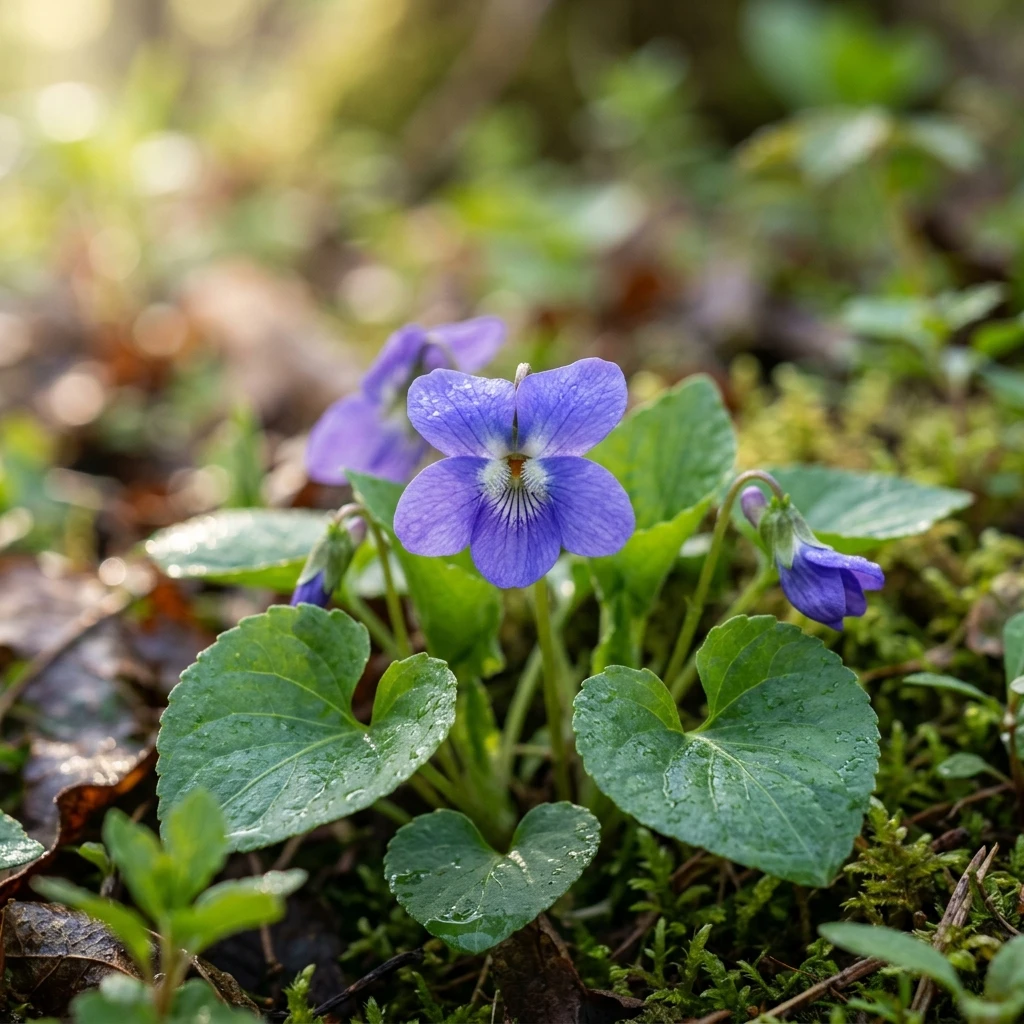
Viola sororia

Wild Violet Identification & Control

Wild Violet, also known as Common Blue Violet or Meadow Violet, is an exceptionally aggressive, tough, and beautiful perennial broadleaf weed. Native to eastern North America, it has Escaped into home lawns, shaded gardens, and valley margins. It features thick, fleshy underground rhizomes that anchor stubbornly into compacted soil, waxy heart-shaped leaves, and showy blue-violet flowers. It is highly notorious for its extreme resistance to standard lawn selective herbicides.


Sunlight Icon
Sunlight Partial Shade to Shade
Watering Icon
Watering Tolerance Moderate to High
Soil Mix Icon
Soil Adaptability Moist Clay / Wet Loam / Any Soil
Temperature Icon
Growth Temp 5°C - 32°C
Toxicity Danger Icon
Danger / Toxicity Pet Safe / Edible Flowers
Botanical macro photography of Wild Violet (Viola sororia) - Plant AI care and control database

How to Identify Wild Violet

An upright perennial with a basal rosette of waxy, heart-shaped leaves, thick scaly rhizomes, and showy blue-purple flowers.

  • Waxy Heart-Shaped Leaves: Leaves are broad, waxy, heart-shaped (5 to 10 cm wide) with finely scalloped margins and a distinct curl near the base.
  • Showy Blue-Purple Flowers: Five-petaled flowers with a distinct, sweet violet shape, primarily colored deep blue-violet with a white throat.
  • Cleistogamous Closed Flowers: Produces small, inconspicuous closed flowers near the soil surface in autumn that self-pollinate without opening.
💡 Plant AI Tip: Wild Violets produce two types of flowers! The showy purple ones in spring attract bees, but the small closed ones (cleistogamous flowers) in autumn self-pollinate and shoot seeds up to 5 feet.

Complete Care & Management Guide

Access highly technical, scientific management directives to control or cultivate Wild Violet effectively.

Highly adapted to wet, damp, and poorly drained compacted soils. It thrives in overwatered lawns and damp pasture margins, but survives summer dry spells by tapping deep sub-soil moisture.
Resistant to mowing. Mowing clips the tall seed heads, but the massive broad leaves adapt by growing flatter to the ground, and the deep yellow taproot remains completely unharmed.
Highly aggressive. It absorbs high levels of nitrogen and potassium, outcompeting pasture grasses and garden flowers. Shifting soil fertility helps grass compete.
Highly versatile. Thrives in Full Sun but exhibits high shade tolerance, allowing it to colonize orchard floors, shaded garden borders, and lawn edges beneath tree canopies.
Prefers moist clay, rich organic loam, and poorly drained high-nitrogen soils. It easily survives in hard-packed ground.
Spreads via seeds and creeping underground root sprouts. Birds eat the small grey-white waxy berries and deposit the seeds along fences, spreading them easily.
Extremely cold-hardy perennial. Leaves die back in winter, but the underground rhizomes survive deep freezing easily, sprouting rosettes in early spring.
Features an exceptionally deep, thick, branched woody yellow taproot that drills 4-5 feet deep. Manual removal requires deep excavation with a garden spade.
Occasionally targeted by aphids, but pests rarely cause significant damage to this highly robust annual grass.
Subject to **Fungal Leaf Spots** and **Dock Rust Fungus**, though diseases rarely kill the extensive yellow taproot system.
To control Wild Violet organically, you must dig up the taproot crown using a sharp spade. You must dig out at least the top 4 inches of the yellow taproot to prevent regeneration. Do not compost seeded plants.

Is your shaded yard showing heart-shaped green leaves or blue-purple flowers?

Dig out the woody yellow taproot crown 4 inches deep, improve clay drainage, and mow before seedheads mature.

Diagnose Weed Instantly

Common Diseases & Treatment

Fungal Leaf Spot

Symptoms: Symptoms: Circular brown spots with distinct purple borders covering the massive broad leaves.

Action: Action: Clip and dispose of infected leaves. Ensure proper air circulation, and apply organic copper fungicide to prevent fungal spread.

Cleistogamous Sprout

Symptoms: Symptoms: Small closed flowers near the soil surface in autumn self-pollinate and shoot seeds, making weeding difficult.

Action: Action: Cut off the closed flowers near the ground in autumn using shears. Dig out the thick rhizomes completely.

Frequently Asked Questions

Why is Wild Violet so difficult to kill with herbicides?

The leaves of Wild Violet are covered in a thick, waxy cuticle that acts like a raincoat, causing liquid chemical weed killers to slide off without being absorbed. Furthermore, it regenerates quickly from its thick scaly rhizomes.

Are the flowers edible?

Yes! The flowers of Wild Violet are completely edible and highly nutritious, rich in vitamins A and C. They are widely harvested in spring to decorate gourmet salads, cakes, or made into violet jelly and teas.

What are cleistogamous flowers?

These are specialized, self-pollinating flowers that never open. Wild Violet produces them in late summer near the soil surface. They self-fertilize in complete darkness and shoot seeds up to 5 feet, bypassing bees.

What is the best way to get rid of Wild Violet organically?

Use a sharp garden spade to slice a circle around the base of the rosette. Dig deep and lift the woody yellow root crown out intact. Mow the area regularly to prevent seed production.

No more dying plants. Grow healthy greens today!

Get Started for Free