White Clover Identification & Control
White Clover is a highly persistent, low-growing herbaceous perennial weed native to Europe and Asia, now globally naturalized. Famous for its creeping, stoloniferous growth habit and classic three-part leaves, it aggressively invades lawns, pastures, and garden beds. Because it is a legume that houses symbiotic nitrogen-fixing bacteria in its roots, it thrives easily in nutrient-poor soils, outcompeting lawn grasses and producing round, honey-scented white flower heads that attract massive bee populations.





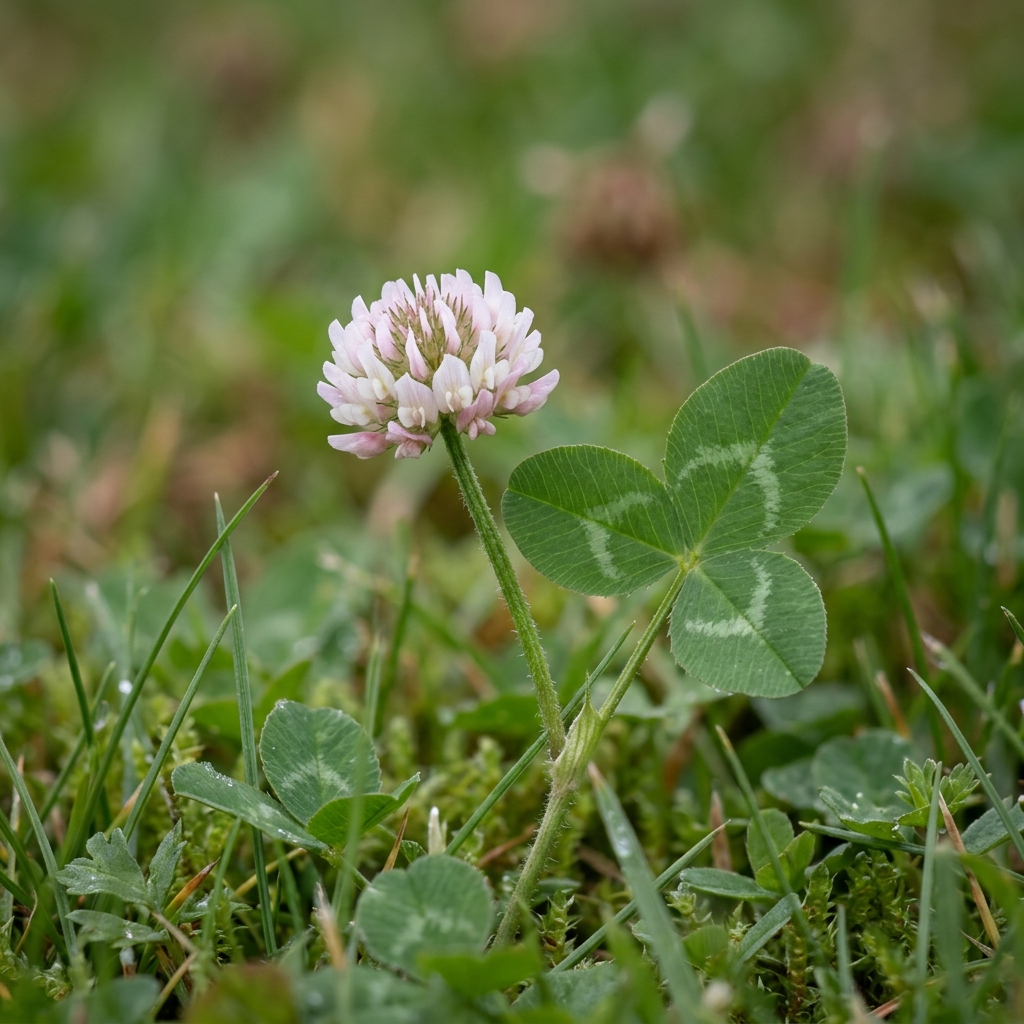
How to Identify White Clover
A low-growing creeping perennial with three-part leaves showing white V-shaped markings, and round, honey-scented white-pink flower heads.
-
✔
Trifoliate Leaves with V-Mark: Leaves are divided into three egg-shaped leaflets, each marked with a distinct, faint pale green-to-white V-shaped band.
-
✔
Creeping Stolons: The stems (stolons) creep flat along the ground, rooting at every node to form dense, mat-like patches in lawns.
-
✔
Round White Flower Heads: Spherical flower heads (1.5 to 2 cm wide) composed of numerous tiny, fragrant white-to-light-pink flowers.
Complete Care & Management Guide
Access highly technical, scientific management directives to control or cultivate White Clover effectively.
Common Diseases & Treatment
Clover Rust
Symptoms: Symptoms: Small, dusty orange-to-brown pustules covering the lower surface of the trifoliate leaves.
Creeping Mat Invasion
Symptoms: Symptoms: The turf grass is completely replaced by dense, flat green mats of three-leaf clover.
Frequently Asked Questions
Why is White Clover growing in my lawn?
White Clover grows where lawn grass is weak, primarily due to low soil nitrogen, high compaction, or overwatering. Clover has the unique ability to fix its own nitrogen, allowing it to thrive in poor soils.
Is White Clover good for the soil?
Yes! Clover is a natural fertilizer. Its roots host beneficial bacteria that pull nitrogen gas from the air and store it in the soil, naturally fertilizing neighboring lawn grass.
Does White Clover attract bees?
Yes. The fragrant, honey-scented round white flowers are highly attractive to honeybees and wild pollinators. If you want a bee-safe lawn, clover is great; if you want a child-safe lawn, mow the flowers off.
How do you get rid of White Clover organically?
Apply a nitrogen-rich organic lawn fertilizer to support grass growth, core-aerate to improve drainage, and manually pull up the creeping stolons, ensuring you don't leave rooted nodes behind.