Water Hyacinth Identification & Control
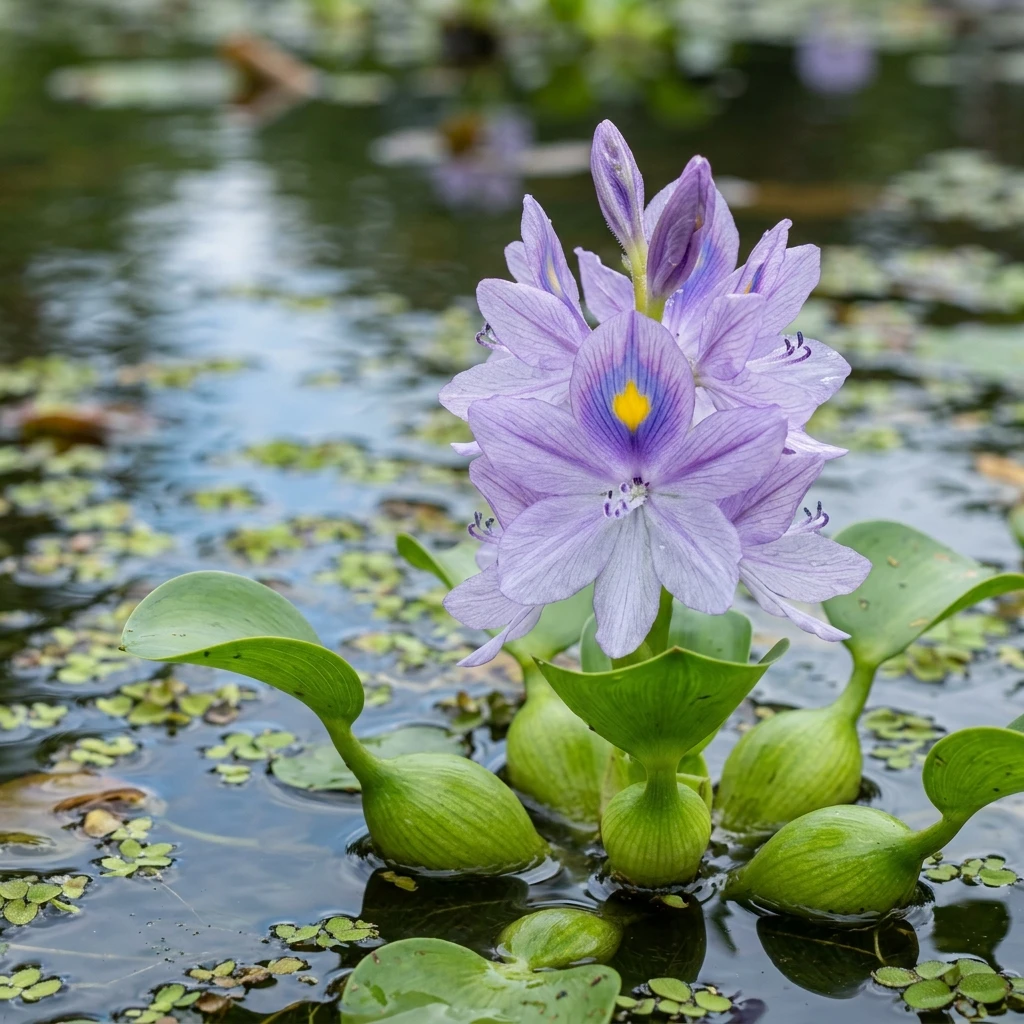
Water Hyacinth, botanically classified as Eichhornia crassipes, is an exceptionally beautiful but highly devastating floating perennial aquatic weed in the Pontederiaceae family. Native to the Amazon basin but highly invasive globally, it is ranked among the world's worst aquatic weeds. Floating freely on water surfaces, it features a rosette of glossy, bulbous leaves with swollen, spongy leaf stalks that act as natural buoys. It sprouts magnificent spikes of lavender-blue flowers, with a distinct yellow spot on the central petal. It reproduces at an astronomical rate, forming dense, suffocating mats that block sunlight, cause severe water oxygen depletion (anoxia), and kill native fish.




How to Identify Water Hyacinth
A free-floating aquatic perennial with swollen, spongy bulbous leaf stalks, glossy round leaves, and showy spikes of lavender-blue flowers.
-
✔
Swollen Spongy Petioles: Leaf stalks are highly distinct, bulbous, swollen, and filled with spongy air cells that provide outstanding buoyancy.
-
✔
Lavender-Blue Flowers: Magnificent terminal spikes of large, lavender-blue flowers, with the top central petal showing a yellow spot rimmed in blue.
-
✔
Feathery Dark Roots: Dense, feathery, dark-purple-to-black roots hang freely in the water column, absorbing dissolved nutrients rapidly.
Complete Care & Management Guide
Access highly technical, scientific management directives to control or cultivate Water Hyacinth effectively.
Common Diseases & Treatment
Aquatic Anoxia
Symptoms: Symptoms: Dense surface mats block all sunlight and prevent oxygen exchange, causing rapid drop in water oxygen and localized fish suffocations.
Silt Accumulation
Symptoms: Symptoms: Spongy leaves and feathery roots decay at the lake bottom, creating a thick layer of organic silt that accelerates pond shallowing.
Frequently Asked Questions
Why is Water Hyacinth ranked among the worst aquatic weeds?
It grows at an astronomical rate, doubling in biomass every 6 days. It forms dense, impenetrable floating mats that block boat traffic, clog hydroelectric intakes, and suffocate aquatic life.
How does it float?
Its bulbous, swollen leaf petioles (stalks) are filled with air-filled, spongy plant tissue, acting as natural life jackets that provide outstanding buoyancy.
Can it be used for water purification?
Yes! Its dense, feathery roots are highly efficient at absorbing nitrogen, phosphates, and toxic heavy metals from polluted water, making it a valuable tool in municipal wastewater treatment.
What is the best organic control?
For garden ponds, manually scoop the floating rosettes regularly in summer before they seed. For large-scale lakes, releasing water hyacinth weevils (Neochetina eichhorniae) is highly effective.