Purple Loosestrife Identification & Control
Purple Loosestrife, botanically known as Lythrum salicaria, is an exceptionally beautiful but ecologically devastating perennial broadleaf weed in the Lythraceae family. Native to Eurasia but highly invasive in North America, it is a dreaded threat to wetlands, riverbanks, and marsh meadows. Growing up to 6 feet tall, it features stiff, square, woody stems, opposite lance-shaped leaves, and produces magnificent, dense spikes of showy reddish-purple 6-petaled flowers. A single mature plant can produce an astonishing 2.7 million tiny seeds annually, allowing it to rapidly choke out native cattails and destroy wetland wildlife habitats.





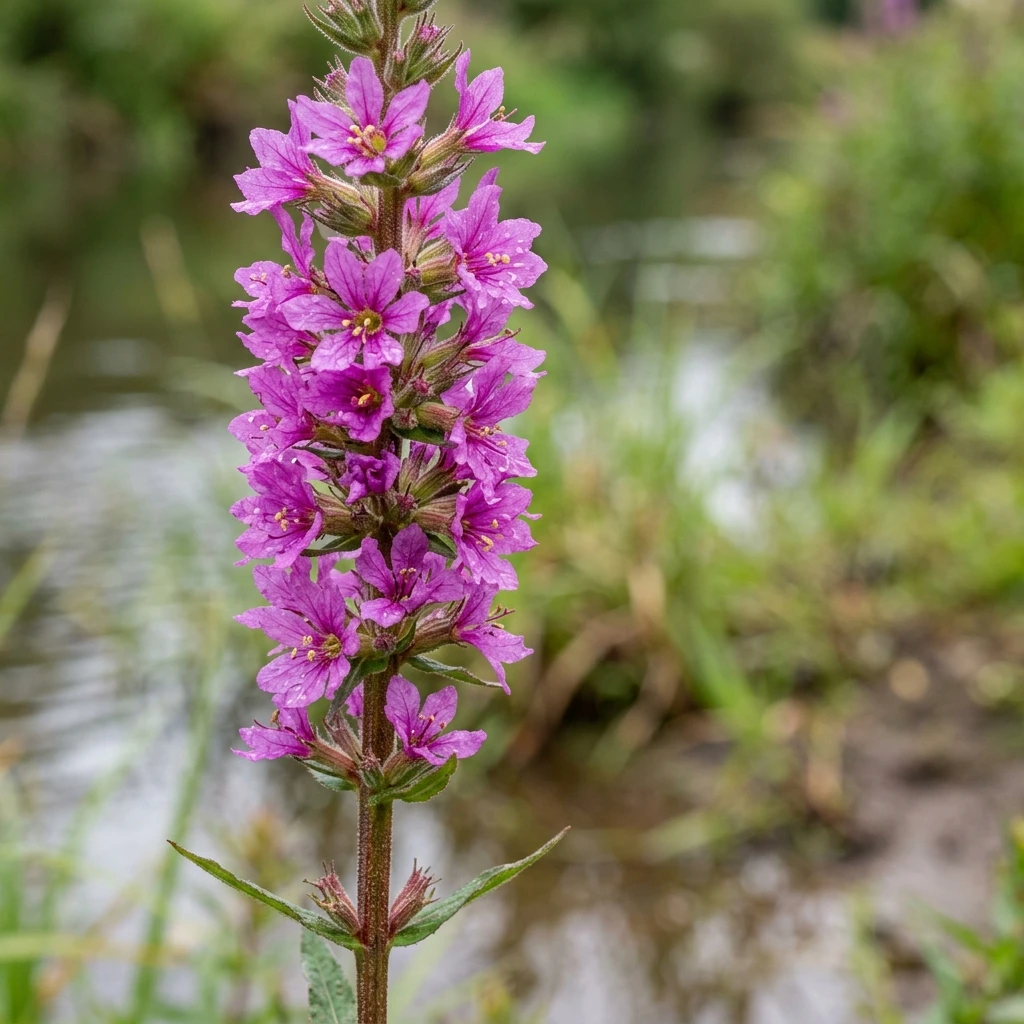
How to Identify Purple Loosestrife
A tall, erect perennial with square woody stems, lance-shaped leaves, and magnificent dense spikes of reddish-purple 6-petaled flowers.
-
✔
Reddish-Purple Flower Spikes: Magnificent, tall terminal flower spikes densely packed with star-like, reddish-purple flowers showing exactly 6 wrinkled petals.
-
✔
Four-Sided Square Stems: Stems are erect, stiff, woody at the base, and distinctly four-sided or square in cross-section.
-
✔
Opposite Clasping Leaves: Lance-shaped, smooth-margined leaves (3 to 10 cm long) grow in opposite pairs or whorls of three, clasping the stems tightly.
Complete Care & Management Guide
Access highly technical, scientific management directives to control or cultivate Purple Loosestrife effectively.
Common Diseases & Treatment
Wetland Monoculture
Symptoms: Symptoms: Localized marshes are completely overtaken by a solid wall of purple loosestrife, choking out native cattails and food for waterfowl.
Seed Rain Infestation
Symptoms: Symptoms: A single neglected garden plant releases millions of seeds, rapidly spreading downstream and infesting clean lake shorelines.
Frequently Asked Questions
Why is Purple Loosestrife considered a noxious weed?
It is an incredibly aggressive invader that outcompetes native wetland vegetation like cattails, forming a dense monoculture that destroys food and nesting cover for waterfowl and fish.
How many seeds can a single plant produce?
A single mature, multi-stemmed plant can produce up to an astonishing 2.7 million seeds annually, which survive dormant in soil mud for decades.
Does it have a successful biological control?
Yes! The introduction of Galerucella beetles (*Galerucella calmariensis* and *G. pusilla*), which feed exclusively on loosestrife foliage, is one of the most successful bio-control stories in history.
What is the best way to eradicate it organically?
For small patches, physically dig up the entire plant using a garden spade, ensuring you extract the complete, thick woody root crown, as broken fragments left behind will sprout.