Prostrate Knotweed Identification & Control
Prostrate Knotweed, also known as Doorweed, Stone Weed, or Wireweed, is an exceptionally tough, highly resilient annual broadleaf weed in the buckwheat family. Globally naturalized, it is famous for its extreme ability to survive severe soil compaction and heavy foot trampling. It thrives in gravel driveways, compacted lawn paths, and dry clay sports fields, forming flat, wiry, multi-branched mats that outcompete weak grasses. It has swollen stem joints wrapped in papery sheaths and tiny pink-white flowers.





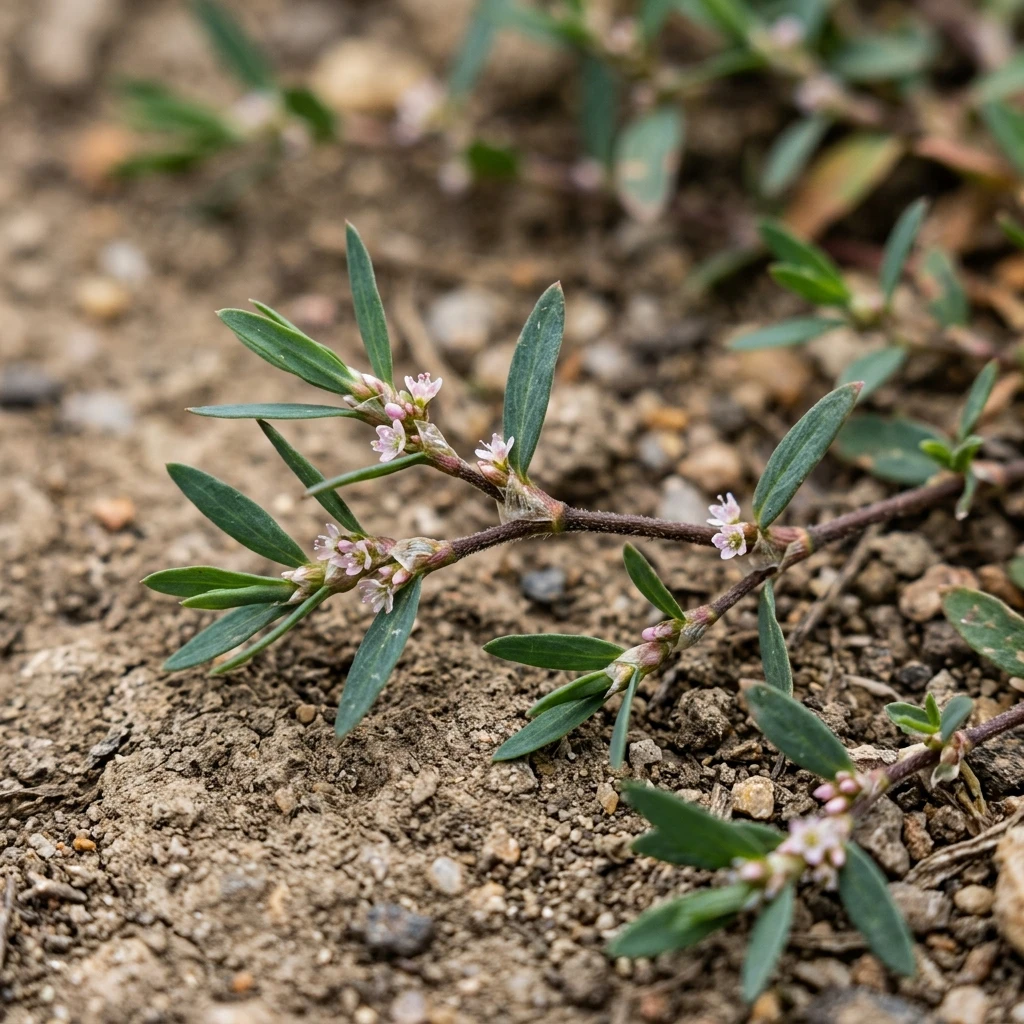
How to Identify Prostrate Knotweed
A low-growing, wiry annual forming flat mats, with narrow, blue-green alternate leaves, papery sheaths at stem joints, and tiny pinkish-white flowers.
-
✔
Wiry Swollen Stems: Stems are exceptionally tough, wiry, highly branched, and show swollen joints wrapped in papery sheaths (ochreae).
-
✔
Narrow Blue-Green Leaves: Small, alternate, oblong-to-linear leaves (1 to 3 cm long) with a distinct blue-green waxy tint.
-
✔
Tiny Pink-White Flowers: Inconspicuous clusters of tiny white-to-pink 5-lobed flowers blooming in leaf joints from summer to autumn.
Complete Care & Management Guide
Access highly technical, scientific management directives to control or cultivate Prostrate Knotweed effectively.
Common Diseases & Treatment
Powdery Mildew Fungal film
Symptoms: Symptoms: A flour-like white-gray film covering the wiry blue-green leaves in damp autumns, causing them to turn yellow.
Compacted Clay Suffocation
Symptoms: Symptoms: Desirable lawn grass dies completely, replaced by flat, wiry, stone-like green mats of knotweed.
Frequently Asked Questions
Why is it called 'Prostrate Knotweed' and 'Wireweed'?
It is called 'Prostrate' because it crawls flat along the ground, and 'Knotweed' due to the distinct swollen, knot-like joints along the stems. 'Wireweed' refers to the wiry, exceptionally tough fibrous stems that can actually dull mower blades.
Is Prostrate Knotweed toxic to dogs?
No, it is completely non-toxic and pet-safe. However, its presence is a loud warning that your soil is heavily compacted, low in oxygen, and hostile to grass.
Does it have any historical uses?
Yes. In traditional European herbalism, it was used as an astringent to stop minor bleeding and treat throat inflammation due to its high tannin content. The seeds are also eaten by wild songbirds.
What is the best way to get rid of it organically?
Since it thrives on soil compaction, mechanical control is only half the battle. Hand-pull young rosettes in spring before the roots grow deep, and then use a core-aerator to loosen the clay soil, allowing grass to take back the area.