Mouse-ear Chickweed Identification & Control
Mouse-ear Chickweed is an exceptionally common, highly persistent perennial broadleaf weed in the pink family. Native to Europe but thoroughly naturalized globally, it is a major nuisance in home lawns and golf courses. It features a creeping, mat-forming growth habit with dark-green leaves covered in dense, fuzzy white hairs resembling mouse ears, and tiny white star-like flowers.





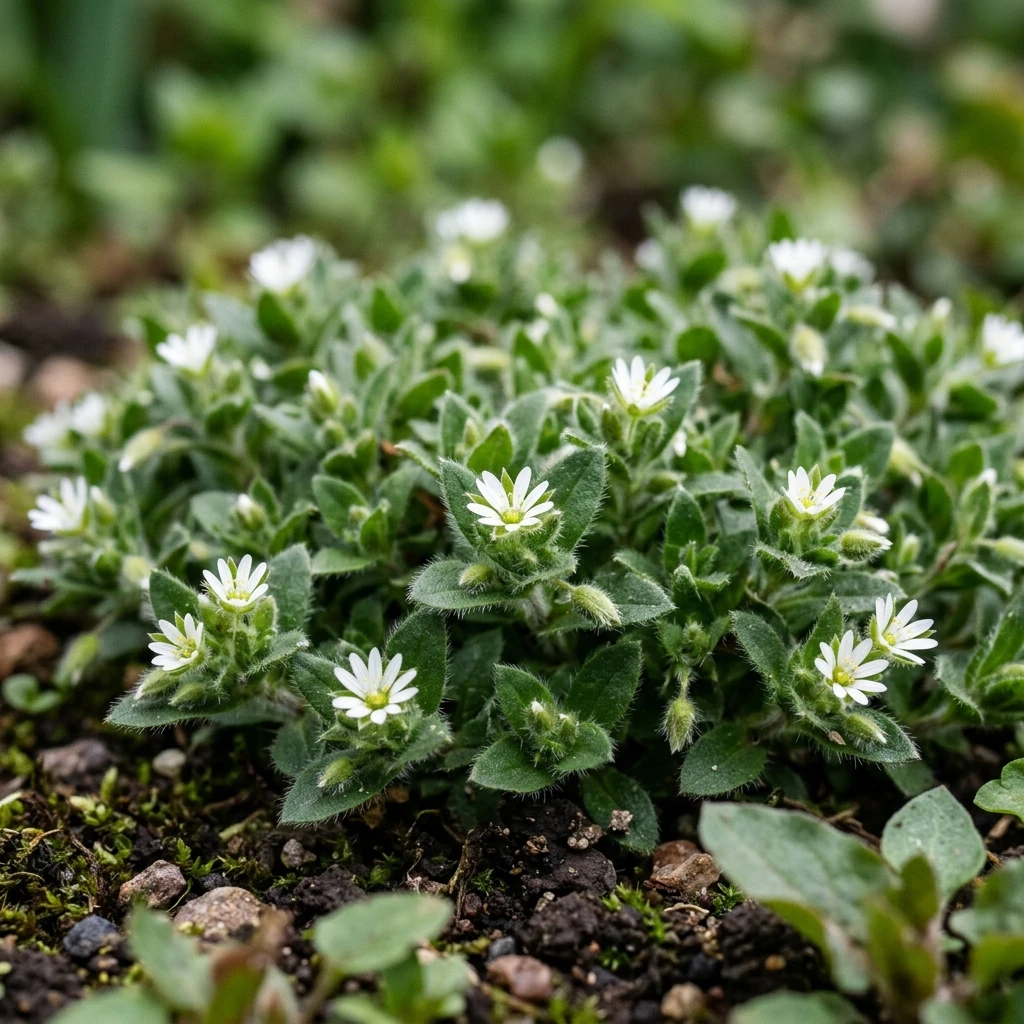
How to Identify Mouse-ear Chickweed
A creeping, mat-forming perennial with dark-green leaves covered in dense, fuzzy white hairs, and tiny white star-like flowers.
-
✔
Fuzzy Mouse-Ear Leaves: Oval leaves (1 to 2 cm long) are covered in dense, fuzzy, velvet-white hairs, resembling the ears of a mouse.
-
✔
Creeping Horizontal Stems: Stems crawl flat along the ground, rooting at nodes to form dense, interconnected green mats.
-
✔
Star-Like White Flowers: Small clusters of tiny white flowers with exactly 5 petals that are deeply split in half, looking like 10 petals.
Complete Care & Management Guide
Access highly technical, scientific management directives to control or cultivate Mouse-ear Chickweed effectively.
Common Diseases & Treatment
Fungal Spot
Symptoms: Symptoms: Water-soaked, circular black or dark brown spots with bright yellow halos appearing on the waxy green leaves.
Creeping Mat Invasion
Symptoms: Symptoms: The turf grass is completely replaced by dense, flat green mats of three-leaf clover.
Frequently Asked Questions
How is Mouse-ear Chickweed different from Common Chickweed?
Mouse-ear Chickweed (Cerastium fontanum) is a perennial with leaves covered in dense, fuzzy hairs on both sides, looking like fuzzy mouse ears. Common Chickweed (Stellaria media) is an annual with completely smooth, hairless leaves, and only a single line of hairs on its stems.
Is Mouse-ear Chickweed toxic to pets?
No, it is completely non-toxic to dogs and cats. However, the fuzzy leaves can cause mild skin irritation and matting in long-haired pets if they run through dense patches.
Can I kill Mouse-ear Chickweed by mowing it low?
No. Low mowing will actually make the problem worse! Its stems creep horizontally flat on the ground, so mowing will miss the weed while cutting your lawn grass, giving chickweed more sunlight to expand.
What is the best way to get rid of it?
Because it has horizontal runners that root at nodes, hand-pulling must be done slowly to extract the entire creeping chain. Aerate compacted lawn soil and sow dense grass seed.