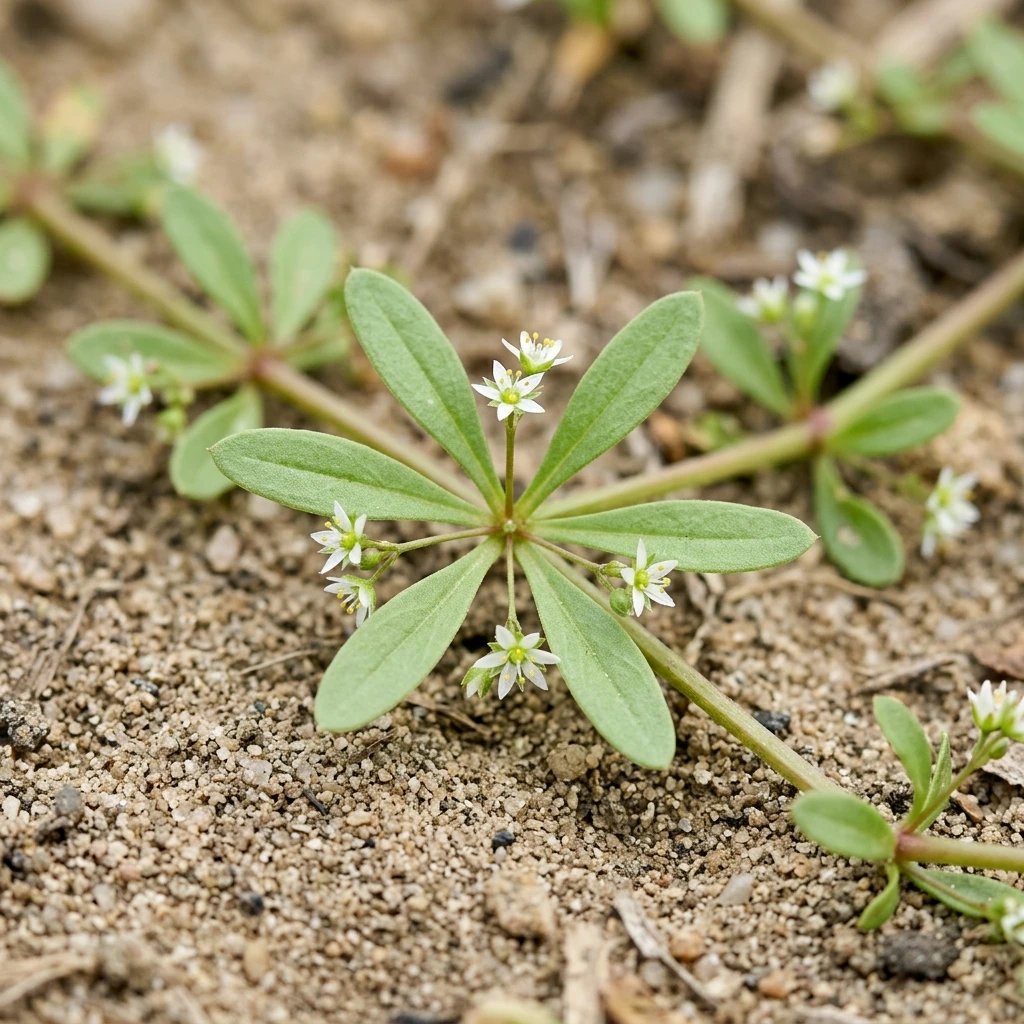
Mollugo verticillata

Carpetweed Identification & Control

Carpetweed, also known as Indian Chickweed, is a highly common, rapid-growing annual broadleaf weed in the Molluginaceae family. Native to tropical America but thoroughly naturalized across North America, it thrives in sandy soils, dry garden beds, and gravel driveways. It features a unique, highly symmetrical wheel-like growth habit, with narrow leaves arranged in beautiful whorled rosettes flat to the ground, forming dense, carpet-like green mats that cover bare soil.


Sunlight Icon
Sunlight Full Sun to Partial Shade
Watering Icon
Watering Tolerance Low to Moderate
Soil Mix Icon
Soil Adaptability Dry Sandy / Loam / Disturbed Soil
Temperature Icon
Growth Temp 15°C - 38°C
Toxicity Danger Icon
Danger / Toxicity Pet Safe / Rapid Mat-former
Botanical macro photography of Carpetweed (Mollugo verticillata) - Plant AI care and control database

How to Identify Carpetweed

A flat, prostrate annual with smooth, light-green leaves arranged in symmetrical whorls of 3 to 8 leaves at stem joints, forming circular mats.

  • Symmetrical Leaf Whorls: Smooth, tongue-shaped leaves (1.5 to 3 cm long) are arranged in perfect whorls of 3 to 8 leaves, looking like a green wheel.
  • Smooth Multi-Branched Stems: Light-green or pinkish stems are completely hairless, smooth, and branched, creeping flat along the soil.
  • Tiny White Flowers: Small, star-like white flowers (3 mm wide) sprout in clusters of 2 to 5 from the leaf whorl joints.
💡 Plant AI Tip: Carpetweed is a classic late-germinating summer annual! It waits for the hot mid-summer sun (July) when other weeds start to dry out, rapidly colonizing bare, hot sandy soil spots.

Complete Care & Management Guide

Access highly technical, scientific management directives to control or cultivate Carpetweed effectively.

Highly adapted to dry and damp conditions. It grows vigorously in early spring moisture but survives dry spells by accelerating its seeding cycle, producing seeds and dying in summer.
Resistant to mowing. Because the circular mats grow completely flat against the soil or pavement, lawn mowers pass over them without clipping the stems or seeds.
Thrives in nutrient-poor and sterile sandy soils. Regular lawn fertilization helps turf grass grow densely, shading out emerging carpetweed seedlings in spring.
Highly versatile. Thrives in Full Sun but exhibits moderate shade tolerance, allowing it to colonize shaded pathway margins and compact orchard margins.
Highly adapted to dry sandy soil, sterile gravel driveways, sidewalk cracks, and compacted dirt yards. It struggles in saturated wet soil.
Spreads aggressively strictly by seeds. A single plant can produce up to 20,000 seeds. The seeds develop a sticky coating when wet, adhering to shoes and tires.
A summer annual. Seeds germinate rapidly in late spring when soil temperatures reach 75°F (24°C). The entire plant dies with the first winter frost.
Features a shallow, thin central taproot. Because the entire circular mat connects to a single taproot, it is exceptionally easy to hand-pull if you grab the center.
Occasionally targeted by aphids, but pests rarely cause significant damage to this highly robust annual grass.
Rarely suffers from diseases, though damp autumns can bring mild leaf spot spots that fail to kill the plant before it drops seeds.
To control Carpetweed organically, manually dig up young rosettes in spring before they flower, use a hoe to scrape seedlings, and mulch garden beds heavily to block seed light.

Are your sandy yard patches showing symmetrical wheel-like leaf whorls?

Hand-pull the single central taproot, apply thick wood mulch to block seeds, and core-aerate compacted spots.

Diagnose Weed Instantly

Common Diseases & Treatment

Whorled Node Rooting

Symptoms: Symptoms: Stems form dense circular carpets, choking out turf grass seed germinations in late summer.

Action: Action: Pull the plant from the central taproot. Hand-dig early in summer before the white flowers release seed.

Late-Season Seeding

Symptoms: Symptoms: Symmetrical mats dry up in late autumn, dropping thousands of orange-brown seeds into sandbox margins.

Action: Action: Apply a thick 3-inch layer of organic cedar mulch to keep the sand dark, preventing spring seed germination.

Frequently Asked Questions

Why is it called 'Carpetweed'?

It is named Carpetweed because its stems branch out horizontally flat in all directions from a central root, creating a dense, flat, light-green circular mat that literally blankets bare soil like a carpet.

Is Carpetweed toxic to dogs?

No, Carpetweed is completely non-toxic and safe for dogs, cats, and horses. However, it grows very fast and will quickly choke out weak lawn grass if left unchecked.

How can I identify Carpetweed from Chickweed?

Carpetweed is easily identified by its leaves, which grow in unique, flat symmetrical 'whorls' (circles of 3 to 8 leaves) around the stem joints. Chickweed leaves are strictly opposite (pairs of 2) along the stems.

What is the best way to get rid of it?

Because it has a very shallow central taproot and no rooting stolons, it pulls up effortlessly. Grip the center of the rosette and pull; the entire carpet mat will lift out intact. Hoeing or heavy mulching also works perfectly.

No more dying plants. Grow healthy greens today!

Get Started for Free