Musa acuminata

Banana Growing & Harvesting Guide

Banana (Musa acuminata) represents the towering crown of the tropical orchard. Although appearing as a tree, this massive evergreen herbaceous plant develops from a subterranean corm, producing heavy hanging hands of sweet golden fruit under intense warmth and abundant moisture.


Sunlight Icon
Sunlight Full Sun (6-8 hours)
Watering Icon
Watering Heavy / Consistent
Soil Mix Icon
Soil pH Rich, Well-Drained (pH 5.5-6.5)
Temperature Icon
Target Temp 18°C - 35°C
Toxicity Warning Icon
Toxicity Pet Friendly (Non-toxic)
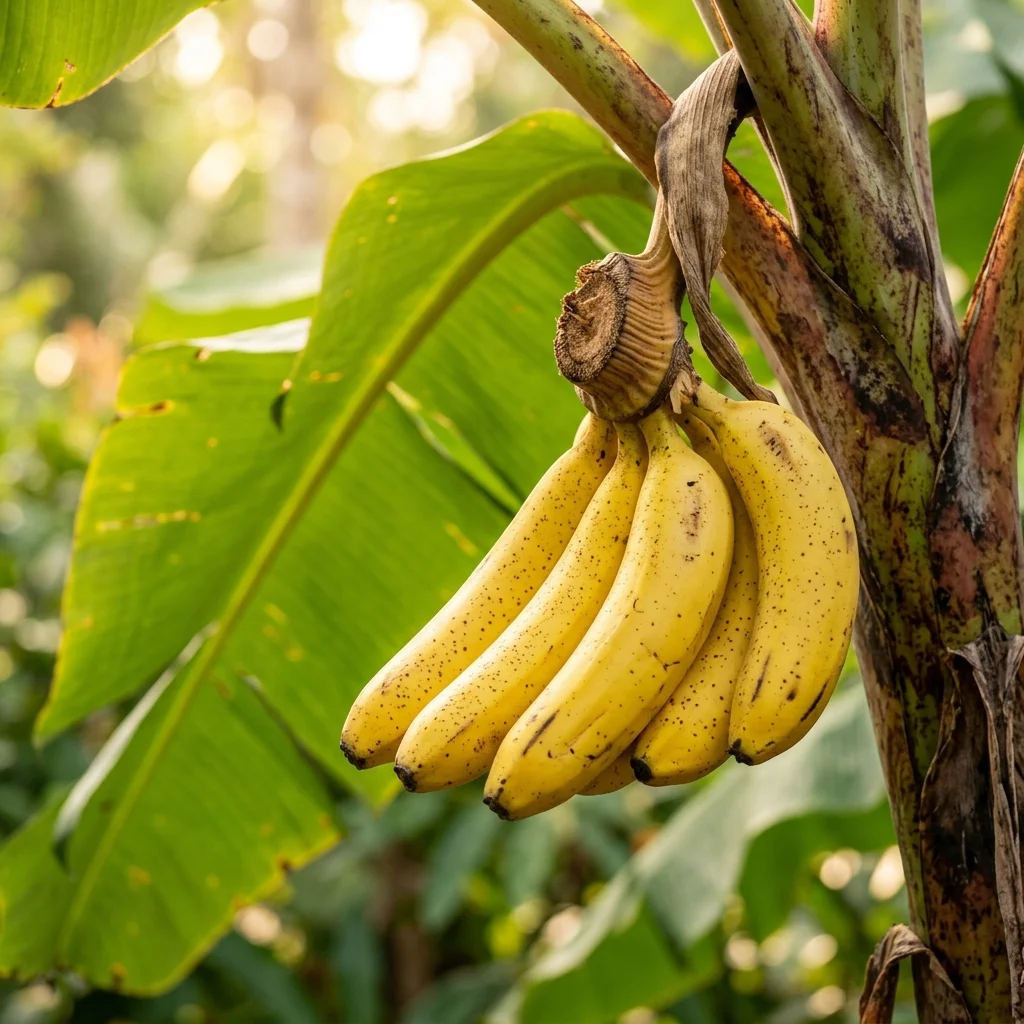
Botanical macro photography of Banana (Musa acuminata) - Plant AI care database

How to Identify Banana

Banana (Musa acuminata) is a highly valued edible crop globally. Recognizing its definitive vegetative and fruit/vegetable structures is key to successful companion growing and harvesting.

  • Key Visual Features: Massive tree-like herbaceous plants developing from a subterranean corm.
  • Leaf & Stems: Very large, broad, oblong light green leaves; a massive drooping purple flower bract.
  • Fruit/Edible Part: Elongated, curved yellow berries clustered in tiers or 'hands' hanging from a single robust stem.
💡 Plant AI Tip: Snap a photo with Plant AI to identify garden veggies and diagnose leaf spot diseases in 1 second.

Complete Growing & Harvesting Guide

Follow our detailed scientific agricultural cultivation guide to keep your Banana thriving and high-yielding.

Requires consistent irrigation, receiving 1.5 to 2 inches of water per week. The huge leaves transpire moisture rapidly; however, ensure sharp drainage to prevent corm rot.
Prune away dead outer leaves to maintain neatness and minimize pest hiding spots. Limit suckers to one main stem and one follower for maximum fruit size.
Extremely heavy feeder. Apply nitrogen-rich organic compost and high-potassium fertilizer monthly to support massive leaf expansion and high-yield fruiting.
Thrives in bright full sun. Provide 6 to 8 hours of direct light. Situate in a wind-sheltered pocket, as strong wind easily shreds the large delicate leaves.
Deep, fertile soil loaded with decayed organic humus. Sand-loam mixtures are best. Avoid heavy clay that holds standing water.
Plant in spring in a wide, deep hole filled with composted manure. Ensure the underground corm is buried fully but leaves remain above ground.
Purely tropical/subtropical. Growth stops entirely below 15°C, and severe frost will kill the pseudostem. Bring container dwarfs indoors during cold seasons.
Space banana plants 8-10 feet apart to prevent massive overlapping leaf canopies from completely blocking out light to the base.
Watch for banana aphids, root weevils, and spider mites. Wash foliage with neem oil and remove wild weeds to lower pest pressure.
Susceptible to Panama Disease and Leaf Spot (Sigatoka). Avoid overhead sprinkling and improve air circulation to keep leaves dry.
Harvest when the fingers turn light green-yellow and lose their sharp-angled ridges. Cut the entire fruiting stalk and hang it in a shady spot to ripen.

Is your Banana leaves turning yellow, spotted or dying?

Protect your kitchen garden. Take a photo with Plant AI to diagnose pests and crop diseases instantly.

Diagnose My Crop

Common Diseases & Treatment

Sigatoka Leaf Spot (Fungal)

Symptoms: Small dark spots on leaves that expand into large brown streaks with yellow halos, causing leaves to wither prematurely.

Action: Prune and destroy infected leaves immediately, improve air circulation, and spray proactive copper fungicide.

Fusarium Wilt (Panama Disease)

Symptoms: Lower leaves turn pale yellow at edges, wilt, and collapse down around the pseudostem; internal stem tissue turns reddish-brown.

Action: No chemical cure exists. Plant resistant cultivars, maintain slightly acidic soil, and isolate infected plants immediately.

Frequently Asked Questions

Why are my banana leaves splitting?

This is a natural evolutionary adaptation. Splitting prevents the wind from blowing over the top-heavy plant by letting air pass through.

How long does it take for a banana plant to fruit?

It takes about 9 to 12 months for a banana stalk to grow to full size, and another 3 to 4 months for the fruits to mature.

Does a banana plant die after harvesting?

Yes, the main pseudostem dies after fruiting. However, the plant propagates continuously by sending up new pups or suckers from the corm.

Are ornamental banana leaves safe for house cats?

Yes, banana leaves are non-toxic and entirely safe for both dogs and cats according to ASPCA standards.

Harvest bountiful greens. Grow healthy edibles today!

Get Started for Free