Saucer Magnolia Care & Identification Guide
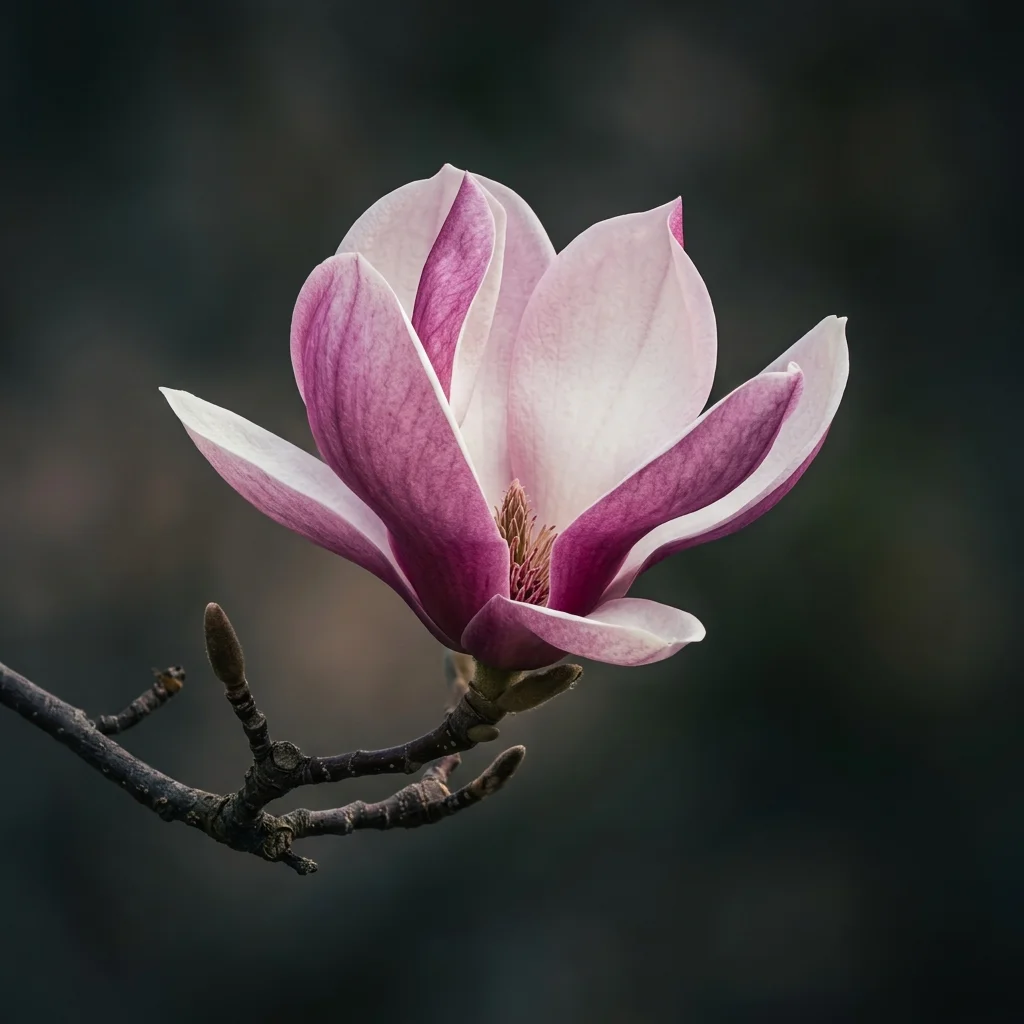
The magnificent Saucer Magnolia (Magnolia × soulangeana) is a highly spectacular deciduous hybrid tree, celebrated globally for its dramatic early spring display where massive cup-like flowers burst on completely bare, leafless branches. The blooms exhibit a rich pinkish-purple gradient on the outside and pure white on the inside. It grows as a multi-stemmed large shrub or small tree. It requires organic, moist, well-drained acidic soil and full sun.





How to Identify Saucer Magnolia
Identify Saucer Magnolia immediately by its highly distinct biological features. Native to its specific ecosystem, it showcases spectacular foliage and structural habits optimized for its environment.
-
✓
Distinctive Features: Large cup-and-saucer shaped pinkish-purple flowers blooming on bare rustic twigs before leaves, and smooth silvery-grey trunk bark.
-
✓
Typical Coloration: Rich pinkish-purple to magenta outside, pure white inside, dark green summer leaves, and warm copper-bronze autumn foliage.
-
✓
Potential Confusions: Similar to Star Magnolia, but distinguished by its much larger, cup-shaped flowers with wider, fleshier petals (Star Magnolia has narrow, ribbon-like petals).
11-Step Professional Care & Planting Guide
💧 【Watering & Moisture】 Water moderately. Keep soil consistently moist but never soggy. Excellent drought-tolerance once established in organic loam.
☀️ 【Sunlight & Exposure】 Requires full direct sun to partial shade. Prefers a location sheltered from late spring frosts, which can ruin the early blooms.
🪴 【Ideal Soil Mix】 Requires rich, deep, well-draining organic acidic soil. Blend 50% organic loam, 30% organic peat moss, and 20% coarse perlite (pH 5.0-6.5).
🌡️ 【Temperature & Winter Care】 Cold-hardy (USDA Zone 5-9). Extremely hardy to winter freezes, but early spring flower buds are highly sensitive to sudden late frosts.
✂ 【Pruning & Grooming】 Prune only immediately after early spring blooming to shape the multi-stemmed habit. Never prune in autumn or winter.
🧪 【Fertilization】 Apply a slow-release organic balanced fertilizer in late spring after flowering. Mulch with composted leaf mold.
🏺 【Potting & Garden Planting】 Plant in highly visible garden spots. Dig a wide, shallow hole, backfill with rich organic acidic loam, and mulch deeply.
🌱 【Propagation】 Propagated by taking softwood cuttings in early summer, or by layering branches in spring.
🐛 【Common Pests】 Watch occasionally for magnolia scale or thrips. Spray manually with organic neem oil or insecticidal soap.
🦠 【Common Diseases】 Susceptible to leaf spot or verticillium wilt. Good drainage and rich organic acidic loam are essential.
🎓 【Botanist Advice】 The Saucer Magnolia is a true early spring showstopper! Plant it in a spot visible from your windows, and protect it from northern winter winds to preserve its spectacular flower buds.
Frequently Asked Questions
Q: Why does it bloom on bare branches?
A: It is an evolutionary strategy! Deciduous magnolias develop their flower buds in autumn and bloom in early spring before leaf emergence to maximize visibility for early insect pollinators.
Q: Is the Saucer Magnolia safe for dogs and cats?
A: Yes, Magnolia × soulangeana is completely non-toxic and pet-safe for cats and dogs.
Q: How to protect early blooms from late frosts?
A: Plant it in a sheltered southern or western location! Avoid eastern exposures where early morning sun will rapidly thaw frozen buds, causing them to turn black and drop.
Q: Can I grow it as a single-trunk tree?
A: Yes, through careful pruning of lower suckers when young. However, it naturally prefers to grow as a magnificent, multi-stemmed specimen.