Royal Poinciana Care & Identification Guide
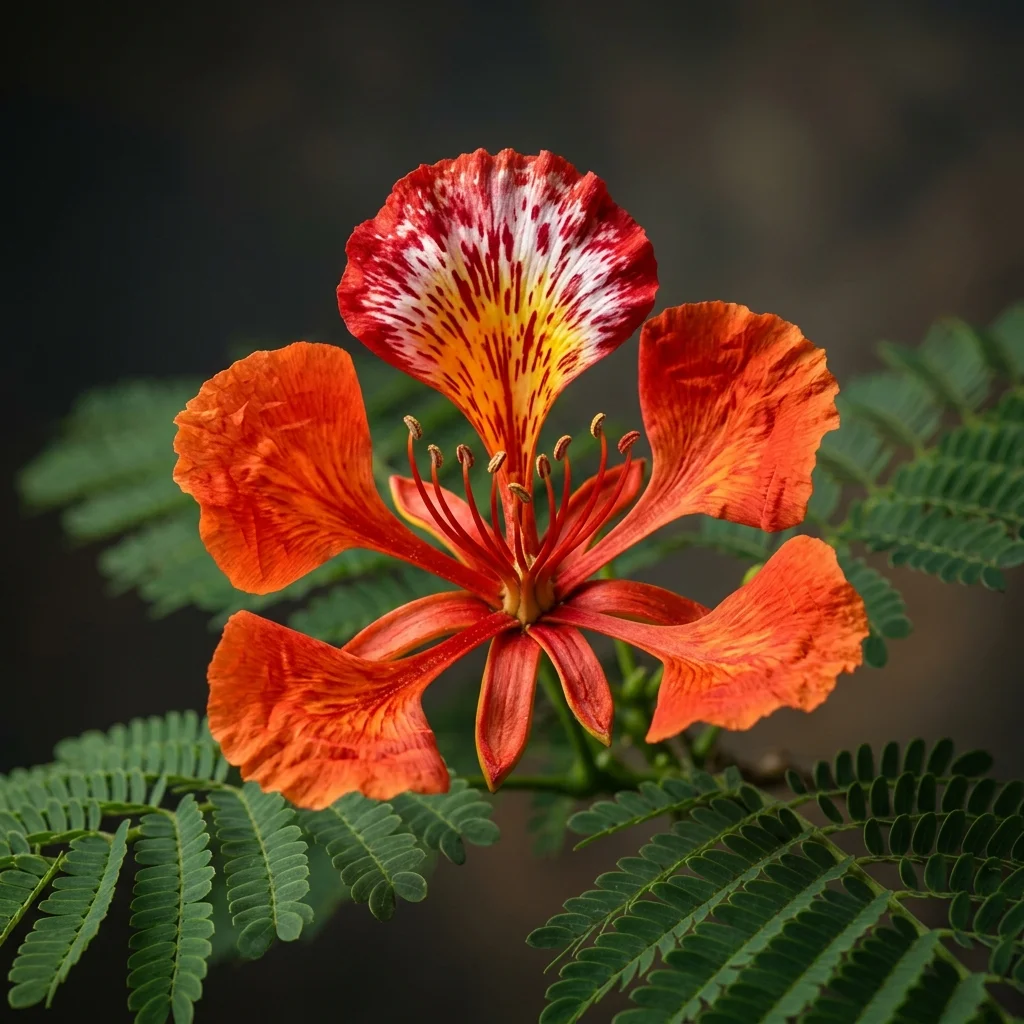
The magnificent Royal Poinciana (Delonix regia), also known as the Flamboyant or Flame Tree, is a colossal and highly spectacular deciduous tropical tree native to Madagascar, celebrated globally for its fiery orange-scarlet flowers and wide-spreading umbrella crown. The five-petaled blooms feature a highly distinct erect banner petal gorgeously splashed with white and yellow. It carries delicate, fern-like green bipinnate leaves. It requires sandy loam, full direct sun, and moderate watering.





How to Identify Royal Poinciana
Identify Royal Poinciana immediately by its highly distinct biological features. Native to its specific ecosystem, it showcases spectacular foliage and structural habits optimized for its environment.
-
✓
Distinctive Features: fiery orange-scarlet five-petaled flowers with one white-yellow upright banner petal, sweeping wide-spreading umbrella crown, and fern-like bipinnate leaves.
-
✓
Typical Coloration: Fiery orange-scarlet flowers, light green fern-like leaves, and massive woody dark brown seed pods.
-
✓
Potential Confusions: Similar to Jacaranda, but instantly distinguished by its fiery orange-scarlet flowers (Jacaranda has lavender-blue blooms).
11-Step Professional Care & Planting Guide
💧 【Watering & Moisture】 Water moderately. Keep soil consistently moist but never soggy. Highly drought-tolerant once established in sandy loam.
☀️ 【Sunlight & Exposure】 Requires full direct sun. Dislikes shade, which reduces flowering and causes thin, weak branch development.
🪴 【Ideal Soil Mix】 Prefers light, sandy, exceptionally fast-draining soil. Blend 50% coarse sand, 30% sandy loam, and 20% organic compost.
🌡️ 【Temperature & Winter Care】 Cold-sensitive (USDA Zone 10-11). Thrives in hot, sunny climates. Protect young trees from freezes below -2°C.
✂ 【Pruning & Grooming】 Prune in late winter to establish a strong central trunk and lift low-hanging limbs. Let its massive horizontal canopy spread naturally.
🧪 【Fertilization】 Apply a slow-release organic balanced fertilizer once in early spring. Mulch with composted leaf mold.
🏺 【Potting & Garden Planting】 Plant in spacious ground away from walls. Dig a wide hole twice the root ball, backfill with sandy loam, and water deeply.
🌱 【Propagation】 Propagated by sowing seeds in spring, which require scarification (nicking the tough seed coat) to germinate.
🐛 【Common Pests】 Watch out for caterpillars or borers. Spray manually with organic neem oil or insecticidal soap.
🦠 【Common Diseases】 Susceptible to root rot if soil is compacted and waterlogged. Gritty sandy soil is essential.
🎓 【Botanist Advice】 The Royal Poinciana is one of the most spectacular tropical trees on Earth! Give it unlimited open space to spread its massive horizontal crown, and plant it in dry, sandy, sunny spots to maximize its brilliant red display.
Frequently Asked Questions
Q: Why is it called the Flame Tree?
A: Because of its flowers! In summer, the entire tree canopy is covered in a spectacular, dense blanket of fiery orange-scarlet flowers, making the tree look like it is on fire.
Q: Is the Royal Poinciana safe for domestic pets?
A: Yes, Delonix regia is completely non-toxic and pet-safe for cats and dogs.
Q: What is the banner petal?
A: It is a beautiful botanical feature! The flower has five petals, but the top upright petal (the banner petal) is slightly larger and marked with yellow, white, and red stripes, contrasting with the solid scarlet of the other four petals.
Q: Can I grow it in a cold northern zone?
A: No, it is highly sensitive to frost and freezing temperatures. It is suited only for warm, tropical USDA Zones 10 to 11.