London Plane Care & Identification Guide
The magnificent London Plane (Platanus × acerifolia) is a colossal and highly spectacular deciduous hybrid tree, celebrated globally as the premier choice for urban streetscapes. It has an incredible ability to shed its outer bark in large, puzzle-like plates. This process self-cleans the trunk, peeling away trapped soot, pollutants, and heavy metals. Uniquely, its seed balls hang in distinctive pairs of two. **Warning: Its young leaves carry tiny irritating hairs.** It requires adaptable loam, full sun, and moderate watering.





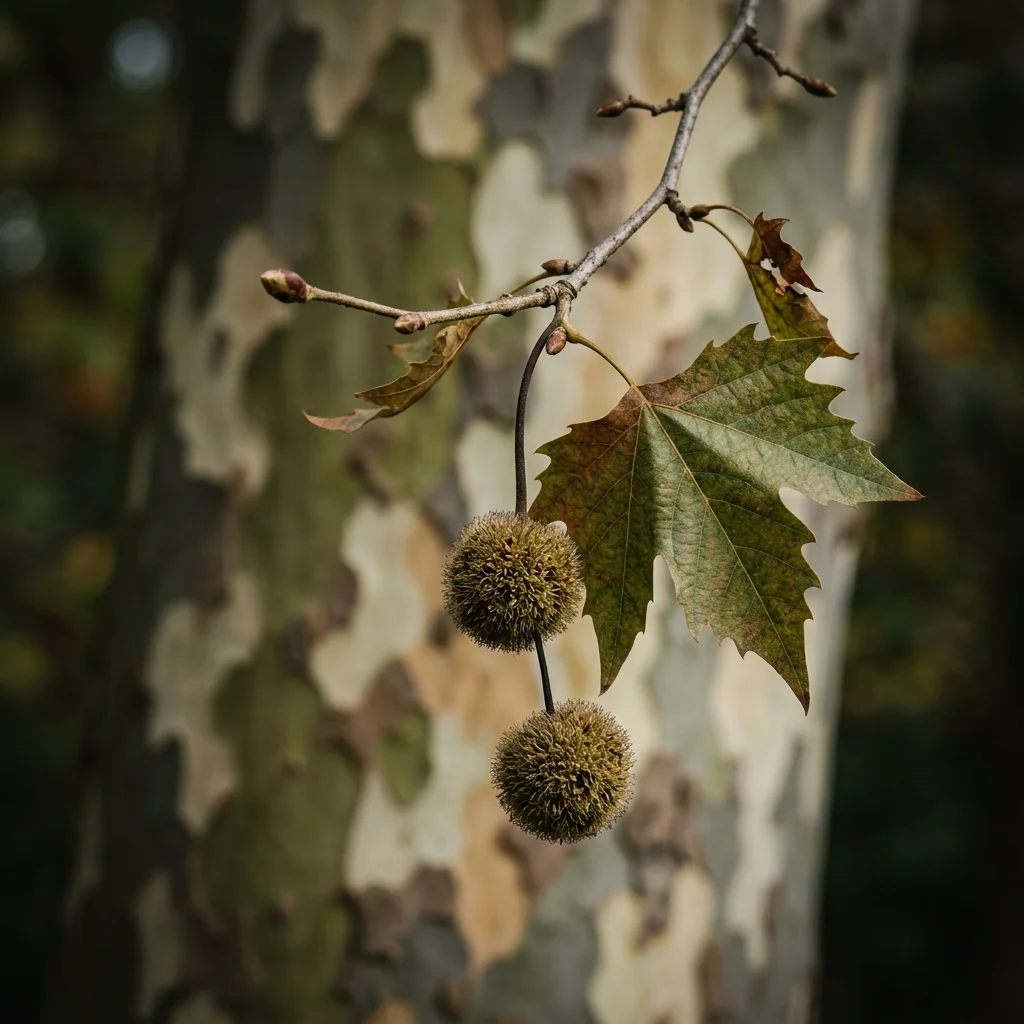
How to Identify London Plane
Identify London Plane immediately by its highly distinct biological features. Native to its specific ecosystem, it showcases spectacular foliage and structural habits optimized for its environment.
-
✓
Distinctive Features: Grand symmetrical crown, puzzle-patterned exfoliating bark showing cream, olive, and grey patches, deeply lobed maple-like leaves, and seed balls hanging in pairs.
-
✓
Typical Coloration: Rich bright green summer foliage, turning to a warm golden-bronze or yellow-brown in late autumn.
-
✓
Potential Confusions: Similar to American Sycamore, but distinguished by its seed balls which hang in pairs of two, and its leaves which have more deeply cut lobes.
11-Step Professional Care & Planting Guide
💧 【Watering & Moisture】 Water moderately. Keep soil consistently moist for young trees. Extremely drought-tolerant once established in heavy urban clay.
☀️ 【Sunlight & Exposure】 Requires full direct sun. Highly valued as a grand shade and street tree; tolerates intense heat and asphalt radiation.
🪴 【Ideal Soil Mix】 Extremely adaptable! Thrives in compacted clay, alkaline soils, and road salt zones. Blend 50% clay-loam, 30% sand, and 20% compost.
🌡️ 【Temperature & Winter Care】 Cold-hardy (USDA Zone 5-9). Highly resilient to freezing winters, high winds, and heavy urban microclimates.
✂ 【Pruning & Grooming】 Prune in winter during dormancy. Widely responsive to pollarding (a traditional pruning technique to restrict size and create compact round crowns).
🧪 【Fertilization】 Apply a slow-release organic balanced fertilizer in early spring. Mulch with organic bark to preserve soil moisture.
🏺 【Potting & Garden Planting】 Plant in spacious ground. Dig a wide hole twice the root ball, backfill with adaptable loam, and apply a thick layer of mulch.
🌱 【Propagation】 Easily propagated by taking semi-hardwood cuttings in late autumn, or by sowing seeds from dry balls in spring.
🐛 【Common Pests】 Generally highly resistant. Watch occasionally for sycamore lace bugs or caterpillars. Spray manually with neem oil.
🦠 【Common Diseases】 Susceptible to powdery mildew and anthracnose (though much more resistant than American Sycamore). Keep pruning tools sterile.
🎓 【Botanist Advice】 **Warning for sensitive individuals:** In spring, the emerging leaves and fruit balls release millions of microscopic hairs (trichomes) that float in the air. These can severely irritate the eyes, nose, and throat, triggering asthma and hay fever symptoms.
Frequently Asked Questions
Q: Why is the London Plane the world's favorite street tree?
A: It is virtually indestructible! It has an unmatched tolerance for compacted urban soil, heavily polluted city air, road salt, summer heat, and severe pruning.
Q: Is the London Plane safe for household pets?
A: Yes, Platanus × acerifolia is completely non-toxic and pet-safe for cats and dogs.
Q: How does the peeling bark help the tree breathe?
A: It is a genius self-cleaning trick! By continuously shedding its bark in large plates, the tree physically discards accumulated urban dust, soot, and industrial heavy metals, keeping its lenticels open for respiration.
Q: Why do the leaves cause coughing in spring?
A: The underside of young leaves is covered in millions of microscopic, irritating hairs (trichomes). When the leaves expand in spring, these hairs shed into the wind, severely irritating human airways and causing coughing.