Copper Beech Care & Identification Guide
The magnificent Copper Beech (Fagus sylvatica 'Atropunicea'), also known as the Purple Beech, is a highly spectacular and prized deciduous cultivar of the European Beech, celebrated globally for its deep purple to coppery-bronze foliage and majestic horizontal scale. It shares the iconic smooth silver-grey elephant-hide bark of its parent, creating a stunning visual contrast with its dark, marbled crown. It requires moisture-retentive organic loam, bright filtered indirect to direct light, and cool summers.





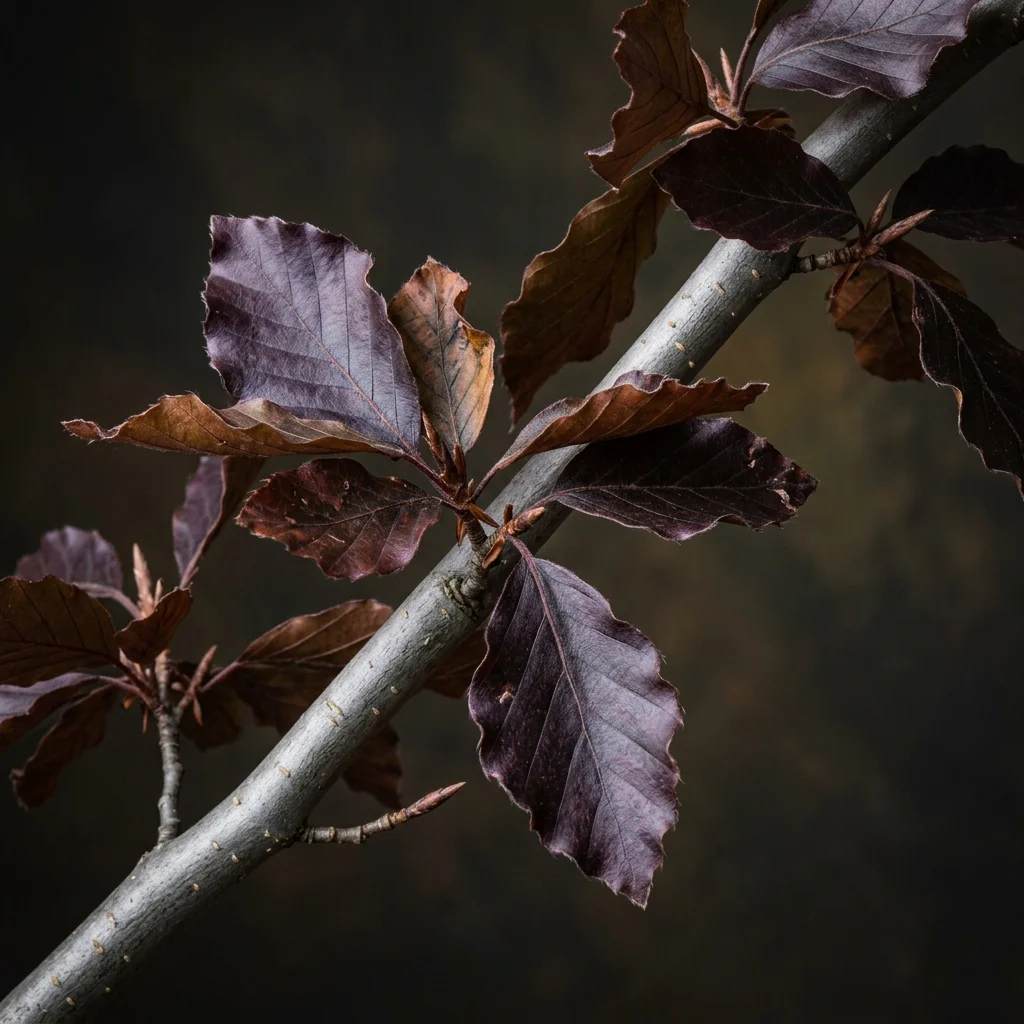
How to Identify Copper Beech
Identify Copper Beech immediately by its highly distinct biological features. Native to its specific ecosystem, it showcases spectacular foliage and structural habits optimized for its environment.
-
✓
Distinctive Features: Smooth silver-grey bark contrasting sharply with a dense, massive crown of deep purple to coppery-bronze wavy leaves.
-
✓
Typical Coloration: Brilliant copper-purple in spring, turning deep black-purple in summer, and coppery-bronze to amber-yellow in autumn.
-
✓
Potential Confusions: Similar to European Beech, but instantly distinguished by its highly distinct purple-copper foliage color.
11-Step Professional Care & Planting Guide
💧 【Watering & Moisture】 Water moderately. Keep soil consistently damp. Avoid clay compaction; it hates stagnant water around its roots.
☀️ 【Sunlight & Exposure】 Requires bright, direct sunlight. Needs full sun to maintain its deep purple-copper color; shady spots cause leaves to revert to a dull green.
🪴 【Ideal Soil Mix】 Requires deep, rich, moisture-retentive organic loam. Blend 50% clay-loam, 30% organic peat moss, and 20% coarse perlite.
🌡️ 【Temperature & Winter Care】 Cold-hardy (USDA Zone 4-7). Prefers cool, humid summers and snowy winters. Protect young trees from blazing dry hot winds.
✂ 【Pruning & Grooming】 Prune in late winter during dormancy to shape the crown. Prunes beautifully into magnificent formal dark hedges.
🧪 【Fertilization】 Apply a slow-release organic balanced fertilizer in early spring under the drip line. Mulch with composted leaf mold.
🏺 【Potting & Garden Planting】 Plant in spacious ground where its dark dome can stand out. Dig a wide hole, backfill with rich organic loam, and mulch deeply.
🌱 【Propagation】 Best propagated by grafting onto European Beech rootstock in winter to guarantee the purple-copper foliage color.
🐛 【Common Pests】 Watch out for beech woolly aphids under leaves. Treat manually with organic neem oil or insecticidal soap.
🦠 【Common Diseases】 Susceptible to root rot if soil is compacted. Ensure superior drainage and avoid planting in low-lying wet clay.
🎓 【Botanist Advice】 The Copper Beech needs full sun! If planted in deep shade, the leaves will produce more chlorophyll and turn green, losing the highly prized copper-purple color.
Frequently Asked Questions
Q: Why are the leaves purple-copper?
A: This is a natural mutation highly prized in horticulture! The leaves contain extremely high concentrations of anthocyanin pigments, which mask the green chlorophyll.
Q: Is the Copper Beech safe for household pets?
A: Yes, Fagus sylvatica 'Atropunicea' is completely non-toxic and pet-safe.
Q: Why is my Copper Beech turning green in summer?
A: This is typically caused by insufficient light. The plant produces more chlorophyll to compensate for lack of light, fading the purple color. Full sun is essential.
Q: Can I grow it as a dark privacy hedge?
A: Yes! It is highly responsive to clipping, forming a spectacular, dense purple-bronze formal privacy barrier that blocks wind and views.