Witch Hazel Care & Identification Guide
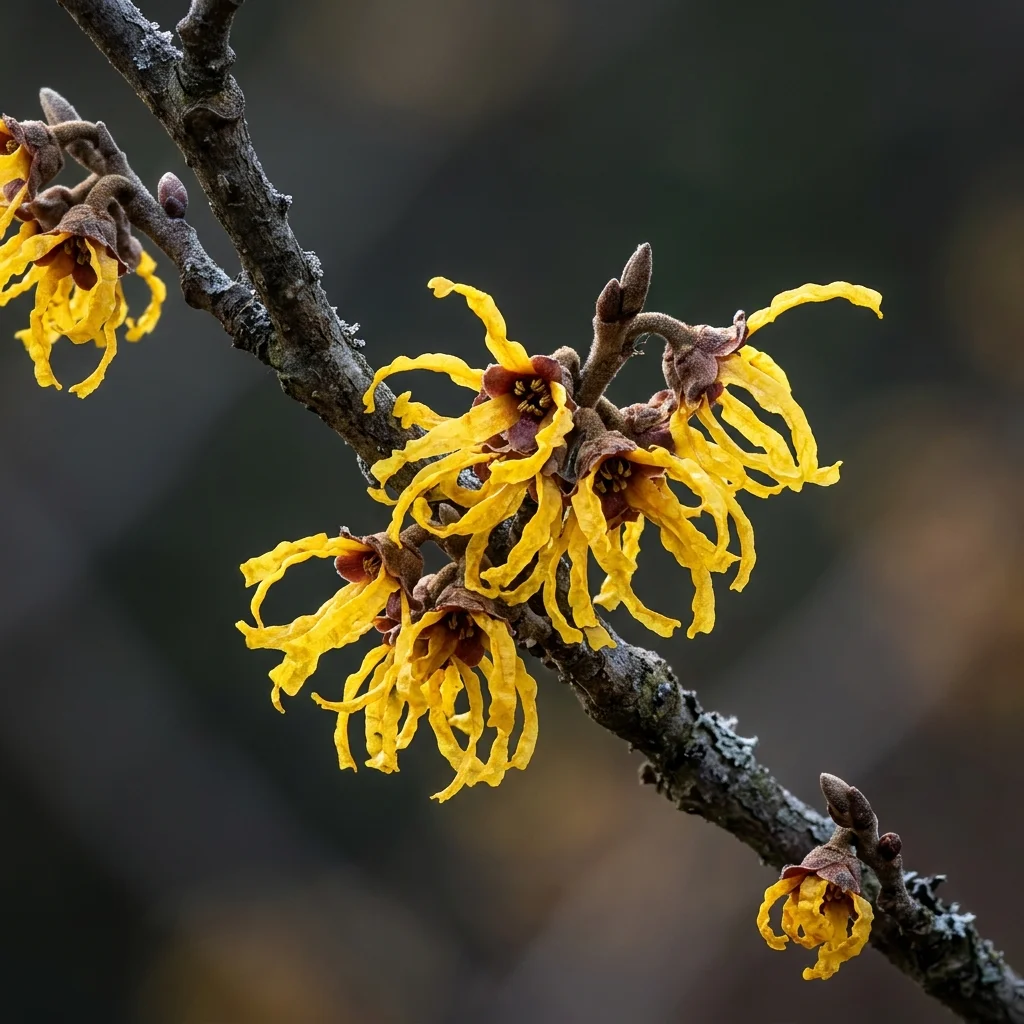
The magnificent Witch Hazel (Hamamelis virginiana) is an outstanding deciduous ornamental shrub celebrated for its unique ribbon-like crinkled bright golden-yellow petals that burst from woody cups in late autumn and winter when most plants are dormant. Native to forest understories and stream banks of eastern North America, this highly resilient wood perennial features a unique physiological mechanism where flowers curl up during extreme freezes to prevent frost damage. Famous for its high concentration of skin-healing tannins in its bark, it requires organic, well-drained woodland loam.





How to Identify Witch Hazel
Identify Witch Hazel (Hamamelis virginiana) immediately by its distinctive leaf arrangements, wood structures, and flowers. Recognizing its definitive visual traits is key to distinguishing it from other similar species.
-
✔
Distinctive Features: Ribbon-like, crinkled golden-yellow petals bursting in clusters from small woody cups along bare branches.
-
✔
Typical Coloration: Bright golden-yellow flowers, with large, wavy-margined opposite medium green leaves turning brilliant gold in autumn.
-
✔
Potential Confusions: Sometimes confused with Corylopsis (Winter Hazel), but easily distinguished by its ribbon-like petals blooming in winter rather than hanging bell-like chains.
Complete Care & Cultivation Guide
Follow our detailed scientific care guide to keep your Witch Hazel thriving and gorgeous all year round.
Frequently Asked Questions
What is the medicinal value of Witch Hazel?
Witch Hazel bark and leaves contain exceptionally high concentrations of tannins, which act as powerful natural astringents. The distilled extract is widely used globally to reduce skin inflammation and soothe bites.
Is Witch Hazel toxic to domestic pets?
No, Hamamelis virginiana is completely non-toxic and pet-safe, offering a beautiful, highly colorful, and worry-free medicinal shrub for pet owners.
Why does my Witch Hazel bloom in winter?
This is an evolutionary survival strategy. By blooming in late autumn and winter when other plants are dormant, Witch Hazel avoids competition and captures late-season pollinators like winter moths.
When is the best time to prune my Witch Hazel?
Prune immediately after early-spring flowering ceases. Witch Hazel sets its buds on 'old wood' during the summer, so pruning too late will cut off all the upcoming winter blossoms.