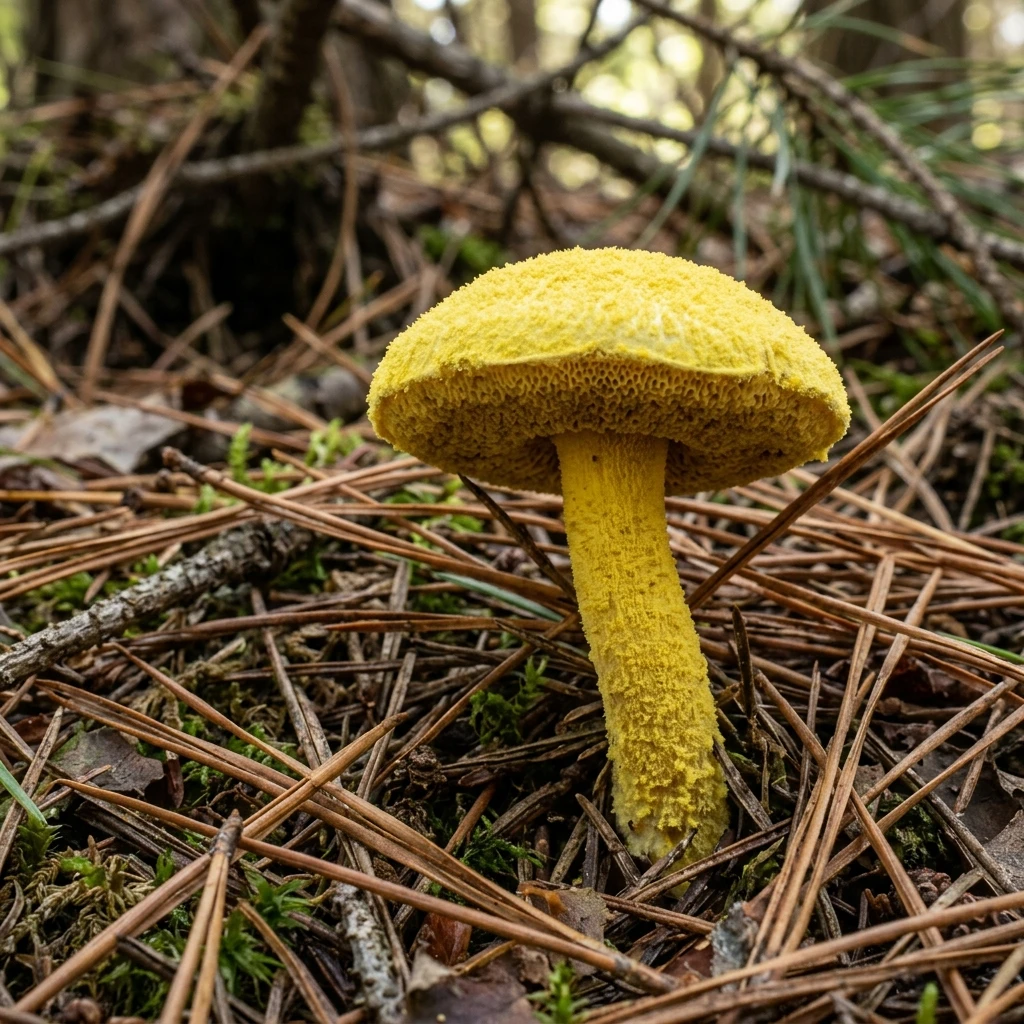
Powdered Bolete
Scientific Name: Pulveroboletus ravenelii
The Powdered Bolete, or Ravenel's Bolete, is a highly striking, colorful, and inedible wild mushroom native to broadleaf and coniferous forests across North America and East Asia. Growing in mycorrhizal symbiosis with hardwood trees, it is a spectacular sight. It is named for the bright, brilliant sulfur-yellow to lemon-yellow powder-like veil that completely covers the young cap and stem like a yellow dusting. Slicing open its firm yellow flesh reveals a dramatic, instant bruising reaction, turning a deep, rich indigo-blue in seconds.
How to Identify
A bright yellow-dusted cap and stem that bleeds instant indigo-blue when sliced open, showing bright yellow pores underneath.
- Sulfur-Yellow Powder: Young cap and stem are completely covered in a dense, powdery, bright sulfur-yellow universal veil.
- Instant Blue Bruising: Slicing the cap or stem reveals pale yellow flesh that instantly turns a deep, vivid indigo-blue in 1 second.
- Yellow Tube Pores: The underside features a bright lemon-yellow, sponge-like pore layer that slowly turns dingy brown when bruised.
Detailed Mycology Profile & Safety Guide
Click on any dimension to expand detailed field guides, substrate requirements, and safety warnings.
Is your Powdered Bolete growing moldy or decaying?
Take a photo with the Plant AI app to instantly diagnose fungal diseases, green mold, or wood decay, and get expert botanical recommendations in 1 second.
Scan Mushroom NowPowder Loss (Aging)
Symptoms: The bright yellow powder disappears, exposing a dry, reddish-brown, smooth cap skin.
Action: Action: This is natural. Rain and wind wash away the powdery universal veil as the mushroom matures. Look at the stem base and veil remnants on the cap edge to confirm identification.
Soggy Browning
Symptoms: The yellow pores turn dark brown, mushy, soggy, and smell sour after heavy rain.
Action: Action: Discard. The sponge-like pores easily absorb water, leading to rapid decay. Only study fresh, dry, active specimens.
Frequently Asked Questions
Why is it called 'Powdered Bolete'?
It is named 'Powdered Bolete' because its entire body is covered in a dense, beautiful, flour-like powder of bright sulfur-yellow color when young, which is actually a protective universal veil.
Why does the flesh turn blue instantly?
It stains blue due to a rapid chemical reaction. Slicing the flesh exposes variegatic acid to oxygen. An enzyme immediately oxidizes this compound, turning it into a brilliant indigo-blue quinone dye in less than 2 seconds.
Is this mushroom poisonous?
It is not known to contain lethal toxins, but it is considered inedible and completely unpalatable. It has a sour, bitter flavor and can cause gastrointestinal irritation if eaten.
Does it have a ring on the stem?
Yes, occasionally. The powdery yellow veil forms a thin, fragile sheet when the button is young. When the cap expands, this sheet tears, sometimes leaving a soft, yellow, powdery ring-like band on the upper stem.