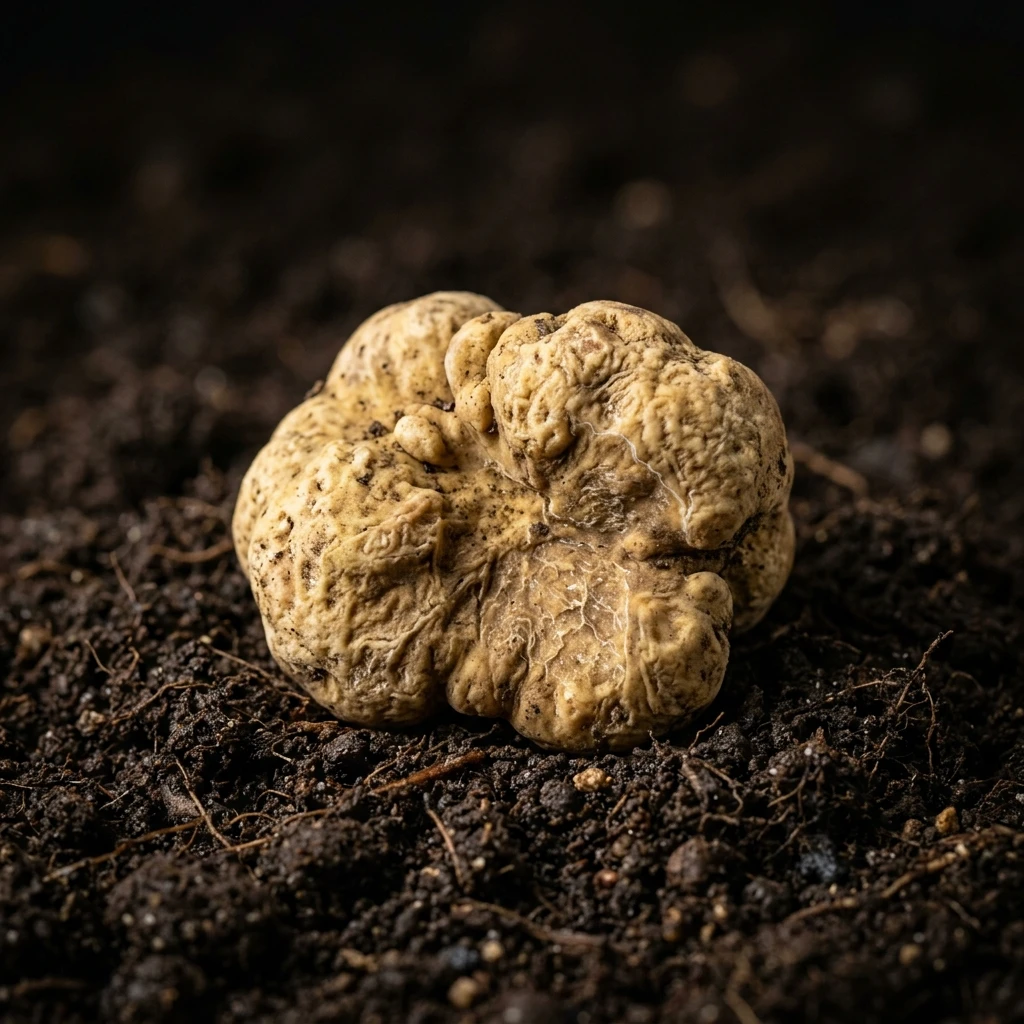
Tuber magnatum

White Truffle Identification & Cultivation

The Italian White Truffle, or 'Trifola d'Alba', is the most expensive and luxurious culinary ingredient in the world. Native to the damp, calcareous soils of Northern Italy, this subterranean mycorrhizal fungus grows exclusively under the roots of oak, hazel, and poplar trees. It is legendary for its intense, complex aroma of garlic, cheese, and honey.


Environment Icon
Environment Subterranean Hardwood Forests
Humidity Icon
Humidity High Humidity (85-95%)
Substrate Icon
Substrate Calcareous/Clay Soil Root Symbiosis
Cap Diameter Icon
Cap Diameter 2cm - 9cm
Edibility Icon
Edibility Choice Edible
Botanical macro photography of White Truffle (Tuber magnatum) - Plant AI care database

How to Identify White Truffle

A subterranean, potato-like cream-colored tuber with a smooth, velvety skin and highly intricate interior marbling.

  • Smooth Velvet Skin: Pale yellow to cream-colored smooth exterior, lacking the rough warts of black truffles.
  • Intricate Gleba: Inner flesh (gleba) is firm, pinkish-brown to dark cream, marbled with dense, thin white veins.
  • Intense Garlic Aroma: A highly potent, unique fragrance blending wild garlic, aged cheese, wet earth, and honey.
💡 Foraging Tip: White truffles grow completely underground. Foragers rely on trained truffle dogs to detect the scent and dig them up safely.

Complete Scientific Cultivation & Identification

Follow our professional mycological parameters and identification guidelines for safe foraging.

White truffles grow underground (5 to 30 cm deep) in symbiotic relationship with host tree roots (Oak, Hazel, Poplar, Linden). They require calcareous, alkaline soils rich in clay and moisture.
Thrives in damp river basins and shaded valleys. Requires regular summer rainfall to keep the underground soil moist enough for the autumn fruiting phase.
No light requirement. Because they are subterranean, white truffles complete their entire lifecycle in complete darkness beneath the leaf litter and soil.
Truffles have no cap, gills, or stem. They are globose, irregularly shaped tubers with a smooth, velvety outer skin called the peridium.
Produces a dark brown spore print. Truffles reproduce underground; animals eat them and disperse the spores through their droings, inoculating new tree roots.
The inner flesh (gleba) is solid, firm, and heavily marbled with white veins. There is no stem, ring, or base structure.
Harvest strictly using trained dogs. Once the dog marks the spot, use a small hand trowel to carefully dig out the truffle without scratching its delicate skin.
The absolute peak of gourmet cuisine. Extremely volatile aroma that destroys under heat. Must be shaved raw over fresh pasta, risotto, or eggs right before serving.
Contains rich bio-active peptides, sterols, and antioxidants that exhibit strong anti-inflammatory, antimicrobial, and skin-rejuvenating effects.
CRITICAL WARNING: Beware of poisonous subterranean fungi like the 'Earthball' (Scleroderma). Earthballs are hard, have a dark purple-black interior, and lack the delicate marbling and garlic aroma.
Never cook white truffles. The heat will destroy their volatile aromatic compounds instantly. Wash off dirt gently using a soft toothbrush under a thin stream of cold water.

Is your White Truffle losing its aroma or sweating?

Keep it completely dry, wrap in paper towels, store in glass jars with raw rice, and use within 5 days.

Identify My Mushroom

Common Diseases & Wild Contamination

Excessive Moisture Sweating

Symptoms: Symptoms: Velvet skin turns wet, slimy, and develops white mold fuzz.

Action: Action: Wrap in clean paper towels and change the paper daily. Truffles consist of 75% water and rot quickly if moisture accumulates.

Scent Dissipation

Symptoms: Symptoms: The truffle smells faint, dusty, or like ammonia.

Action: Action: The truffle is overripe and decomposing. Cook immediately or freeze in butter to lock in the remaining aroma.

Frequently Asked Questions

Why are White Truffles so expensive?

White truffles cannot be cultivated commercially. They only grow in specific regions in Northern Italy and Croatia, have a short autumn season, and must be dug up one by one by hand.

How do you store White Truffles correctly?

Wrap the truffle in a clean paper towel, place it in a hermetically sealed glass jar, and store in the refrigerator. Change the paper towel every day. You can add raw arborio rice to the jar to absorb moisture.

Can Truffle Oil replace real White Truffle?

No. Most commercial truffle oils are synthetic, made using lab-created 2,4-dithiapentane. They lack the complex, multi-layered depth of a genuine shaved white truffle.

How do you clean a fresh White Truffle?

Clean only right before eating. Brush off loose soil with a dry, soft-bristled toothbrush. Rinse very briefly under cold water if necessary, pat dry immediately with paper towels, and slice.

Understand nature safely. Identify mushrooms instantly!

Get Started for Free