Spring Amanita
Scientific Name: Amanita verna
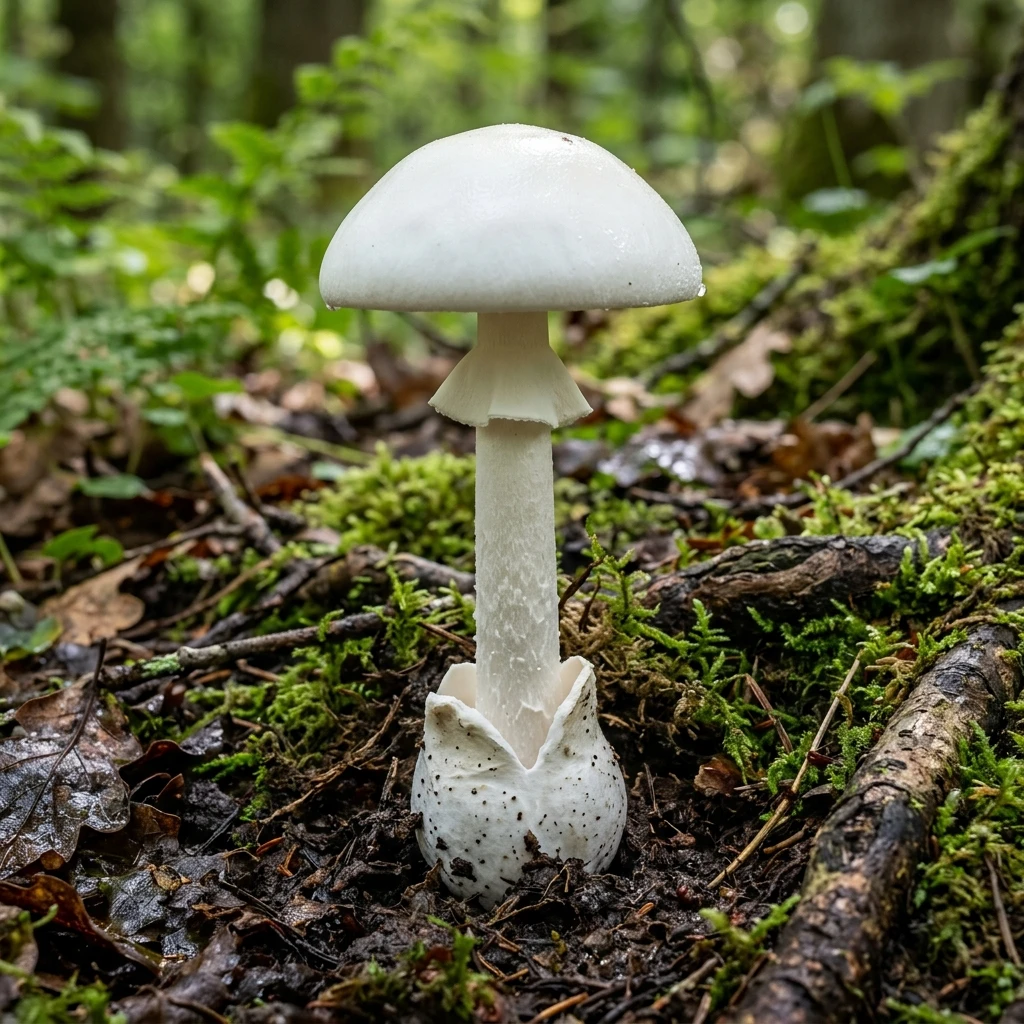
The Spring Amanita, or Fool's Mushroom, is a lethally poisonous, highly toxic wild fungus native to deciduous broadleaf forests across Europe and North America. Emerging in the warm moisture of spring and early summer (unlike most other Amanitas that fruit in autumn), it represents a deadly trap for early-season foragers. Flawlessly smooth and pure white, it features a delicate ring, white gills, and a deep sac-like volva cup at the base, containing the same deadly amatoxins as the Death Cap.
How to Identify
A smooth, pure white spring-fruiting mushroom with a delicate white ring, white gills, and a distinct sac-like volva at the base.
- Smooth White Cap: A completely smooth, pure white cap, 4 to 10 cm, that becomes slightly yellow only in the center when old.
- Delicate Hanging Ring: A thin, fragile, white skirt-like ring hanging from the upper part of the smooth white stem.
- Loose Sac-like Volva: A bulbous stem base that is fully enclosed in a tight, white, bag-like cup (volva) sitting in the soil.
Detailed Mycology Profile & Safety Guide
Click on any dimension to expand detailed field guides, substrate requirements, and safety warnings.
Is your Spring Amanita growing moldy or decaying?
Take a photo with the Plant AI app to instantly diagnose fungal diseases, green mold, or wood decay, and get expert botanical recommendations in 1 second.
Scan Mushroom NowCentral Yellowing
Symptoms: The center of the pure white cap develops a soft, pale yellow-ochre coloration as it matures.
Action: Action: This is natural aging. The cap surface is highly sensitive to spring heat. It remains lethally toxic; do not handle.
Ring Shriveling
Symptoms: The delicate white ring on the upper stem shrivels, falls off, or clings tightly to the stem, appearing invisible.
Action: Action: This is caused by hot spring winds. Always dig up the soil carefully to check for the bulbous stem base and loose volva cup to confirm identification.
Frequently Asked Questions
Why is it called 'Spring Amanita'?
It is named 'Spring Amanita' because it fruits during the spring and early summer (May to June), which is highly unusual for Amanitas, which normally fruit in the autumn.
How poisonous is the Spring Amanita?
It is extremely deadly. A single bite of the cap contains enough amatoxins to cause severe liver necrosis, kidney failure, and death in an adult if medical treatment is not received immediately.
How do you distinguish it from a white Morel?
They look completely different. Morels are hollow, brown-to-cream, and have a honeycomb-like pitted cap with no gills. The Spring Amanita has a smooth white cap, white gills, a ring on the stem, and a cup at the base.
What is the difference between Amanita verna and Amanita virosa?
Both are pure white and lethal, but Amanita verna (Spring Amanita) fruits in spring, has a completely smooth stem, and does not change color when touched with KOH. Amanita virosa (European Destroying Angel) fruits in autumn, has a shaggy stem, and turns bright yellow under KOH.