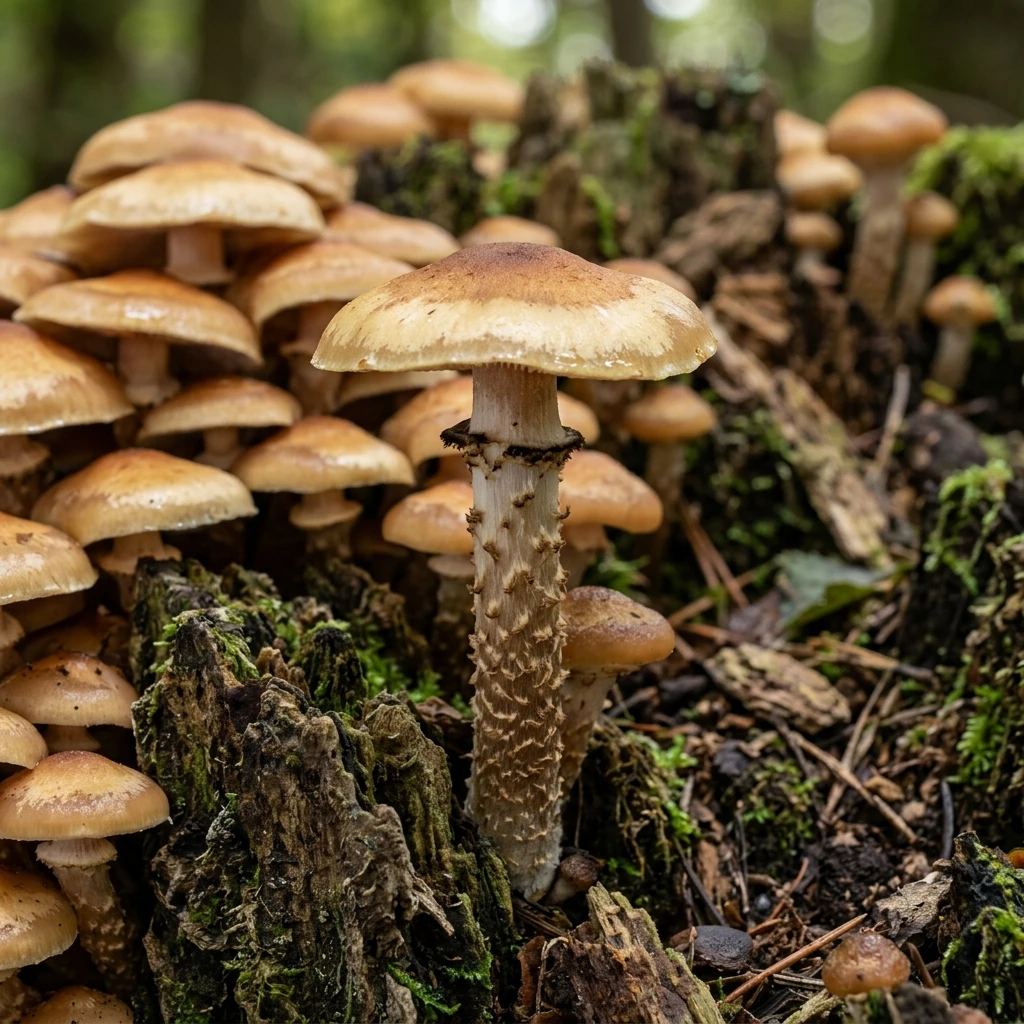
Sheathed Woodtuft
Scientific Name: Kuehneromyces mutabilis
The Sheathed Woodtuft, also known as the Two-Toned Woodtuft, is a highly common, popular, and choice wild edible mushroom native to temperate forests across Europe, North America, and Asia. Growing in spectacular, massive clusters on decaying hardwood stumps, it is highly prized by advanced foragers. It is instantly recognizable by its cap which changes color dramatically depending on moisture (hygrophanous), showing a pale cream center and a dark-brown outer ring, and its tough fibrous stem covered in a highly dense, prominent, warty pattern of recurved brown scales below a waxy ring. However, it requires extreme caution due to a lethal, poisonous look-alike.
How to Identify
Dense clusters of two-toned yellow-brown caps growing on wood, with a waxy ring on the stem and prominent recurved brown scales below the ring.
- Hygrophanous Two-Toned Cap: A smooth cap, 3 to 8 cm, showing a pale cream-yellow center and a dark-brown outer margin when drying.
- Recurved Stem Scales: The stem below the waxy ring is densely covered in prominent, warty, brown scales that curl upward (recurved).
- Wood-Growing Clusters: Strictly grows in dense, overlapping clusters on decaying hardwood stumps, never directly on soil.
Detailed Mycology Profile & Safety Guide
Click on any dimension to expand detailed field guides, substrate requirements, and safety warnings.
Is your Sheathed Woodtuft growing moldy or decaying?
Take a photo with the Plant AI app to instantly diagnose fungal diseases, green mold, or wood decay, and get expert botanical recommendations in 1 second.
Scan Mushroom NowSmooth Stems (Lethal Look-alike)
Symptoms: The caps in your cluster are identical to Sheathed Woodtuft, but the stems are smooth and covered in silver-white fibers with no scales.
Action: Action: DISCARD IMMEDIATELY. You have harvested the deadly poisonous Funeral Bell (Galerina marginata). Eating this will cause fatal liver failure. Do not take risks.
Cap Fading
Symptoms: The beautiful two-toned cap turns a uniform pale yellow-white and loses its dark outer ring.
Action: Action: This is natural drying (hygrophanous change). The cap remains edible, provided the stem is still covered in rough recurved scales.
Frequently Asked Questions
Why is it called 'Two-Toned Woodtuft'?
It is nicknamed the 'Two-Toned Woodtuft' because of its hygrophanous cap. When wet, the cap is a uniform dark brown. As it dries, it loses moisture from the center first, turning a pale cream color while the outer edge remains dark brown, creating a striking two-toned appearance.
How do you tell it apart from the deadly Funeral Bell?
The deadly Funeral Bell (Galerina marginata) has a stem covered in flat, smooth, silver-white fibers with absolutely no scales. The edible Sheathed Woodtuft has a stem densely covered in prominent, curly, recurved brown scales below the waxy ring.
Is the stem edible?
Is the stem edible?
No. The stem is extremely fibrous, tough, and woody. It remains leathery even after long cooking, making it very difficult to chew and digest. Most foragers only harvest and cook the tender, delicious caps.
Can you eat it raw?
No. Like many wild mushrooms, it contains mild, heat-sensitive compounds when raw that cause stomach upset. You must cook it thoroughly for at least 15 minutes to make it safe and choice edible.