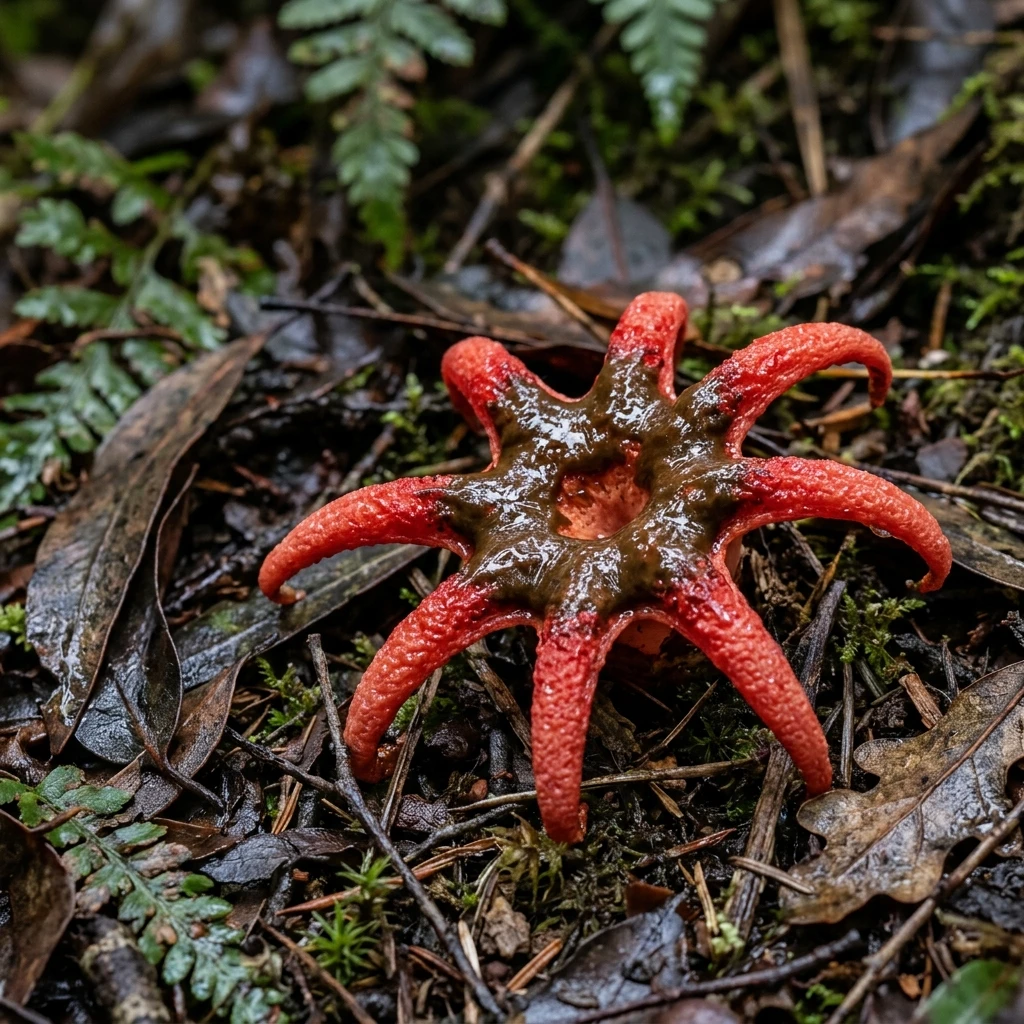
Red Starfish Fungus
Scientific Name: Aseroe rubra
The Red Starfish Fungus, also known as the Anemone Stinkhorn or Starfish Fungus, is a bizarre, fascinating, and inedible wild fungus native to Australia, Tasmania, and widely introduced worldwide. Thriving in damp garden mulch, leaf litter, and forest soils, it is named for its striking resemblance to a sea anemone or a bright red starfish. Sprouting from a buried white egg, it features a hollow white-to-pink stalk topped by 6 to 10 bright crimson-red branched arms radiating outwards around a highly foul-smelling, dark brown spore slime.
How to Identify
A bright red starfish-shaped cap with branched arms radiating from a central disk covered in dark-brown, foul-smelling slime.
- Starfish-shaped Arms: Cap features 6 to 10 bright carmine-red arms that are deeply divided or branched at the tips.
- Foul-smelling Gleba: The central disk is covered in a sticky, olive-brown-to-dark-brown slime that smells strongly of rotting meat.
- Hollow Stalk & Egg Base: The stalk is hollow, cylindrical, white at the base turning pink-red at the top, emerging from a white egg-like sac.
Detailed Mycology Profile & Safety Guide
Click on any dimension to expand detailed field guides, substrate requirements, and safety warnings.
Is your Red Starfish Fungus growing moldy or decaying?
Take a photo with the Plant AI app to instantly diagnose fungal diseases, green mold, or wood decay, and get expert botanical recommendations in 1 second.
Scan Mushroom NowFoul Odor & Fly Swarms
Symptoms: The mushroom is covered in dozens of flies and emits an intense smell of rotting meat.
Action: Action: This is natural. The foul odor is how the stinkhorn attracts insects to carry its spores. If the smell is too close to your home, dig up the mulch slightly and discard the white egg base.
Shriveling & Browning
Symptoms: The bright red starfish arms turn pale, dry, brown, and shrivel flat against the mulch.
Action: Action: This is natural decay. The fruiting body has completed its spore release and is decomposing back into the mulch. No action is required.
Frequently Asked Questions
Why does it look like a starfish?
Its sea-anemone or starfish shape, combined with the bright red color, is an evolutionary design to mimic carrion or decaying flesh, attracting insects to help disperse its spores.
Is the Red Starfish Fungus poisonous?
No, it is not known to be chemically toxic. However, it is considered completely inedible due to its tough, spongy structure, lack of nutritional value, and repulsive odor.
How long does the mushroom last?
The entire lifespan is very short. It emerges from its egg-like base, fully expands into a red starfish shape, releases its spores, and shrivels up all within 24 to 48 hours.
How do you prevent it from growing in garden mulch?
Since it grows on decaying wood, you can reduce its occurrence by turning your mulch regularly to dry it out, or by replacing woodchip mulch with gravel or composted leaves in shaded areas.