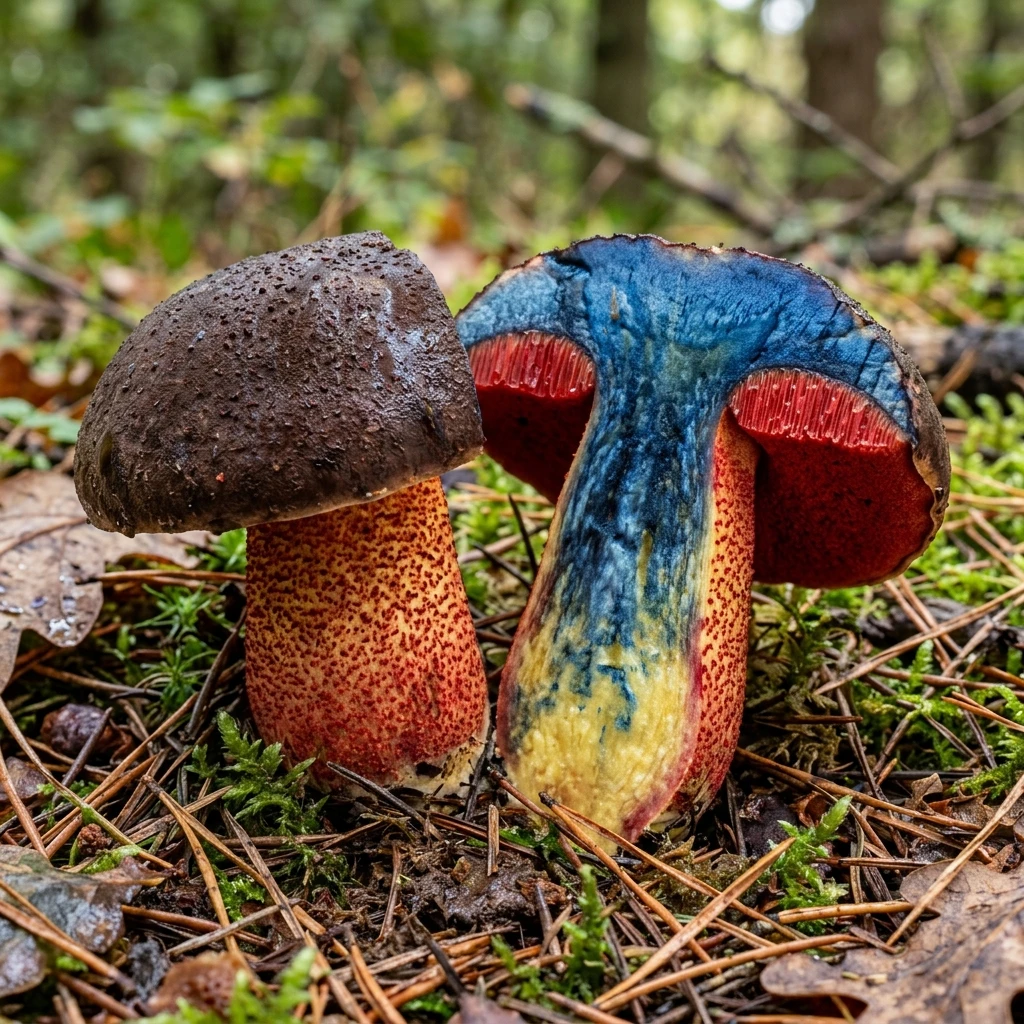
Scarletina Bolete
Scientific Name: Neoboletus luridiformis
The Scarletina Bolete, or Red-Mouthed Bolete, is a highly prized, choice wild edible mushroom native to coniferous and broadleaf forests across Europe and temperate Asia. Famous for its highly dramatic, instant oxidation reaction, slicing its firm yellow flesh open causes it to turn a brilliant, deep indigo-blue in a fraction of a second. Featuring a dark-brown velvety cap, a thick stem covered in fine red dots, and a sponge pore layer of bright blood-red, it represents an astonishing botanical wonder that must always be cooked thoroughly.
How to Identify
A dark-brown velvety cap with bright blood-red pores underneath and a stem covered in red dots, staining instant deep blue when cut.
- Velvety Dark-Brown Cap: A large, convex cap, 5 to 20 cm, that is dark-brown to olive-brown and velvety to the touch.
- Blood-Red Pores: Underneath the cap is a dense sponge pore layer that is bright orange-red to deep blood-red.
- Red-Dotted Stem: A solid, thick stem that is yellow, densely covered in tiny, bright red warty dots (floccules), completely lacking a net pattern.
Detailed Mycology Profile & Safety Guide
Click on any dimension to expand detailed field guides, substrate requirements, and safety warnings.
Is your Scarletina Bolete growing moldy or decaying?
Take a photo with the Plant AI app to instantly diagnose fungal diseases, green mold, or wood decay, and get expert botanical recommendations in 1 second.
Scan Mushroom NowBlueing Discoloration (Handling)
Symptoms: The entire mushroom cap, stem, and pores turn a dark warty black-blue color after being carried in a basket.
Action: Action: This is natural. The intense blue staining occurs wherever the mushroom is bruised. It is purely aesthetic and does not affect safety; cook as normal, and the blue will turn yellow in the pan.
Soggy Red Pores
Symptoms: The blood-red pores turn dark brown, mushy, soggy, and smell sour after heavy rain.
Action: Action: Past its prime. The sponge-like pores absorb water easily, leading to decay. Do not harvest; only collect firm, dry, active specimens.
Frequently Asked Questions
Why does the Scarletina Bolete turn blue instantly?
It turns blue due to a rapid biochemical oxidation. When sliced, oxygen reacts with a compound called variegatic acid in the presence of an enzyme, converting it instantly into a brilliant, deep indigo-blue quinone pigment.
Is the Scarletina Bolete poisonous?
It is toxic when raw or undercooked, causing severe stomach cramps and vomiting due to heat-sensitive toxins. However, cooking it thoroughly for 15 minutes completely destroys these toxins, making it a choice, delicious edible.
How do you tell it apart from the deadly Satan's Bolete?
The toxic Satan's Bolete (Rubroboletus satanas) has a pale chalky-white cap and a bulbous stem covered in a distinct red net-like pattern. The edible Scarletina Bolete has a dark-brown velvety cap and a stem covered in tiny red dots (no netting).
Does the blue color remain after cooking?
No. The blue pigment is heat-unstable. Once you put the sliced blue mushrooms into a hot frying pan, the blue color completely vanishes, and the flesh turns a beautiful, appetizing golden-yellow.