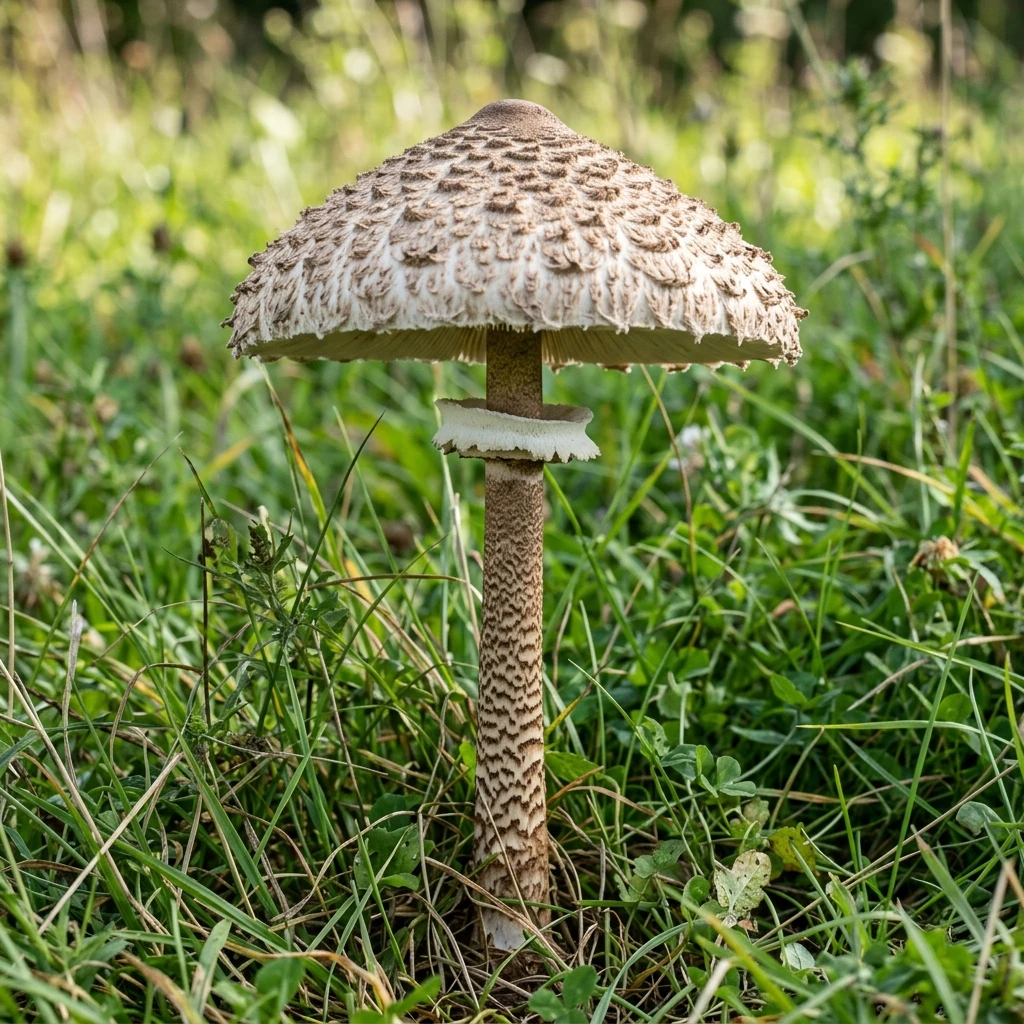
Parasol Mushroom
Scientific Name: Macrolepiota procera
The Parasol Mushroom is a choice, highly prized wild edible mushroom native to temperate grasslands, meadows, and forest edges across Europe and North America. Growing exceptionally tall on slender, snakeskin-patterned stems, it features a grand, dome-like white cap that flattens into a massive umbrella covered in coarse brownish scales. Celebrated by wild food foragers for its delicious nutty flavor, it represents a crucial study in mycology safety due to a highly common, deadly poisonous look-alike.
How to Identify
A very tall mushroom with a large shaggy cap, white gills, a sliding double ring, and a brown snakeskin-patterned stem.
- Grand Shaggy Cap: Cap is 10 to 30 cm, initial egg-shaped, flattening into a broad umbrella with a prominent dark central bump (umbo) and shaggy brown scales.
- Snakeskin Stem: The exceptionally tall, slender stem (up to 40 cm) features distinct, dark brown concentric cracks resembling a snakeskin pattern.
- Movable Double Ring: A thick, leathery, double-flanged white ring on the stem that can be easily slid up and down without tearing.
Detailed Mycology Profile & Safety Guide
Click on any dimension to expand detailed field guides, substrate requirements, and safety warnings.
Is your Parasol Mushroom growing moldy or decaying?
Take a photo with the Plant AI app to instantly diagnose fungal diseases, green mold, or wood decay, and get expert botanical recommendations in 1 second.
Scan Mushroom NowGreenish Gill Tint
Symptoms: Gills turn a light grey-green or olive-green color as the mushroom matures.
Action: Action: DISCARD IMMEDIATELY. This is a highly toxic False Parasol (Chlorophyllum molybdites). True Parasols always maintain white or cream gills that never turn green.
Smooth Plain Stem
Symptoms: The mushroom cap looks shaggy and scaly, but the tall stem is completely smooth and solid white without snakeskin markings.
Action: Action: Use extreme caution. This could be a toxic Chlorophyllum or Lepiota species. True Macrolepiota procera always features a highly prominent brown snakeskin pattern on its stem.
Frequently Asked Questions
How do you distinguish a Parasol Mushroom from a False Parasol?
The most reliable test is a spore print: true Parasol has a white-to-cream spore print, while False Parasol has a green spore print. Additionally, true Parasol has a brown snakeskin-patterned stem and a sliding double ring, whereas False Parasol has a smooth stem.
Are Parasol stems edible?
No. While the caps are highly prized and delicious, the stems are extremely tough, woody, and fibrous. Foragers usually discard the stems or dry and grind them into a powder for mushroom seasonings and stocks.
Can Parasol Mushrooms grow in rings?
Yes. Like many grassland fungi, the underground mycelium of the Parasol Mushroom grows outwards in all directions, sometimes forming beautiful circular 'fairy rings' on pasture turf.
Does the flesh of the Parasol Mushroom stain red when cut?
No. The flesh of Macrolepiota procera remains pure white and does not change color when cut or bruised. If the cut flesh turns reddish or saffron-orange, it is likely a Shaggy Parasol (Chlorophyllum rhacodes), which is edible but can cause mild indigestion in some individuals.