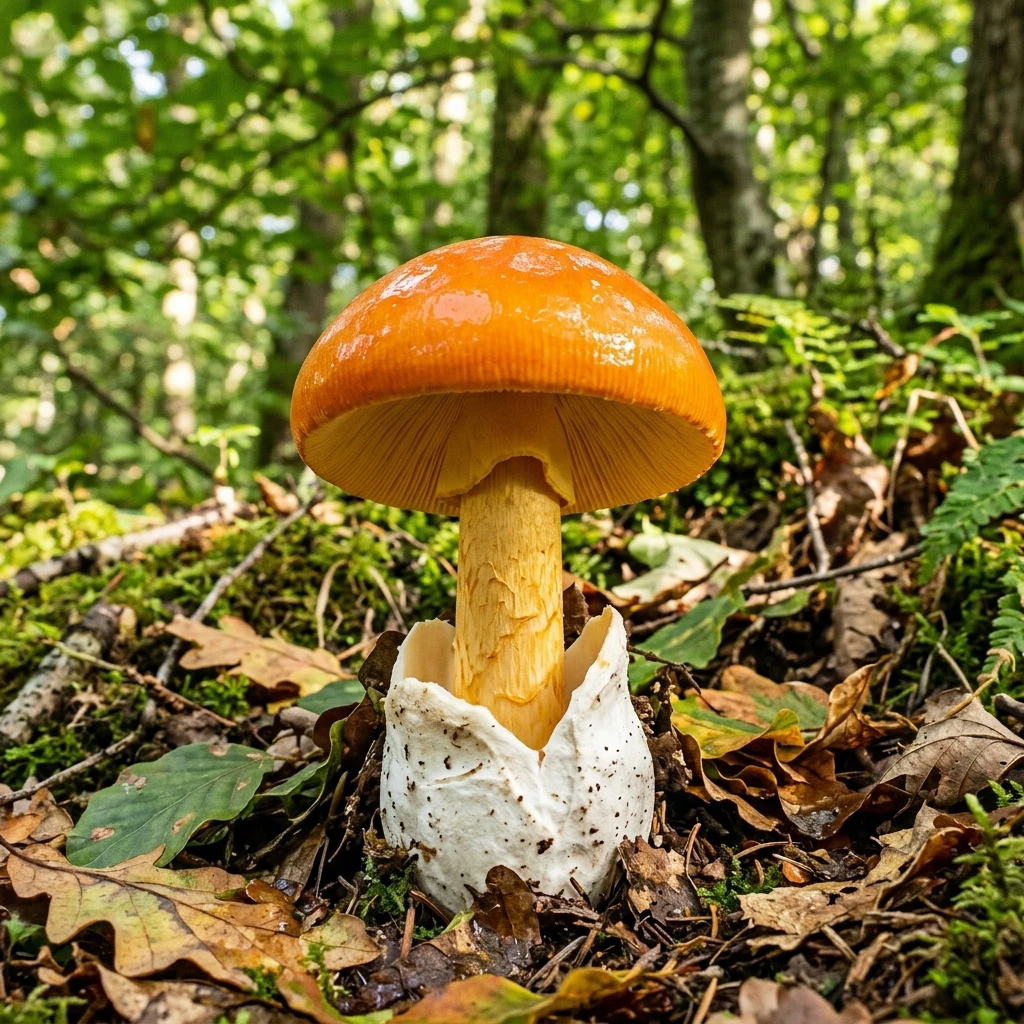
Caesar's Mushroom
Scientific Name: Amanita caesarea
The Caesar's Mushroom, also known as the Royal Amanita, is an exceptionally highly prized, choice wild edible mushroom native to warm deciduous woodlands across Southern Europe, North Africa, and temperate Asia. Growing in mycorrhizal symbiosis with mature Oak and Chestnut trees, it represents one of the most famous, historic culinary delicacies in human history, historically served exclusively to Roman Emperors. Instantly recognizable by its brilliant, striking golden-orange cap, its gorgeous golden-yellow gills and stem, and its massive, thick, pure-white cup-like volva at the base, it boasts a deeply rich, sweet, and nutty flavor.
How to Identify
A brilliant golden-orange cap with gold gills, a golden-yellow stem with a hanging gold ring, emerging from a massive, thick white cup-like volva.
- Brilliant Golden-Orange Cap: A large, smooth, shiny cap, 8 to 20 cm, displaying a brilliant golden-orange color with a finely lined margin.
- Golden-Yellow Gills: Unlike most Amanitas which have white gills, the gills and stem of Caesar's Mushroom are a gorgeous, striking golden-yellow.
- Massive White Volva: The base of the golden-yellow stem is wrapped in a very thick, loose, pure-white cup-like sac (volva).
Detailed Mycology Profile & Safety Guide
Click on any dimension to expand detailed field guides, substrate requirements, and safety warnings.
Is your Caesar's Mushroom growing moldy or decaying?
Take a photo with the Plant AI app to instantly diagnose fungal diseases, green mold, or wood decay, and get expert botanical recommendations in 1 second.
Scan Mushroom NowFading Color (Sun Bleaching)
Symptoms: The brilliant orange cap turns a pale, dingy yellow-white after prolonged exposure to intense summer sun.
Action: Action: This is natural bleaching. The mushroom remains safe to eat, provided the gills underneath are still golden-yellow and the flesh is firm.
Gill Whitening (Lethal Look-alike)
Symptoms: The cap is yellowish-orange, but the gills and stem underneath are completely white.
Action: Action: DISCARD IMMEDIATELY. You have harvested a lethal poisonous Amanita (such as the Death Cap or Fly Agaric variants). True Caesar's Mushroom must have 100% golden-yellow gills and stem.
Frequently Asked Questions
Why is it called 'Caesar's Mushroom'?
It is named 'Caesar's Mushroom' (Amanita caesarea) because it was highly celebrated in ancient Rome, where it was considered a food fit only for royalty. Roman emperors (Caesars) prized it above all other wild delicacies.
How do you tell it apart from the deadly Death Cap?
The deadly Death Cap (Amanita phalloides) has pure white gills, a white stem, and a white ring. The edible Caesar's Mushroom has a brilliant golden-orange cap, and its gills, stem, and ring are all a striking golden-yellow.
Why is it dangerous to harvest in the egg stage?
Why is it dangerous to harvest in the egg stage?
When very young, both Caesar's Mushroom and the deadly Death Cap are completely enclosed in a white, egg-like universal veil. They look identical from the outside, making mistake-free identification impossible until they break open.
How do you cook it?
Because it has an exceptionally delicate, sweet, and nutty flavor, it is one of the very few wild mushrooms that is traditionally eaten raw. Shave the fresh cap very thinly, drizzle with high-quality olive oil, a squeeze of fresh lemon juice, and a pinch of sea salt.