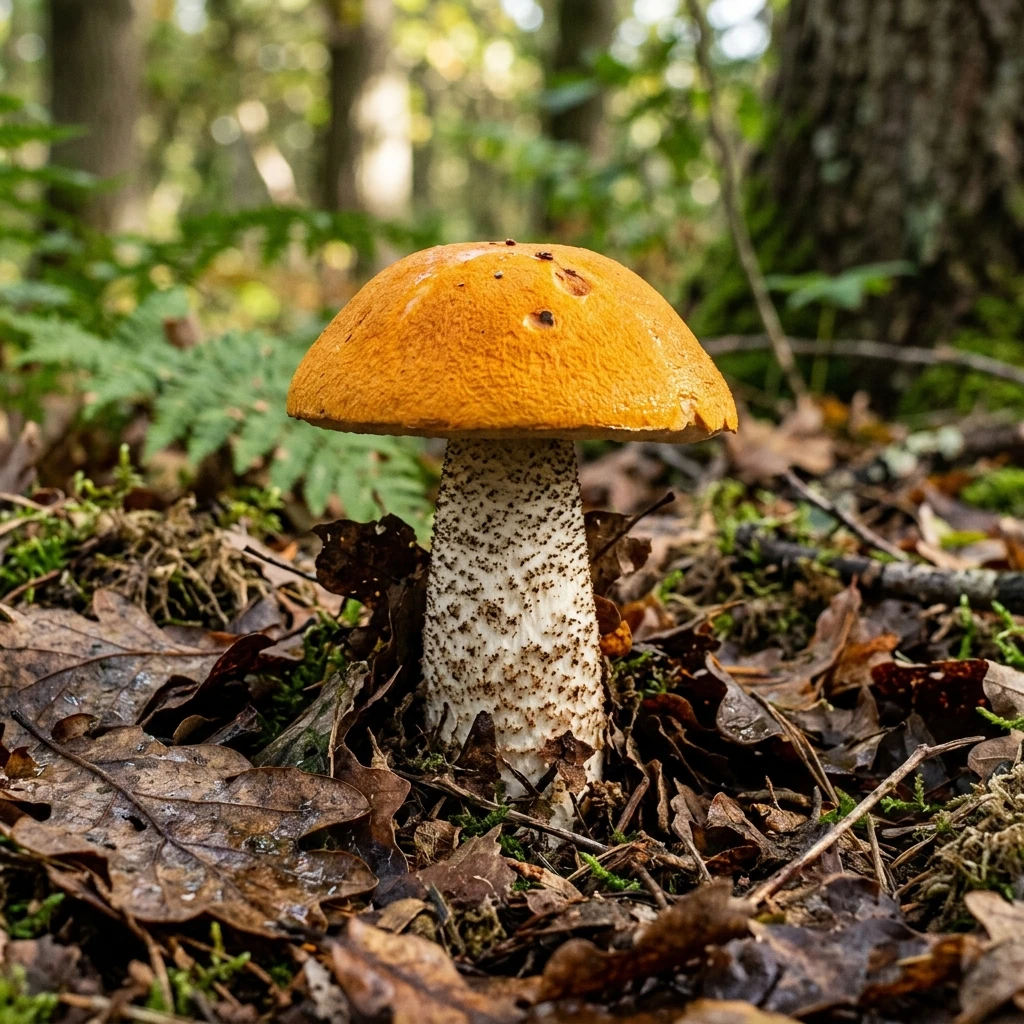
Orange Oak Bolete
Scientific Name: Leccinum aurantiacum
The Orange Oak Bolete, also known as the Orange-Capped Scaber Stalk, is a highly beautiful, choice wild edible mushroom native to broadleaf oak woodlands across Europe, North America, and temperate Asia. Instantly recognizable by its brilliant, striking golden-orange to brick-red cap, its thick white stem densely covered in warty dark-brown scales (scabers), and its firm white flesh that stains a dramatic red-purple before turning a charcoal-black when cut, it represents a legendary summer-to-autumn foraging treasure.
How to Identify
A brilliant golden-orange cap on a thick white stem covered in prominent dark-brown warty scales, staining red-purple then black when sliced.
- Brilliant Orange Cap: A large, convex, velvety cap, 6 to 20 cm, showing an intense, gorgeous golden-orange to brick-red color.
- Oak Host Association: Strictly grows on the ground in mycorrhizal symbiosis with mature Oak trees (*Quercus*).
- Red-to-Black Bruising: Slicing the firm white flesh open causes it to turn a distinct red-purple in 30 seconds, slowly turning charcoal-black.
Detailed Mycology Profile & Safety Guide
Click on any dimension to expand detailed field guides, substrate requirements, and safety warnings.
Is your Orange Oak Bolete growing moldy or decaying?
Take a photo with the Plant AI app to instantly diagnose fungal diseases, green mold, or wood decay, and get expert botanical recommendations in 1 second.
Scan Mushroom NowWoody Fiber (Stem)
Symptoms: The stem feels extremely hard, fibrous, stringy, and impossible to cut or chew after cooking.
Action: Action: This is natural. The stem of Leccinum is highly fibrous to support the heavy cap. Always cut the stem off in the field and only cook the tender orange caps.
Soggy Gray Pores
Symptoms: The gray-white pores turn dark brown, mushy, soggy, and smell sour after heavy rain.
Action: Action: Past its prime. The sponge-like pores absorb water easily, leading to decay. Do not harvest; only collect firm, dry, active specimens.
Frequently Asked Questions
Why is it called 'Orange Oak Bolete'?
It is named for its brilliant, striking golden-orange cap and its strict symbiotic relationship with Oak trees, where its underground mycelium partners with oak roots.
Why does the flesh turn red-purple and then black?
It is a two-stage chemical reaction. Slicing the flesh exposes compounds to oxygen, turning them red-purple instantly. Over the next hour, a secondary reaction converts these pigments into a stable charcoal-black quinone dye.
Is it safe to eat raw?
No. Like many *Leccinum* species, it contains mild, heat-sensitive toxins when raw that cause gastrointestinal irritation. You must cook it thoroughly for at least 15 minutes to render it safe and delicious.
How do you cook it?
Sauté the sliced caps in butter or olive oil with garlic. Because the flesh turns completely black when cooked, it adds a wonderful, dramatic visual element to dark risottos, wild mushroom pastas, or game stews.