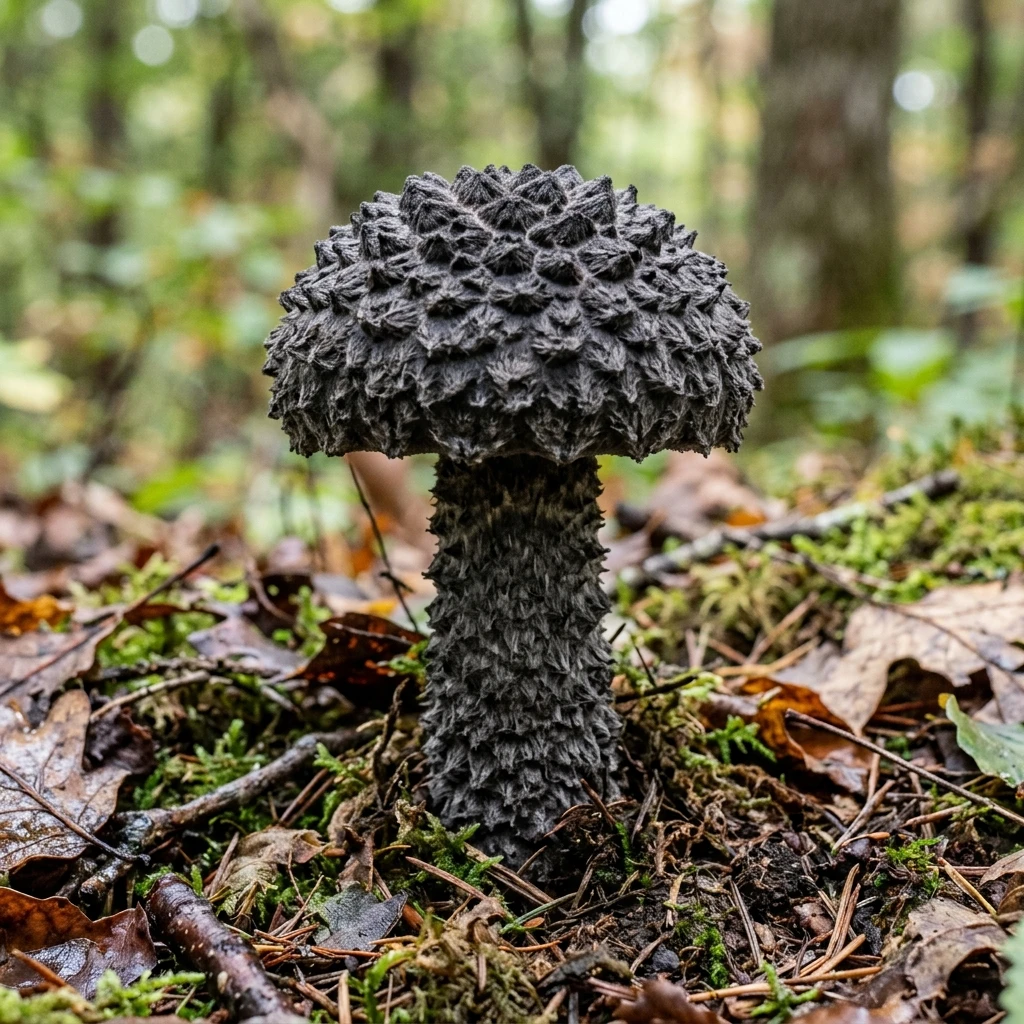
Old Man of the Woods
Scientific Name: Strobilomyces strobilaceus
The Old Man of the Woods is a highly unique, bizarre, and edible wild mushroom native to temperate broadleaf and coniferous forests across North America and Europe. Instantly recognizable by its highly distinct, shaggy appearance, it features a convex cap densely covered in large, blackish-gray warty scales that look exactly like a soft gray pinecone or a pile of charcoal. A classic icon of mycology, its firm white flesh stains a dramatic red-orange when sliced, slowly maturing to a charcoal-black, representing a fascinating study in fungal chemistry.
How to Identify
A highly unique cap densely covered in large, blackish-gray shaggy scales resembling a pinecone, with a shaggy gray stem.
- Pinecone-like Shaggy Cap: A convex cap, 4 to 15 cm, densely packed with large, raised, soft, blackish-gray or charcoal-black shaggy scales.
- Grey-Black Pores: Underneath the cap is a tube pore layer that is pale gray when young, turning dark gray-to-black in age.
- Red-to-Black Bruising: Slicing the firm white flesh open causes it to turn a bright orange-red in 10 seconds, slowly turning charcoal-black.
Detailed Mycology Profile & Safety Guide
Click on any dimension to expand detailed field guides, substrate requirements, and safety warnings.
Is your Old Man of the Woods growing moldy or decaying?
Take a photo with the Plant AI app to instantly diagnose fungal diseases, green mold, or wood decay, and get expert botanical recommendations in 1 second.
Scan Mushroom NowCharcoal Blackening (Mature)
Symptoms: The entire cap, stem, and pore layer turn completely charcoal-black, dry, and brittle.
Action: Action: Past its prime. The mushroom has fully matured its spores, and the flesh has become dry and tasteless. Do not harvest; leave it to release its black spores.
Stem Woodiness
Symptoms: The stem feels extremely hard, fibrous, stringy, and impossible to cut or chew after cooking.
Action: Action: This is natural. The stem of Strobilomyces is highly fibrous to support the heavy shaggy cap. Always cut the stem off in the field and only cook the tender shaggy caps.
Frequently Asked Questions
Why is it called 'Old Man of the Woods'?
It is named 'Old Man of the Woods' because of its highly unique, shaggy, grey-and-black warty appearance, which resembles a wrinkled, hairy old man covered in a grey beard blending with the forest.
Why does the flesh turn red and then black?
It is a two-stage chemical oxidation. Slicing the flesh exposes compounds to air, turning them red-orange instantly. Over the next hour, a secondary reaction converts these pigments into a stable, warty charcoal-black quinone dye.
Does it taste good?
Yes. It has a very pleasant, mild, earthy, and rich mushroom flavor with a firm, meaty texture. Its only culinary drawback is that it turns black when cooked, coloring other ingredients in the pan.
Is it safe for beginners?
It is one of the safest mushrooms to forage. Because it looks like a soft, shaggy gray pinecone and has no look-alikes, it is virtually impossible to confuse with any poisonous species.