Jack-O'-Lantern
Scientific Name: Omphalotus illudens
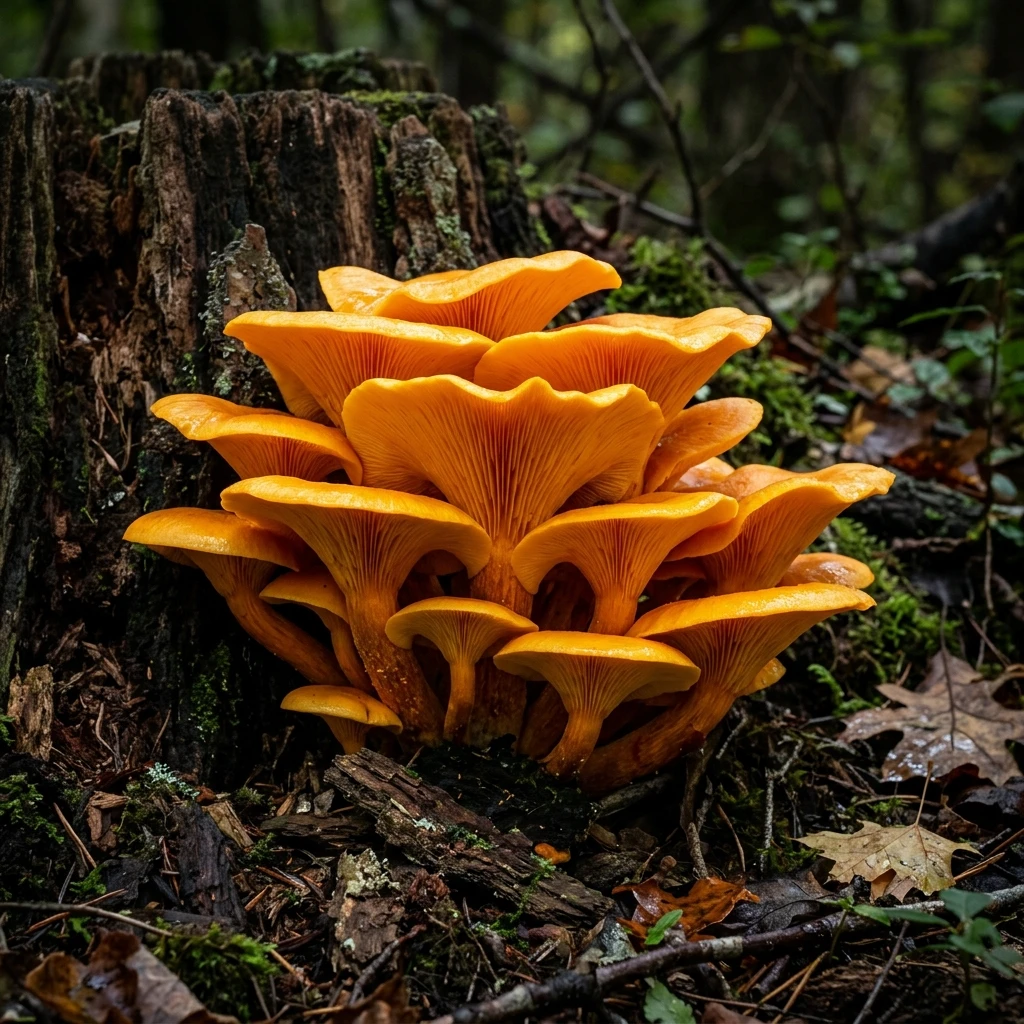
The Jack-O'-Lantern is a highly toxic, exceptionally beautiful orange mushroom native to deciduous forests in eastern North America. Growing in dense, tightly overlapping clusters at the base of oak stumps, it is named for its brilliant orange-yellow color and its unique ability to emit a soft, ghostly green bioluminescent glow from its gills at night. Because it closely resembles edible chanterelles, it presents a major poisoning risk.
How to Identify
A bright orange, funnel-shaped cluster growing on oak wood, with gills running down the stem that glow in the dark.
- Funnel-shaped Cap: Funnel-like cap with a depressed center and wavy edges, entirely brilliant orange-yellow.
- Decurrent Orange Gills: Gills are bright orange, running down the stem (decurrent), glowing with green bioluminescence.
- Clustered Growth: Grows in highly dense, tightly overlapping clusters directly at the base of oak stumps.
Detailed Mycology Profile & Safety Guide
Click on any dimension to expand detailed field guides, substrate requirements, and safety warnings.
Is your Jack-O'-Lantern growing moldy or decaying?
Take a photo with the Plant AI app to instantly diagnose fungal diseases, green mold, or wood decay, and get expert botanical recommendations in 1 second.
Scan Mushroom NowBioluminescence Fading
Symptoms: The gills fail to emit a green glow in the dark.
Action: Action: This is natural. The green glow is extremely faint and can only be seen in complete, pitch-black darkness after your eyes adjust for at least 10 minutes. Old, dry specimens will stop glowing completely.
Cap Browning
Symptoms: The bright orange cap turns dull, dry, and dark brown at the center.
Action: Action: This is natural decay. The mushroom has reached maturity and is releasing white spores. Avoid gathering decaying or dried-out specimens.
Frequently Asked Questions
Why do Jack-O'-Lantern mushrooms glow in the dark?
Their glow is caused by a chemical reaction between a substance called luciferin and an enzyme called luciferase (the same mechanism fireflies use to glow). It produces a very faint, ghostly green light from the active gills.
How can you distinguish a Jack-O'-Lantern from a Chanterelle?
Chanterelles grow singly on soil, have thick fork-like ridges (not sharp blade gills), and have white inside flesh. Jack-O'-Lanterns grow in dense clusters directly on wood, have sharp orange gills, and have solid orange inside flesh.
What toxins do Jack-O'-Lanterns contain?
They contain illudin S, a potent sesquiterpene toxin. When consumed, it causes severe, violent stomach cramps, vomiting, diarrhea, and intense nausea. While not typically fatal to healthy adults, it causes immense suffering.
Is their glowing light visible to the naked eye?
Yes, but it is extremely faint. To see it, you must take fresh specimens into a pitch-black room at night and wait 5 to 10 minutes for your eyes to fully adjust to the darkness. Old or dry specimens will not glow.