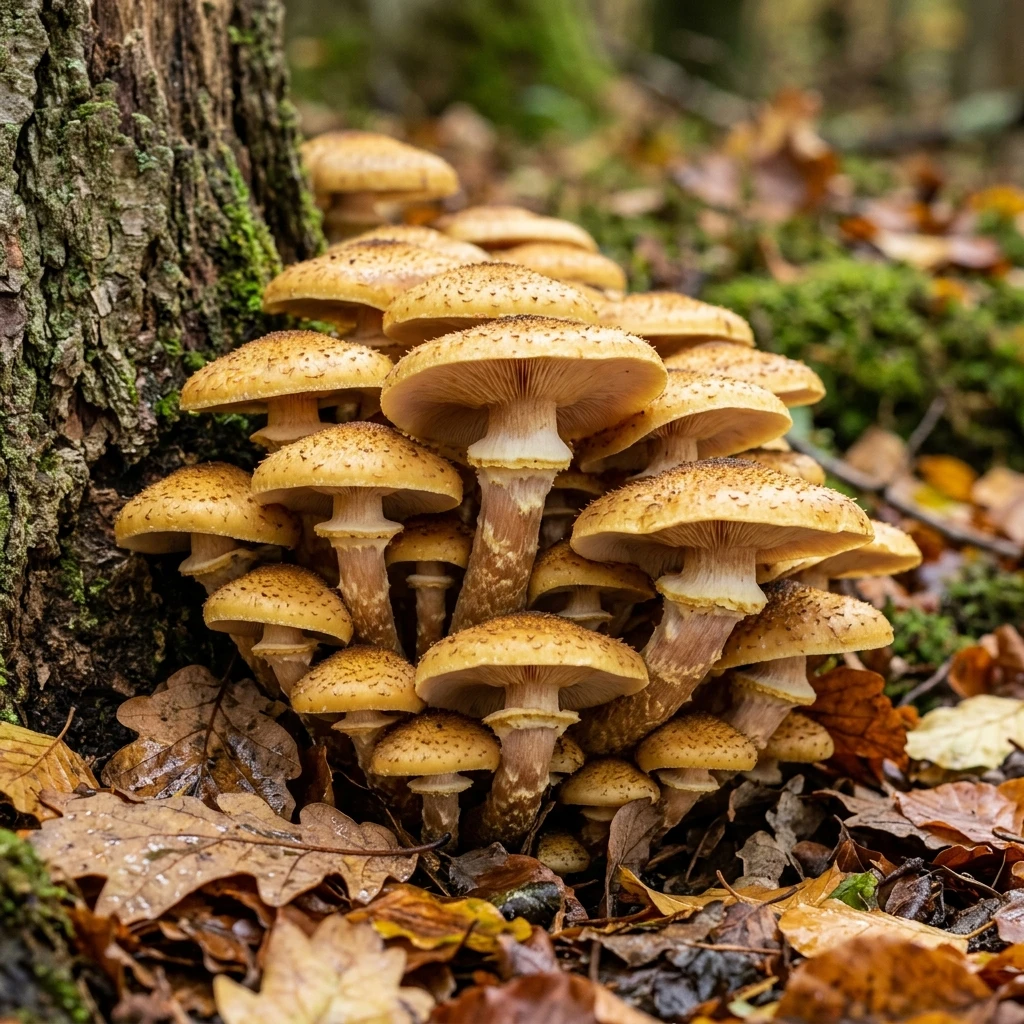
Honey Mushroom
Scientific Name: Armillaria mellea
The Honey Mushroom, or Bootlace Fungus, is a highly common, popular, and choice wild edible mushroom native to temperate forests globally. Eerily famous as a massive forest parasite, it spreads underground using black, wire-like cords (rhizomorphs) that can grow to be the largest living organisms on Earth. Growing in spectacular, massive clusters at the base of trees, it features a honey-yellow cap covered in tiny, dark hair-like scales, and a fibrous stem with a distinct waxy ring. However, it is a crucial study in safety as it has a lethal, poisonous look-alike.
How to Identify
Dense, massive clusters of honey-yellow mushrooms with white gills, a waxy ring on the stem, and tiny dark hairs on the cap.
- Honey-Yellow Cap: A convex cap, 3 to 15 cm, ranging from pale honey-yellow to golden-brown, covered in tiny, dark hair-like scales.
- Waxy Stem Ring: A tough, fibrous stem featuring a distinct, prominent, cottony white-and-yellow ring (annulus) on the upper part.
- Pure White Spores: The gills underneath are white-to-cream, producing a pure white spore print.
Detailed Mycology Profile & Safety Guide
Click on any dimension to expand detailed field guides, substrate requirements, and safety warnings.
Is your Honey Mushroom growing moldy or decaying?
Take a photo with the Plant AI app to instantly diagnose fungal diseases, green mold, or wood decay, and get expert botanical recommendations in 1 second.
Scan Mushroom NowBrown Spore Dust
Symptoms: The caps in your cluster are dusted with a distinct, rusty-brown powdery coating.
Action: Action: DISCARD IMMEDIATELY. Edible Honey Mushroom produces only white spores. A rust-brown coating indicates you have harvested the deadly poisonous Funeral Bell (Galerina marginata). Double-check every single stem.
Scale Loss (Heavy Rain)
Symptoms: The honey-yellow cap loses its warty dark scales, turning dry, pale yellow, and completely smooth.
Action: Action: This is caused by heavy rain. The cap scales are fragile. Always check the spore print and stem ring to confirm the species even if the cap appears smooth.
Frequently Asked Questions
Why is it called 'Honey Mushroom'?
It is named 'Honey Mushroom' because of the beautiful, golden honey-yellow color of its cap, which resembles fresh honeycomb in the autumn sun.
What are the underground black cords?
These are called rhizomorphs. They are thick, shoestring-like networks of fungal mycelium covered in a protective dark shell. They grow under the bark and underground, traveling great distances to infect new host trees.
How do you tell it apart from the lethal Funeral Bell?
The lethal Funeral Bell (Galerina marginata) has a completely smooth cap with no hairs, a stem with a faint waxy ring, and produces a rust-brown spore print. The edible Honey Mushroom has tiny, dark, hair-like scales in the center of its cap, and produces a pure white spore print.
Is the Honey Mushroom safe to eat raw?
No. Like many wild mushrooms, it contains mild, heat-sensitive toxins when raw that cause severe stomach cramps and vomiting. You must cook it thoroughly for at least 15 minutes to render it safe and delicious.