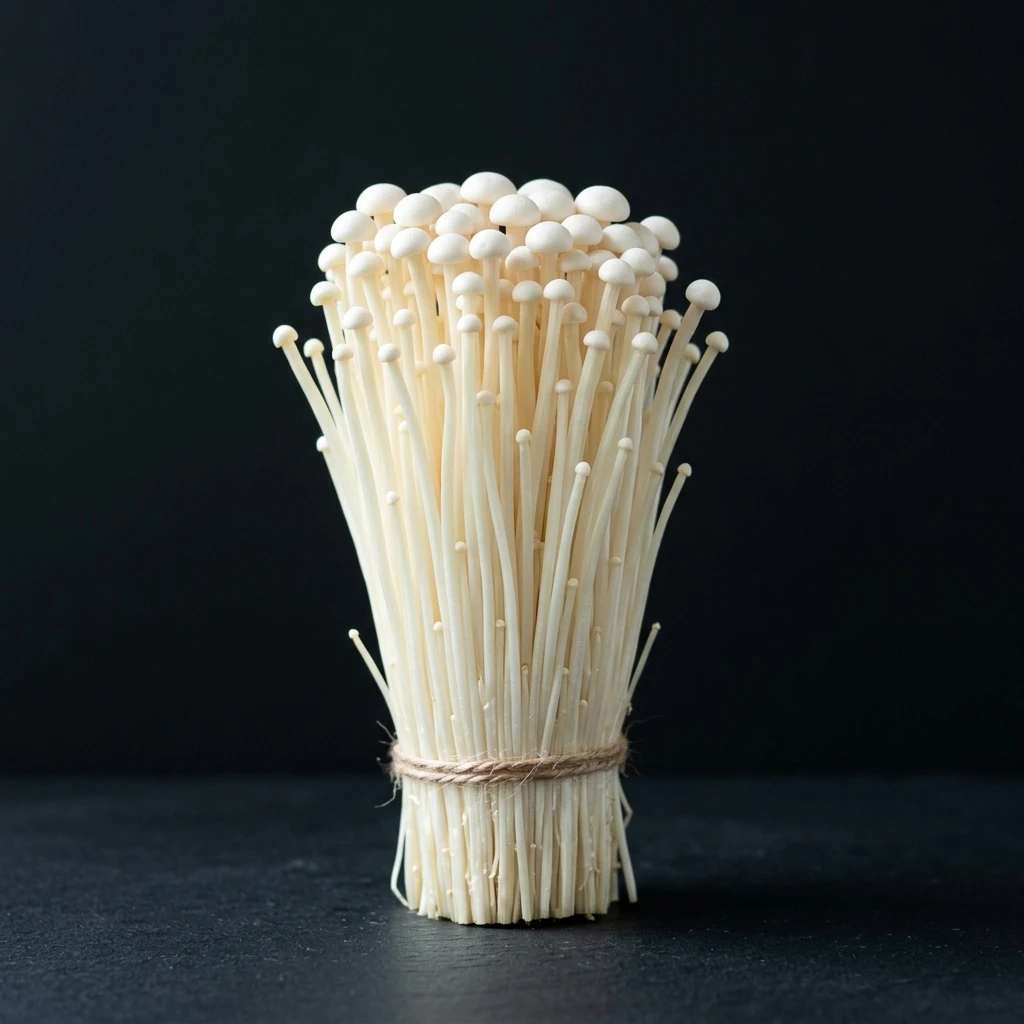
Golden Needle
Scientific Name: Flammulina filiformis
The Golden Needle, also known as the Cultivated Enoki or Lily Mushroom, is one of the most popular, widely cultivated, and commercially successful edible mushrooms in the world, especially in East Asian cuisine. Cultivated in specialized, high-carbon dioxide, low-light, and cool-temperature conditions, it does not resemble its wild relative (Velvet Shank), but instead forms a clean, pure-white bundle of exceptionally long, slender stems topped with tiny, delicate, semi-spherical button caps. It is highly valued for its sweet, mild flavor and its highly unique, crisp, and crunchy texture.
How to Identify
Dense bundles of exceptionally long, slender, pure-white stems with tiny, delicate, semi-spherical caps, cultivated under high CO2.
- Slender White Stems: Exceptionally long, thin, pure-white stems, 10 to 20 cm, that are highly flexible and crisp.
- Tiny Button Caps: Tiny, delicate, smooth, semi-spherical white caps, 0.5 to 1.5 cm, remaining closed.
- Dense Bundle Growth: Grows in highly compressed, dense, uniform bundles out of sterilized cultivation bottles.
Detailed Mycology Profile & Safety Guide
Click on any dimension to expand detailed field guides, substrate requirements, and safety warnings.
Is your Golden Needle growing moldy or decaying?
Take a photo with the Plant AI app to instantly diagnose fungal diseases, green mold, or wood decay, and get expert botanical recommendations in 1 second.
Scan Mushroom NowSoggy Sliminess (Rot)
Symptoms: The white stems turn soggy, develop a slimy texture, and smell sour or alcoholic inside the plastic wrap.
Action: Action: Discard. Excess moisture in the packaging can cause bacterial rot. Store in a breathable paper bag and consume within 5 days.
Yellow-Brown Discoloration
Symptoms: The pure-white cap and stems turn a dull yellow-brown color and feel soft.
Action: Action: This is caused by exposure to light and warmth during storage. The mushroom remains safe to eat but has lost its crispness. Cook thoroughly.
Frequently Asked Questions
Why are they so long and white?
They are grown in high-tech, darkened rooms with very high levels of carbon dioxide. The high CO2 mimics being buried under bark, causing the stems to stretch exceptionally long to reach 'oxygen,' while the darkness prevents the caps from turning brown.
Are they the same as wild Enoki?
Yes, genetically they are the same genus (*Flammulina*). However, wild Enoki (Velvet Shank) has a short, thick, velvety black-brown stem, a flat orange-yellow cap, and grows in open forests, looking completely different due to natural light and oxygen.
How do you cook them?
How do you cook them?
Cut off the solid root base, separate the strands, and add them to hot pots, ramen, or stir-fries. They only need 1 to 2 minutes of cooking. Searing them quickly with garlic and sesame oil is highly popular.
Are they good for you?
Yes! They are low in calories, high in dietary fiber, and contain high amounts of essential B vitamins, potassium, and unique antioxidants that support immune system health.