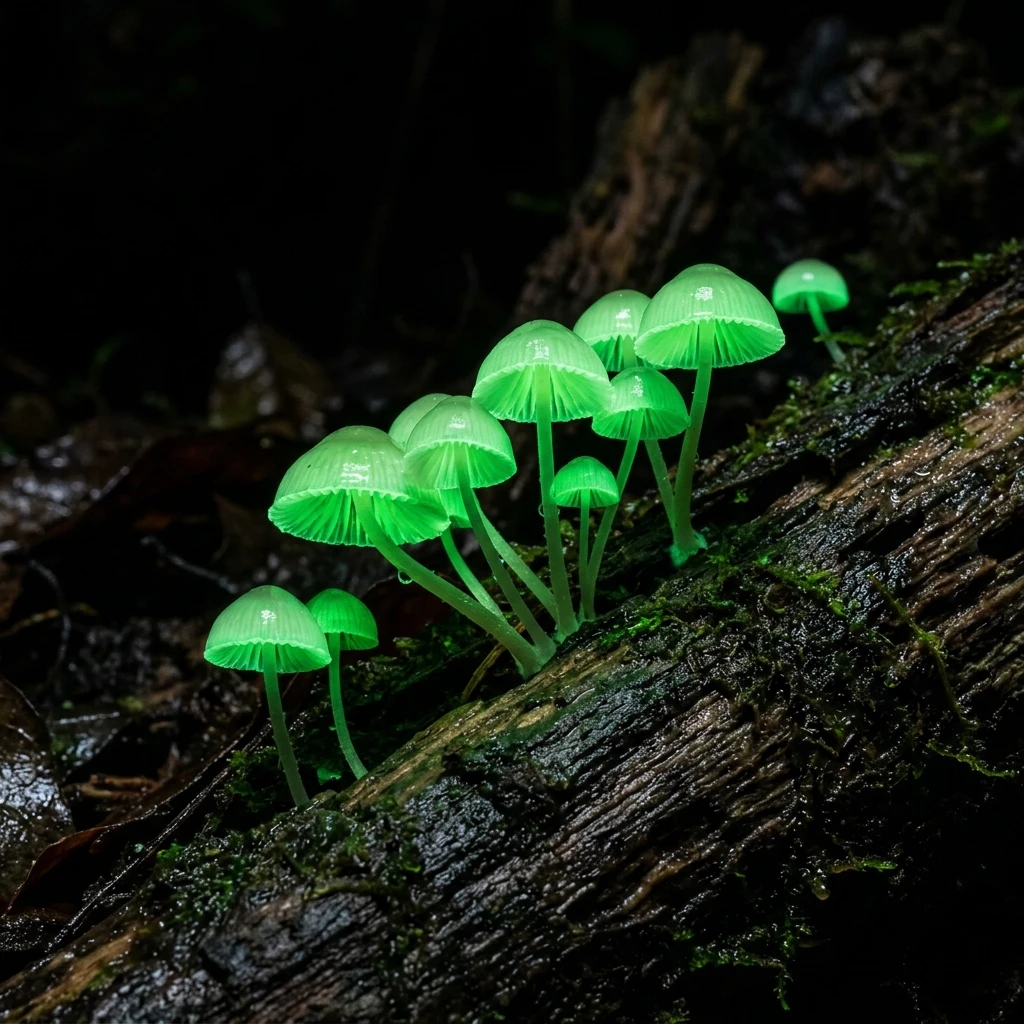
Glowing Mycena
Scientific Name: Mycena chlorophos
The Glowing Mycena, or Pale-Green Bioluminescent Mycena, is a spectacular and legendary bioluminescent micro-mushroom native to subtropical forests across East Asia, Australia, and the Pacific Islands. Renowned for its astonishing ability to emit a bright, eerie, pale-green light (bioluminesce) in complete darkness, it is a magnificent marvel of natural biochemistry. Typically growing in delicate clusters on decaying hardwood branches and bamboo stems, it represents a peak interest in nocturnal forest ecology.
How to Identify
Tiny pale gray-white sticky caps that emit an eerie, bright neon-green glow in complete darkness.
- Neon-Green Glow: Caps and gills glow brightly with a sustained, pale-green bioluminescent light visible to the naked eye at night.
- Sticky Pale Cap: A tiny, bell-shaped cap, 1 to 3 cm, pale brownish-gray when young, turning white, covered in a sticky gel layer.
- Delicate Slender Stem: A thin, hollow white stem, 1 to 5 cm long, emerging from a small, flat basal disc attached to decaying wood.
Detailed Mycology Profile & Safety Guide
Click on any dimension to expand detailed field guides, substrate requirements, and safety warnings.
Is your Glowing Mycena growing moldy or decaying?
Take a photo with the Plant AI app to instantly diagnose fungal diseases, green mold, or wood decay, and get expert botanical recommendations in 1 second.
Scan Mushroom NowLoss of Bioluminescence
Symptoms: The mushroom cap looks healthy but completely stops emitting its pale-green light at night.
Action: Action: This is caused by dryness. The biochemical light reaction requires high moisture and active cell respiration. Lightly mist the specimens with water, and the glow should return if the cells are still alive.
Shriveling and Wilting
Symptoms: The delicate white stalks fold, dry up, and turn into thin black threads within hours of rising sun.
Action: Action: Protect the colony. Mycena species have incredibly thin walls and dry out instantly in low humidity. Keep them deeply shaded and mulched.
Frequently Asked Questions
How does the Glowing Mycena emit light?
It glows through a process called bioluminescence. A chemical called fungal luciferin reacts with oxygen in the presence of an enzyme called luciferase, releasing energy in the form of a bright, cold, pale-green light.
Why does the mushroom glow in the dark?
Biologists believe the glow serves to attract nocturnal insects like beetles, flies, and gnats. These insects crawl over the glowing mushroom, get covered in spores, and help disperse the spores throughout the dark forest.
Can you grow Glowing Mycena at home?
Yes. It can be cultivated in sterile agar cultures and grown on pasteurized hardwood sawdust blocks inside highly humid, temperature-controlled terrariums (kept at 25-27°C).
Is the green glow warm to the touch?
No. Like fireflies, the mushroom's light is 'cold light.' Almost 100% of the energy from the chemical reaction is converted into light rather than heat, so the mushroom remains completely cool.