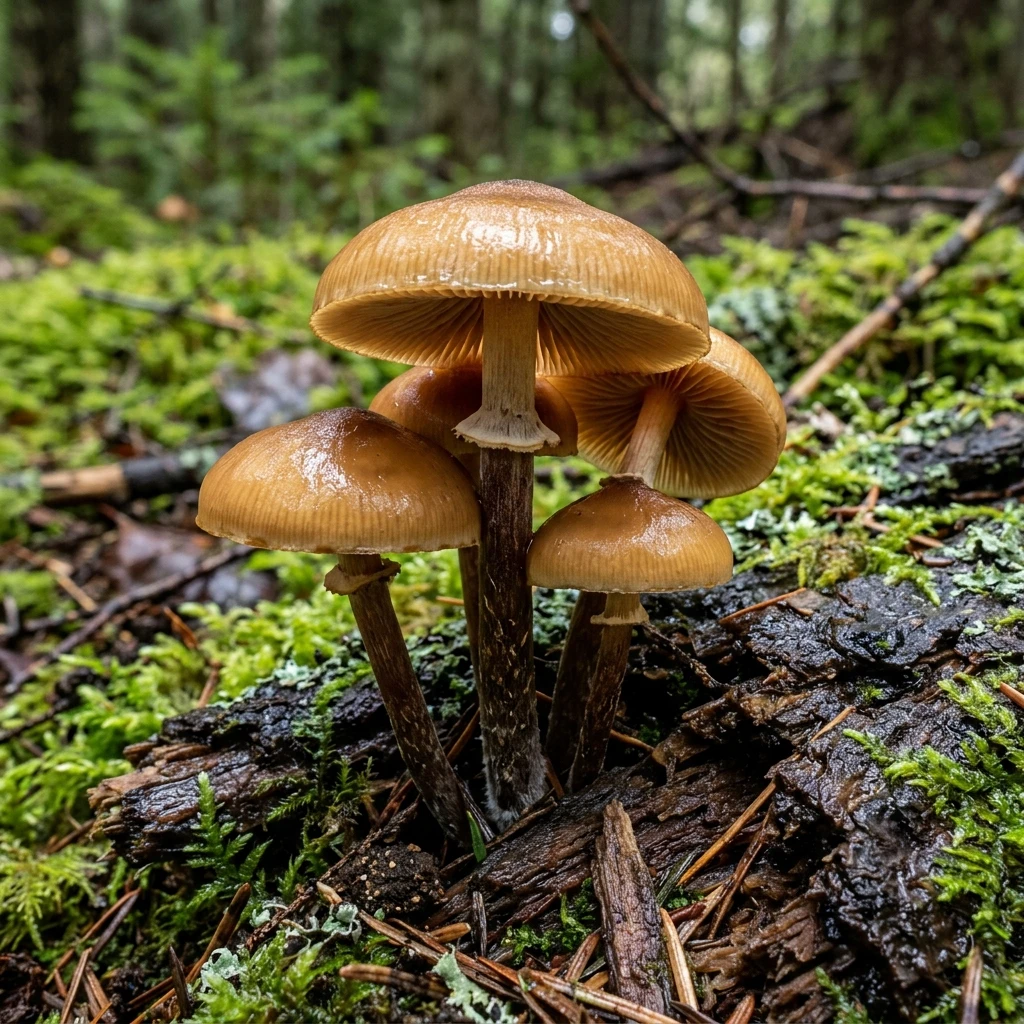
Funeral Bell
Scientific Name: Galerina marginata
The Funeral Bell, also known as the Deadly Galerina, is a small, unremarkable but highly lethal wood-decaying mushroom found throughout temperate forests globally. Typically growing in clusters on rotting conifer logs, its small, orange-brown caps mask a deadly concentration of amatoxins. Due to its size and wood-decay habitat, it presents a extreme hazard, frequently confused with popular edible wood-inhabiting mushrooms.
How to Identify
A small brownish-orange cap, yellowish-brown gills, a tiny fragile ring on a dark brown fibrous stem, growing on decaying logs.
- Brownish-Orange Cap: Small, convex cap that fades to yellowish-tan, often showing faint lines near the wet margin.
- Attached Gills: Gills are yellowish-brown, crowded, and broadly attached or slightly running down the stem.
- Fragile Ring & Dark Stem: A small, thin, brown-white ring on a fibrous stem that is off-white at the top and dark brown at the base.
Detailed Mycology Profile & Safety Guide
Click on any dimension to expand detailed field guides, substrate requirements, and safety warnings.
Is your Funeral Bell growing moldy or decaying?
Take a photo with the Plant AI app to instantly diagnose fungal diseases, green mold, or wood decay, and get expert botanical recommendations in 1 second.
Scan Mushroom NowRing Disappearance
Symptoms: The tiny, fragile whitish ring on the slender stem disappears or turns invisible.
Action: Action: Always check other features. Galerina rings are extremely thin and fragile, easily brushed off by rain, insects, or contact. Check the fibrous stem structure and rusty spore print.
Color Bleaching
Symptoms: The moist brownish-orange cap dries out to a dull, pale yellowish-tan.
Action: Action: This is natural moisture loss (hygrophanous behavior). The mushroom changes color drastically as it dries, but remains highly lethal. Perform a spore print to confirm rusty-brown spores.
Frequently Asked Questions
What toxins does the Funeral Bell contain?
It contains deadly amatoxins (specifically alpha-amanitin), the exact same family of cytotoxins found in the Death Cap. Amatoxins destroy liver and kidney cells, leading to organ failure.
What is the most dangerous look-alike of the Funeral Bell?
Its most dangerous look-alikes are the edible Wild Enoki (Velvet Foot) and the Sheathed Woodtuft, as all grow in dense brown clusters on decaying forest logs during the same autumn season.
How do you distinguish Funeral Bell from Wild Enoki?
Perform a spore print: Funeral Bell has a rusty-brown spore print and a stem ring, whereas Wild Enoki has a white spore print, a velvety dark-brown stem base, and completely lacks a ring.
Can a child die from eating a Funeral Bell?
Yes. Because the mushroom is small, children are at high risk. Ingesting even one or two small caps contains enough amatoxin to cause fatal liver failure in a child.