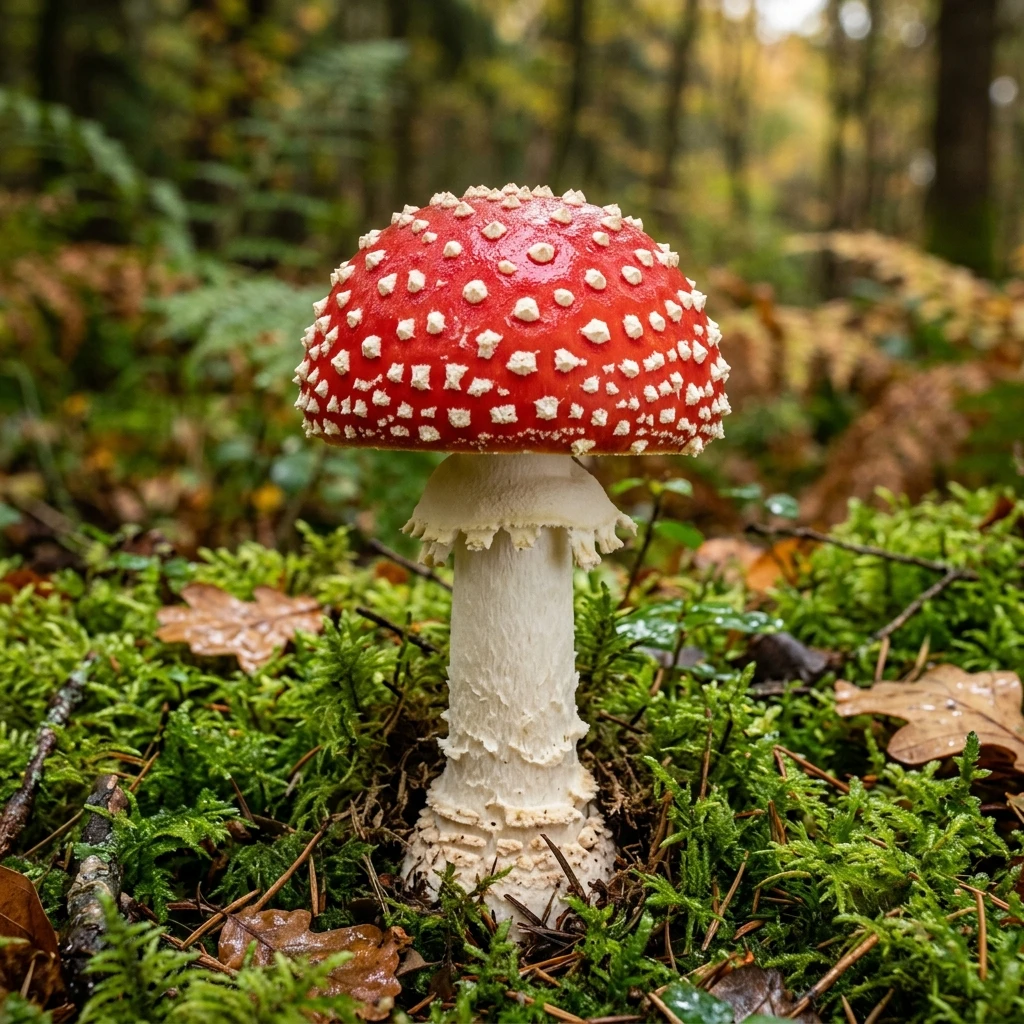
Fly Agaric
Scientific Name: Amanita muscaria
The Fly Agaric is a globally recognized and visually stunning woodland mushroom famous for its bright cherry-red cap covered in distinct, raised white warty spots. Growing in mycorrhizal association with pine and birch trees, it contains psychoactive compounds such as ibotenic acid and muscimol, making it both toxic and highly hallucinogenic. A classic icon of mycology, it represents a core subject of wild mushroom safety education.
How to Identify
A bright red cap covered with white cottony patches, white gills, a white stem ring, and a bulbous base.
- Bright Red Cap: The cap is 8 to 20 cm, starting dome-shaped and flattening to a striking red surface covered in white warts.
- White Free Gills: Gills are white, crowded, and completely free from attachment to the stem.
- Bulbous Base & Ring: The stem is white, featuring a prominent, fluffy hanging ring and a swollen base wrapped in warty concentric bands.
Detailed Mycology Profile & Safety Guide
Click on any dimension to expand detailed field guides, substrate requirements, and safety warnings.
Is your Fly Agaric growing moldy or decaying?
Take a photo with the Plant AI app to instantly diagnose fungal diseases, green mold, or wood decay, and get expert botanical recommendations in 1 second.
Scan Mushroom NowRain Washing
Symptoms: The white warty spots disappear completely, leaving a smooth, plain red cap.
Action: Action: This is natural. Heavy autumn rains can physically wash away the fragile white veil remnants (warts) from the cap, making it look deceptively smooth.
Insect Infestation
Symptoms: Small white woodland grubs boring holes through the thick white stem and red cap.
Action: Action: Leave wild specimens in place. Forest beetles and flies frequently lay eggs in Amanita mushrooms, as their larvae are highly immune to ibotenic acid.
Frequently Asked Questions
Are the white spots on Fly Agaric permanent?
No. The white spots are remnants of the universal veil that protected the mushroom in its egg phase. As the cap expands, the veil tears into spots, which can be easily washed off by heavy rains or brushed off by wind.
What are the primary toxins in Fly Agaric?
The primary toxins are ibotenic acid and muscimol. Ibotenic acid acts as a powerful brain stimulator, while muscimol acts as a sedative and hallucinogen, leading to a highly unpredictable and dangerous 'delirium' state.
Can you die from eating a Fly Agaric?
Fatalities are extremely rare in healthy adults, as the mushroom rarely contains lethal concentrations of cytotoxins. However, it causes severe, violent vomiting, muscle twitching, confusion, and deep coma-like sleep.
How do you distinguish it from Caesar's Mushroom?
Fly Agaric has pure white gills, a white stem, and a warty bulbous base. Caesar's Mushroom (Amanita caesarea) is a choice edible featuring bright yellow gills, a yellow stem, a yellow ring, and a clean white cup volva.