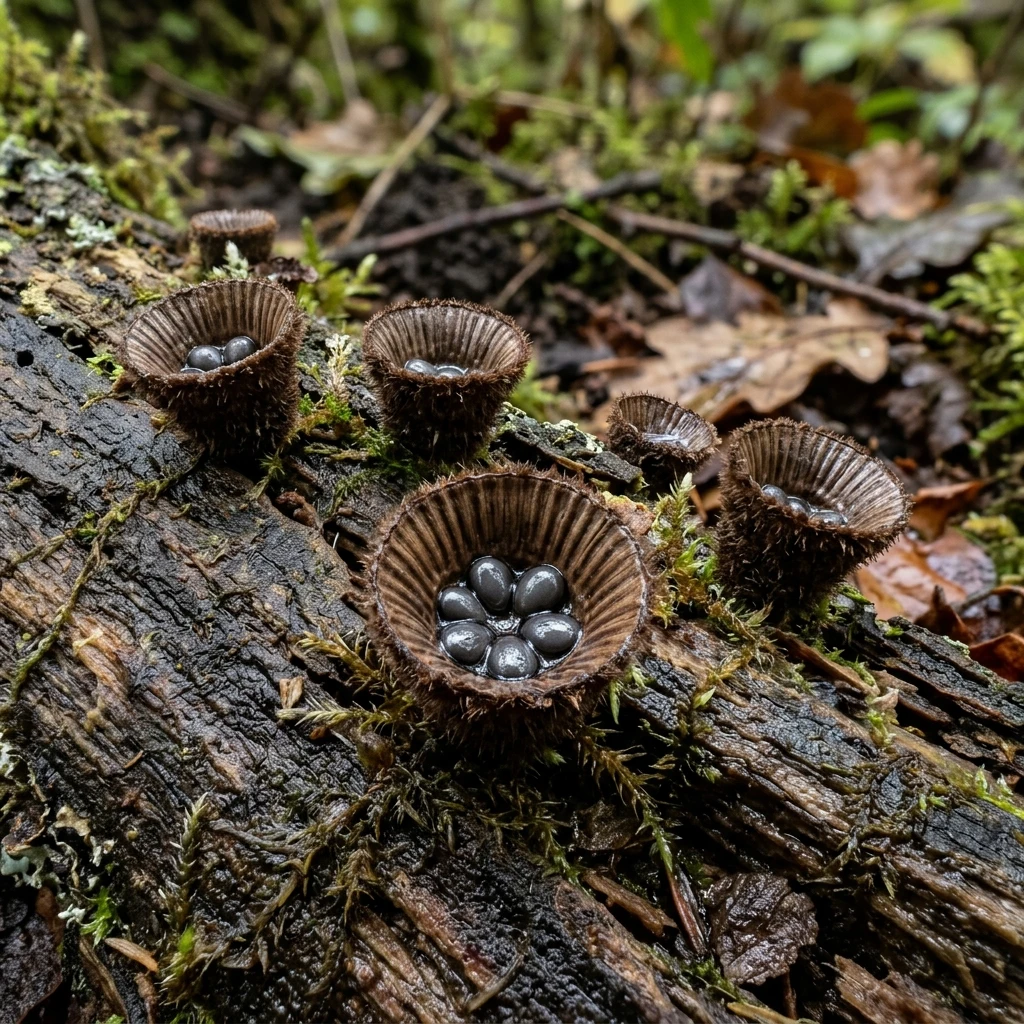
Fluted Bird's Nest
Scientific Name: Cyathus striatus
The Fluted Bird's Nest is a highly intricate, fascinating, and inedible micro-fungus widely distributed in temperate forests worldwide. Typically growing in dense, clustered colonies on decaying hardwood logs, mulch, and twigs, it is named for its striking, miniature resemblance to a bird's nest filled with tiny eggs. Featuring tiny brown cups with fine, vertical fluted ridges inside and holding small gray spore-bearing discs, it utilizes a brilliant physical mechanism to disperse its spores.
How to Identify
Tiny, funnel-like brown cups with vertical ridges inside, filled with several small gray disc-like egg-shaped spore sacs.
- Fluted Nest Cups: Extremely small cups, 0.5 to 1.5 cm tall, with a hairy dark-brown outer surface and distinct, vertically striped (fluted) inner walls.
- Egg-like Peridioles: Inside each cup are 10 to 15 small, shiny gray, lentil-like discs ('eggs') which hold the spores.
- Furry Outer Skin: The outer cup surface is covered in rough, shaggy, dark-brown hairs that help trap falling raindrops.
Detailed Mycology Profile & Safety Guide
Click on any dimension to expand detailed field guides, substrate requirements, and safety warnings.
Is your Fluted Bird's Nest growing moldy or decaying?
Take a photo with the Plant AI app to instantly diagnose fungal diseases, green mold, or wood decay, and get expert botanical recommendations in 1 second.
Scan Mushroom NowWhite Membrane Cover (Young Stage)
Symptoms: The tiny cups are closed at the top, covered by a thin, white-to-orange fuzzy membrane.
Action: Action: This is natural. Young bird's nest cups are sealed by a protective lid (epiphragm). As they mature, the lid tears open and disappears, exposing the eggs inside to falling raindrops.
Empty Nest Cups
Symptoms: The brown fluted cups are completely empty, with no gray eggs left at the bottom.
Action: Action: This is successful reproduction. Raindrops have successfully splashed the spore-bearing peridioles out of the cups. The empty cups will slowly decay back into the wood.
Frequently Asked Questions
How do the 'eggs' get out of the nest?
This fungus uses a 'splash cup' mechanism. The cup is shaped and angled so that when a raindrop hits the bottom, the water pressure hurls the gray spore-bearing eggs out of the cup, launching them up to 2 meters away.
Are the 'eggs' real eggs?
No. The 'eggs' are actually peridioles—hard, protective discs containing millions of microscopic spores. As the peridiole slowly decays on a nearby twig, it releases the spores to colonize new wood.
Does it harm garden plants?
No. Fluted Bird's Nest is completely saprophytic, feeding only on dead wood and mulch. It is highly beneficial for your garden soil, converting wood into rich organic matter.
How do you tell it apart from the Crucible Fungus?
Fluted Bird's Nest has a furry, dark-brown cup with vertical ridges inside and gray eggs. Crucible Fungus (Crucibulum laeve) has a smooth, bright yellow-to-cream cup interior and white eggs.