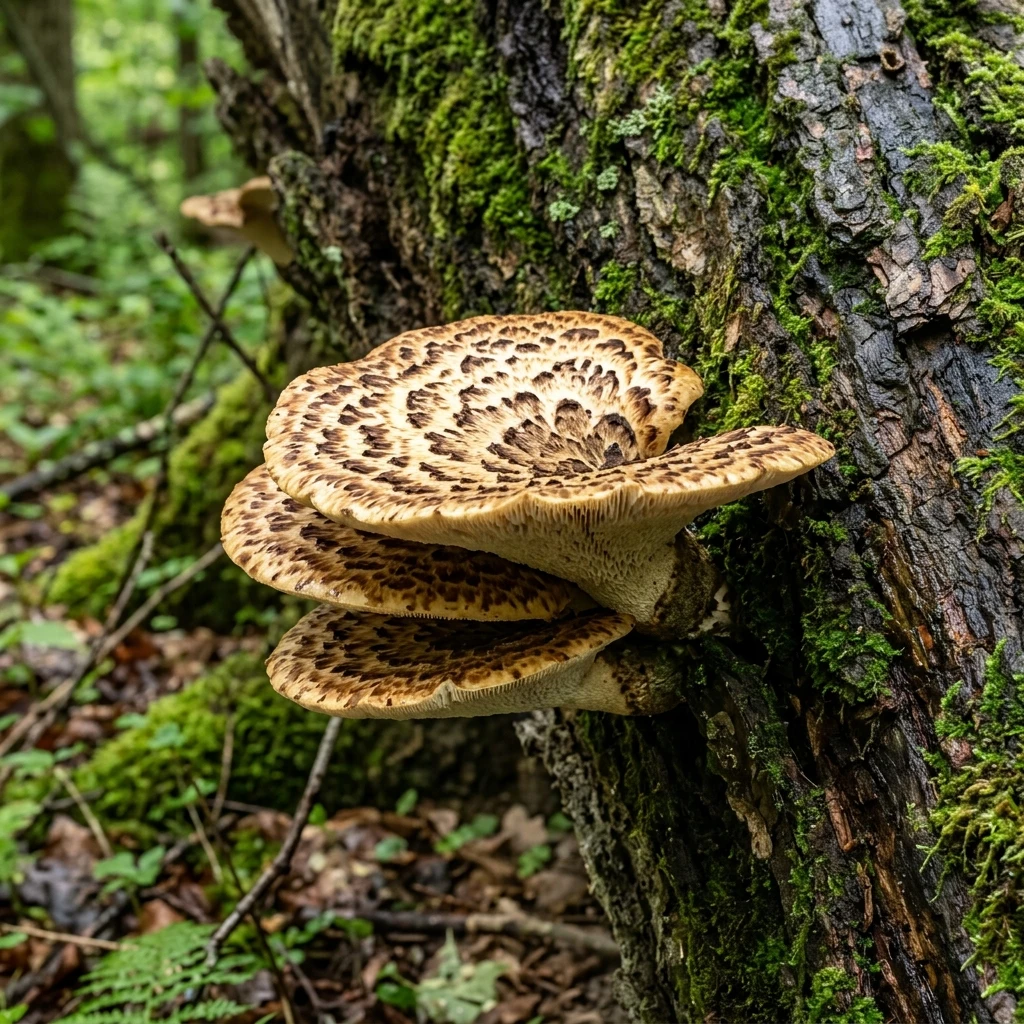
Dryad's Saddle
Scientific Name: Cerioporus squamosus
The Dryad's Saddle, also known as the Pheasant's Back Mushroom, is a large, highly common, and edible wild bracket polypore mushroom native to temperate woodlands across Europe, North America, and Asia. Growing horizontally in spectacular shelf-like layers on decaying deciduous stumps and living hardwood trees, it is named for its striking resemblance to a feathered pheasant's back. Renowned for its unique, fresh watermelon-rind or cucumber scent when cut, it represents a classic early-season foraging target.
How to Identify
Large, fan-shaped cream-colored brackets covered in concentric dark-brown feather-like scales, with large angular pores underneath and a cucumber-like smell.
- Pheasant-Feather Cap: A large, thick, fan-shaped cap, 10 to 30 cm, covered in concentric rings of dark-brown, shaggy, feather-like scales.
- Large Honeycomb Pores: Underneath the cap is a white-to-creamy sponge layer consisting of exceptionally large, angular, honeycomb-like pores.
- Watermelon/Cucumber Odor: When sliced or scraped, the firm white flesh emits a powerful, unmistakable fresh scent of cucumber or watermelon rind.
Detailed Mycology Profile & Safety Guide
Click on any dimension to expand detailed field guides, substrate requirements, and safety warnings.
Is your Dryad's Saddle growing moldy or decaying?
Take a photo with the Plant AI app to instantly diagnose fungal diseases, green mold, or wood decay, and get expert botanical recommendations in 1 second.
Scan Mushroom NowWoody Hardening (Aging)
Symptoms: The entire bracket turns dry, extremely hard, corky, and impossible to cut or pierce with a fingernail.
Action: Action: Past its prime. The mushroom has fully matured and dried out. Do not harvest for food; only collect young, soft, fleshy spring brackets.
Soggy White Mold
Symptoms: The white pore layer underneath develops a fuzzy, dense white mold coating, smelling sour.
Action: Action: Discard. Excessively wet spring weather can cause the pores to mold. Leave them to decompose naturally.
Frequently Asked Questions
Why is it called 'Dryad's Saddle'?
In Greek mythology, Dryads are tree nymphs (spirits). The large, flat, shelf-like shape of this mushroom was historically imagined to be the perfect size and shape for these woodland spirits to use as a saddle.
What does it smell like?
It has a highly unique, refreshing, and powerful smell that is uncannily identical to a freshly cut watermelon rind or a cool, sliced cucumber. This scent is a key identification mark.
How do you cook it?
Slice the soft, tender outer margins thinly. Sauté them in olive oil or butter with garlic, thyme, and a splash of white wine. You can also dry the tougher inner parts to use as a base for rich vegetable stocks.
Does it kill the tree it grows on?
Yes, but very slowly. It is a heart-rot fungus, meaning it slowly decays the dead heartwood inside the center of the living tree. Sturdy oak trees can host this fungus for decades before showing any structural weakness.