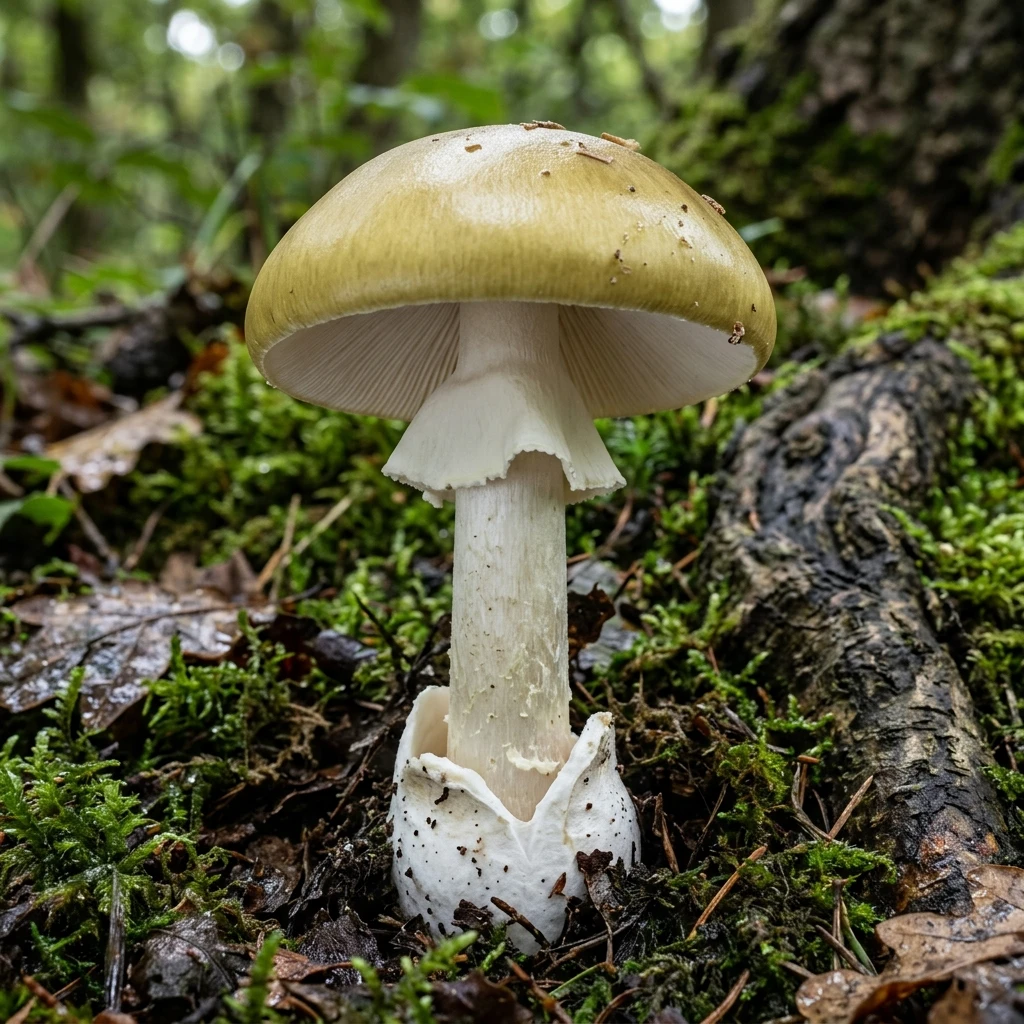
Death Cap
Scientific Name: Amanita phalloides
The Death Cap is the most notoriously lethal mushroom in the world, responsible for over 90% of all global mushroom-related fatalities. Native to Europe but now widely introduced worldwide, it grows in mycorrhizal symbiosis under hardwood trees like oaks. Packed with highly stable, heat-resistant amatoxins, consuming just half a cap triggers severe, irreversible liver and kidney destruction, making it a critical safety subject.
How to Identify
A smooth olive-green or yellowish cap, white gills, a high white hanging ring, and a distinct bag-like white volva at the stem base.
- Olive-Green Cap: Smooth, shiny olive-green to pale yellow-green cap, sometimes fading to white at the edges.
- Pure White Gills: Free, crowded white gills that do not darken with age.
- Volva & Ring: Features a high membranous hanging ring on the stem and a distinct, large cup-shaped white bag (volva) at the bulbous base.
Detailed Mycology Profile & Safety Guide
Click on any dimension to expand detailed field guides, substrate requirements, and safety warnings.
Is your Death Cap growing moldy or decaying?
Take a photo with the Plant AI app to instantly diagnose fungal diseases, green mold, or wood decay, and get expert botanical recommendations in 1 second.
Scan Mushroom NowColor Fading
Symptoms: The metallic olive-green cap fades to a pale, yellowish-white color.
Action: Action: Do not trust color alone. Death Caps growing in heavy shade or dry conditions frequently fade to white, making them easily confused with white button mushrooms. Always verify volva and ring.
Volva Buried
Symptoms: The crucial cup-like volva at the base of the stem seems missing or invisible.
Action: Action: Dig carefully. The white bag volva is often buried completely underground. Never identify mushrooms by cutting them at soil level; always gently dig out the base to inspect for a volva.
Frequently Asked Questions
Why is the Death Cap so dangerous?
It contains extremely stable amatoxins that halt protein synthesis in vital organs. Furthermore, symptoms do not appear until 6 to 24 hours after eating, by which time the liver and kidneys are already severely damaged.
What does a Death Cap taste like?
Survivors of poisoning report that Death Caps taste exceptionally delicious, sweet, and mild. This lack of bitterness or acrid taste makes it incredibly deceptive and dangerous.
Can touch-contact with Death Cap kill you?
No. Touching a Death Cap will not cause poisoning, as amatoxins cannot be absorbed through the skin. However, you must wash your hands thoroughly to prevent accidental ingestion of any residual tissue particles.
Is there an antidote for Death Cap poisoning?
There is no direct chemical antidote. Treatment involves aggressive intravenous fluids, activated charcoal, high-dose intravenous silibinin (derived from milk thistle), and emergency liver transplantation in severe cases.