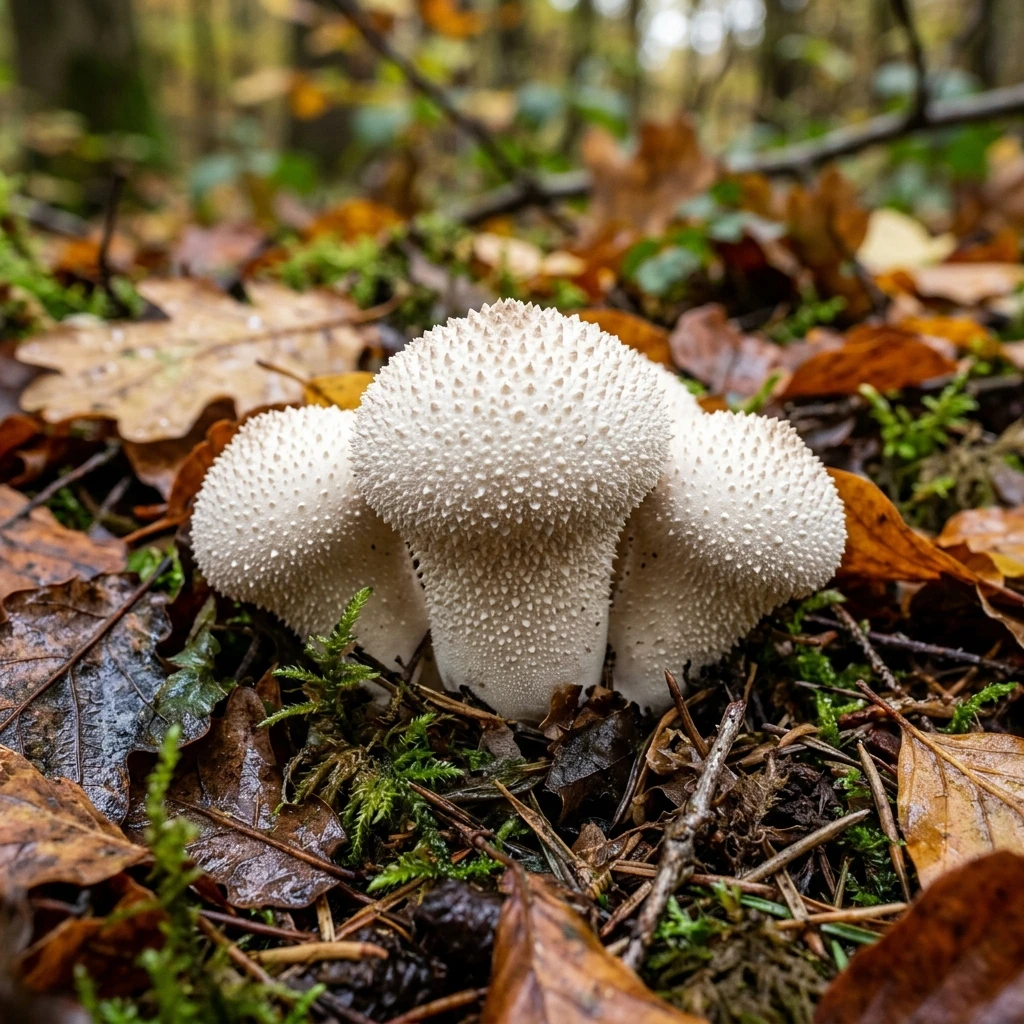
Common Puffball
Scientific Name: Lycoperdon perlatum
The Common Puffball, also known as the Gem-Studded Puffball, is a highly popular and widely distributed wild edible mushroom native to forests and grassy meadows across North America and Europe. Featuring a unique, reverse-pear-shaped white body covered in tiny, gem-like warty spines, it lacks a traditional cap and gills. Highly delicious when young and pure white inside, it represents a critical safety subject in mycology due to a highly fatal look-alike.
How to Identify
A pear-shaped white mushroom covered in tiny, rub-off warty spines, with a solid white interior when young.
- Gem-Studded Skin: The white, pear-shaped body is covered in tiny, easily rubbed-off warty spines and granules.
- Solid White Interior: When sliced vertically, the young interior (gleba) is completely solid, pure white, resembling cream cheese.
- Central Spore Pore: As it matures, a small hole opens at the top, allowing clouds of olive-brown spores to puff out when squeezed.
Detailed Mycology Profile & Safety Guide
Click on any dimension to expand detailed field guides, substrate requirements, and safety warnings.
Is your Common Puffball growing moldy or decaying?
Take a photo with the Plant AI app to instantly diagnose fungal diseases, green mold, or wood decay, and get expert botanical recommendations in 1 second.
Scan Mushroom NowYellow Interior (Maturation)
Symptoms: Slicing the puffball reveals a yellow, greenish, or spongy olive-brown interior.
Action: Action: DO NOT EAT. The puffball has begun producing spores. It is no longer edible and will cause severe stomach upset. Only eat specimens that are 100% solid white inside.
Insect Tunneling
Symptoms: Small brown tunnels or tiny worms boring through the white solid interior flesh.
Action: Action: Discard affected specimens. Forest flies frequently lay eggs in young puffballs. Always slice them open to check for cleanliness before cooking.
Frequently Asked Questions
How do you distinguish a Puffball from a deadly Amanita egg?
You must slice the mushroom vertically from top to bottom. A true Puffball is completely solid, uniform white inside like cream cheese. A deadly Amanita egg will reveal the distinct outline of a miniature mushroom cap, gills, and stem resting inside.
Are all puffballs edible?
Most true puffballs are edible when young and pure white inside. However, you must avoid the toxic Pigskin Poison Puffball (Scleroderma citrinum), which has a tough, thick yellowish outer skin and a dark purple-black interior.
Why do puffballs 'puff'?
When mature, the puffball's skin dries and forms a paper-like sac with a central hole. When raindrops or animals strike the sac, it compresses, shooting a cloud of dry, dust-like spores out of the hole into the wind.
Can you eat the outer skin of the Gem-Studded Puffball?
Yes, but some people find the tiny warty spines to have a slightly gritty texture. You can easily rub them off with your fingers or a damp cloth before cooking, leaving a smooth white surface.