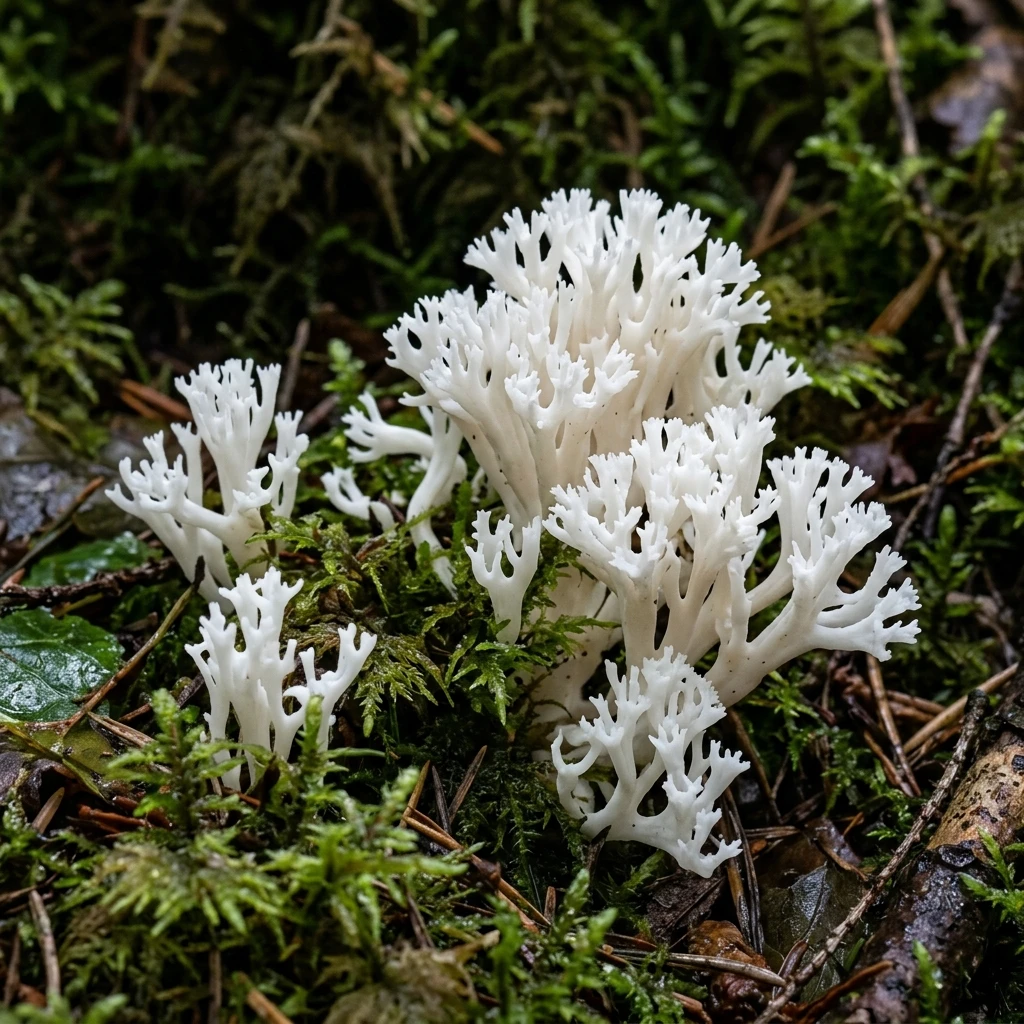
Crested Coral
Scientific Name: Clavulina cristata
The Crested Coral, also known as the Wrinkled Coral Fungi, is a highly common, beautiful, and edible wild coral-like mushroom native to temperate woodlands across Europe, North America, and temperate Asia. Growing in symbiotic mycorrhizal association with both broadleaf and coniferous trees, it does not resemble a traditional cap-and-gill mushroom, but instead forms a highly detailed, pure-white to pale-gray clustered structure of upright branches. It is celebrated by mycology enthusiasts for its extremely unique, delicate branches which terminate in highly intricate, crested, and feathered tooth-like tips that resemble a miniature forest crown.
How to Identify
Highly branched, pure-white to pale-gray coral-like clusters with intricate, feathered, crested tips, growing in damp moss under mature trees.
- Crested Feathered Tips: The tips of the upright branches are highly divided, crested, and feathered into tiny, tooth-like projections.
- Pure-White Coral Structure: A delicate coral-like branching body, 3 to 8 cm, ranging from pure snow-white to pale cream or gray.
- Mossy Forest Growth: Grows in small scattered groups or dense colonies directly on damp soil or deep green moss near tree roots.
Detailed Mycology Profile & Safety Guide
Click on any dimension to expand detailed field guides, substrate requirements, and safety warnings.
Is your Crested Coral growing moldy or decaying?
Take a photo with the Plant AI app to instantly diagnose fungal diseases, green mold, or wood decay, and get expert botanical recommendations in 1 second.
Scan Mushroom NowGray-Black Discoloration (Parasitism)
Symptoms: The pure-white branches turn a dull gray, purple-gray, or charcoal-black and feel soft.
Action: Action: Discard. This is caused by a microscopic parasitic fungus (*Helminthosphaeria clavariarum*) which frequently attacks Crested Coral. Infected specimens are inedible.
Brittle Melting
Symptoms: The fragile white branches become extremely brittle, soggy, and melt into a soft mass after heavy rains.
Action: Action: Past its prime. The mushroom has completed its growth phase and absorbed excess water. Do not harvest; leave it to decompose naturally.
Frequently Asked Questions
Why is it called 'Crested Coral'?
It is named the 'Crested Coral' (Clavulina cristata) because its branching structure strongly resembles natural ocean coral reef formations, and the tips of the branches are highly divided and flat-toothed, like a rooster's crest or crown.
Is it safe to eat?
Yes, it is edible and safe, with a very mild, subtle flavor and a pleasant, slightly crisp texture. It is not considered a top-tier gourmet mushroom due to its mildness, but it is highly valued for its beautiful appearance in dishes.
What is the black coating sometimes found on it?
What is the black coating sometimes found on it?
If you see a gray or black coating, do not eat it. This is not dirt, but rather a parasitic mold (*Helminthosphaeria clavariarum*) that feeds on the Crested Coral, turning it black and making it unfit for consumption.
Are there toxic look-alikes?
There are no highly toxic look-alikes that resemble pure-white coral with flat crested tips. Some other coral fungi (like *Ramaria*) can be mildly toxic and cause stomach upset, but they are usually larger, much more branched, yellow, pink, or orange, and lack the feathered tips.