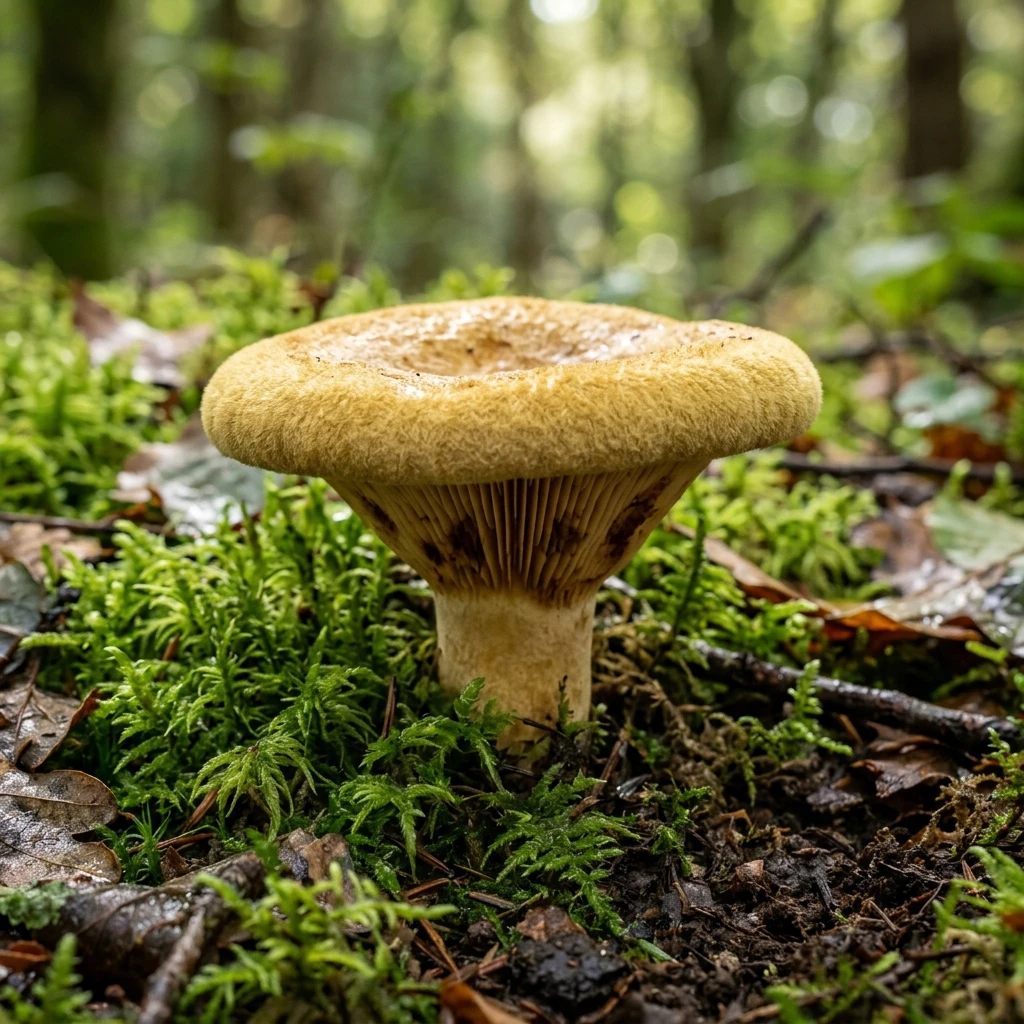
Brown Rollrim
Scientific Name: Paxillus involutus
The Brown Rollrim, or Common Rollrim, is a highly common, deceptive, and lethally poisonous wild fungus native to woodlands and grassy parks across Europe, North America, and Asia. Growing in mycorrhizal symbiosis with Birch and Pine, it is a very common park mushroom. It features a yellowish-brown cap with a strongly, distinctly inrolled edge that is covered in fine, velvety hairs. Long considered a safe edible mushroom in Eastern Europe, modern science has revealed a terrifying, unique toxicity: it triggers a fatal autoimmune reaction known as Paxillus Syndrome.
How to Identify
A yellowish-brown cap with a strongly inrolled velvety margin and brownish-yellow gills that stain dark brown when touched.
- Inrolled Velvety Margin: The cap margin is strongly and distinctly rolled inward toward the gills, remaining rolled in even when mature, covered in fine velvety hairs.
- Brown-Bruising Gills: The gills are decurrent (running down the stem), pale brownish-yellow, and stain a dark, dingy brown instantly when touched.
- Funnel-shaped Cap: A convex cap, 5 to 12 cm, that quickly becomes depressed in the center, forming a shallow brown funnel.
Detailed Mycology Profile & Safety Guide
Click on any dimension to expand detailed field guides, substrate requirements, and safety warnings.
Is your Brown Rollrim growing moldy or decaying?
Take a photo with the Plant AI app to instantly diagnose fungal diseases, green mold, or wood decay, and get expert botanical recommendations in 1 second.
Scan Mushroom NowMargin Unrolling (Extreme Age)
Symptoms: The cap margin becomes flat or slightly wavy, losing its distinct rolled-in look.
Action: Action: This is caused by extreme maturity. The cap expands fully to release the last spores. The toxic compounds remain highly active; do not handle.
Gill Mold
Symptoms: The decurrent brownish gills develop a white or yellow powdery mold coating in wet grass.
Action: Action: Discard. The crowded gills easily trap grass moisture, leading to mold decay. Avoid lawn compost contamination.
Frequently Asked Questions
Why is the Brown Rollrim considered so dangerous?
It is dangerous because of 'Paxillus Syndrome.' It is a cumulative poison. A person can eat it safely for years with zero symptoms, but their body is slowly building up antibodies. Suddenly, after a random meal, these antibodies trigger a massive autoimmune attack, destroying their own red blood cells.
What are the symptoms of Paxillus Syndrome?
The autoimmune reaction triggers sudden, violent hemolytic shock with kidney pain, dark urine (hemoglobinuria), severe jaundice, kidney failure, and death if immediate blood transfusion and dialysis are not received.
Does cooking destroy the toxins in this mushroom?
No. While cooking destroys the compounds that cause immediate stomach irritation, it has absolutely no effect on the antigens that trigger the fatal autoimmune Paxillus Syndrome.
How do you distinguish it from a Milk Cap?
Edible Milk Caps (Lactarius species) always exude a sticky, milky sap (latex) from their gills when scratched or cut. The toxic Brown Rollrim never exudes any milky sap, and its gills bruise a dark, dingy brown color.