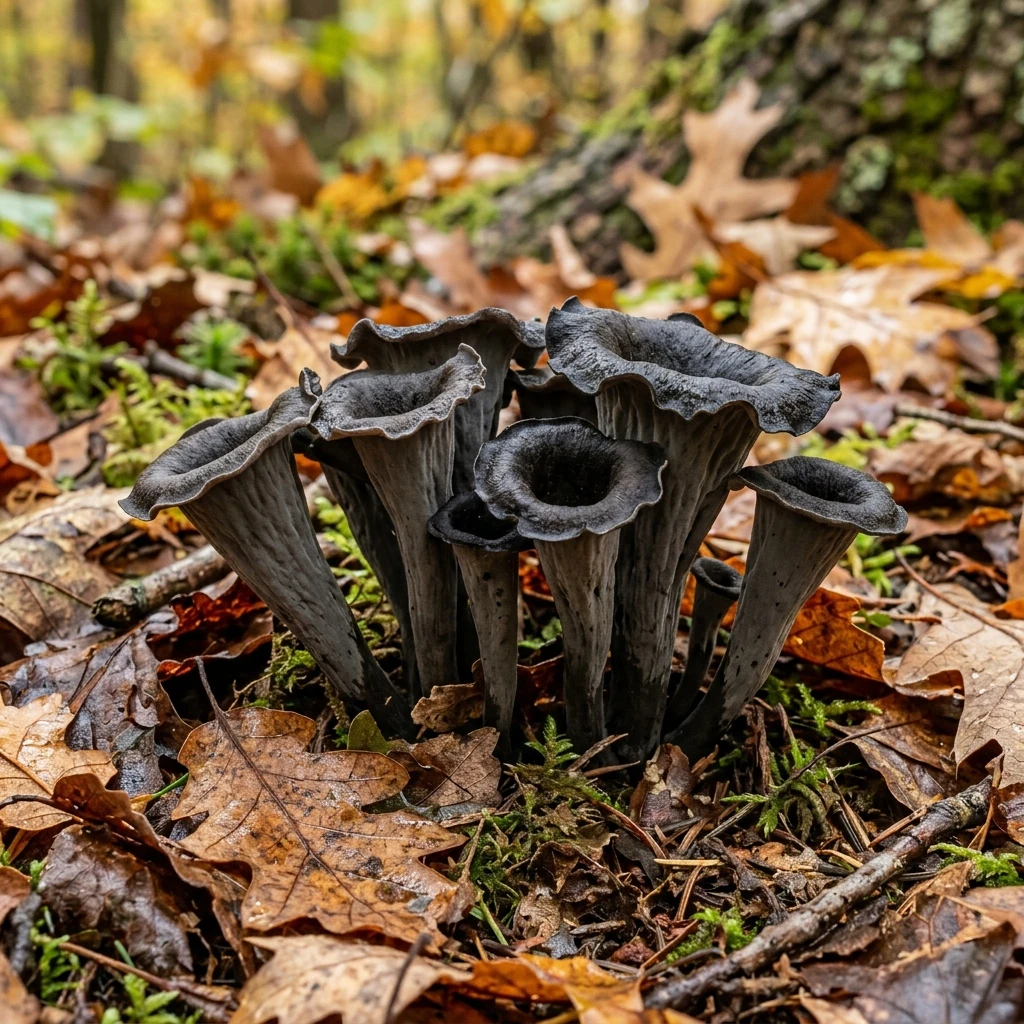
Black Trumpet
Scientific Name: Craterellus cornucopioides
The Black Trumpet, also known as the Horn of Plenty or the 'Poor Man's Truffle,' is an exceptionally highly prized, choice wild edible mushroom native to deciduous forests across Europe, North America, and East Asia. Resembling a deep, hollow, dark gray-black trumpet or funnel with thin, delicate margins, it represents a peak delicacy in the mycology world. Lacking true gills, its smooth-to-slightly wrinkled outer surface hides a remarkably intense, rich, and sophisticated aroma of smoky wood, sweet earth, and dried stone fruits, making it a legendary target for gourmet chefs.
How to Identify
Hollow, dark gray-to-black trumpet-shaped funnels with wavy, thin margins, lacking true gills underneath, growing under oak and beech trees.
- Hollow Trumpet Shape: A deep, hollow, funnel-shaped body, 3 to 10 cm, running completely down to the base of the stem.
- Smooth Outer Surface: The outer (underneath) spore-bearing surface is gray-brown, smooth to slightly wrinkled, with absolutely no true gills.
- Rich Smoky Aroma: The extremely thin, delicate flesh emits a highly sophisticated, sweet, earthy, and smoky wood aroma.
Detailed Mycology Profile & Safety Guide
Click on any dimension to expand detailed field guides, substrate requirements, and safety warnings.
Is your Black Trumpet growing moldy or decaying?
Take a photo with the Plant AI app to instantly diagnose fungal diseases, green mold, or wood decay, and get expert botanical recommendations in 1 second.
Scan Mushroom NowSoggy Rot (Waterlogging)
Symptoms: The thin trumpet walls turn extremely soggy, mushy, black, and develop a sour, decaying odor.
Action: Action: Discard. The thin flesh easily rots if waterlogged for too long after heavy autumn storms. Only harvest fresh, firm, elastic funnels.
Debris Trap
Symptoms: The hollow center of the trumpet is packed with sand, soil, and decaying oak leaves.
Action: Action: Slice each trumpet vertically from cap to stem base, brush out any debris, and rinse quickly under cool running water before cooking.
Frequently Asked Questions
Why is it called 'Poor Man's Truffle'?
It is nicknamed the 'Poor Man's Truffle' because when dried and powdered, its intense, earthy, smoky, and complex flavor is remarkably similar to the luxurious flavor of true French black truffles, but it can be wild-foraged for free.
Does it have look-alikes?
The Black Trumpet has virtually no toxic look-alikes. Its unique combination of thin, hollow, black funnel shape, lack of true gills, and pleasant smoky smell make it one of the safest mushrooms for beginner foragers to identify.
How do you dry them?
How do you dry them?
Slice them vertically, brush away debris, and place them on a dehydrator tray at 45°C for 6 to 8 hours until they are bone-dry and brittle. Store in an airtight glass jar away from direct sunlight.
Can you eat the stem?
Yes! The entire mushroom is composed of a single, continuous, hollow sheet of thin flesh. The stem is just as tender and flavorful as the cap margin, so you eat the entire mushroom.