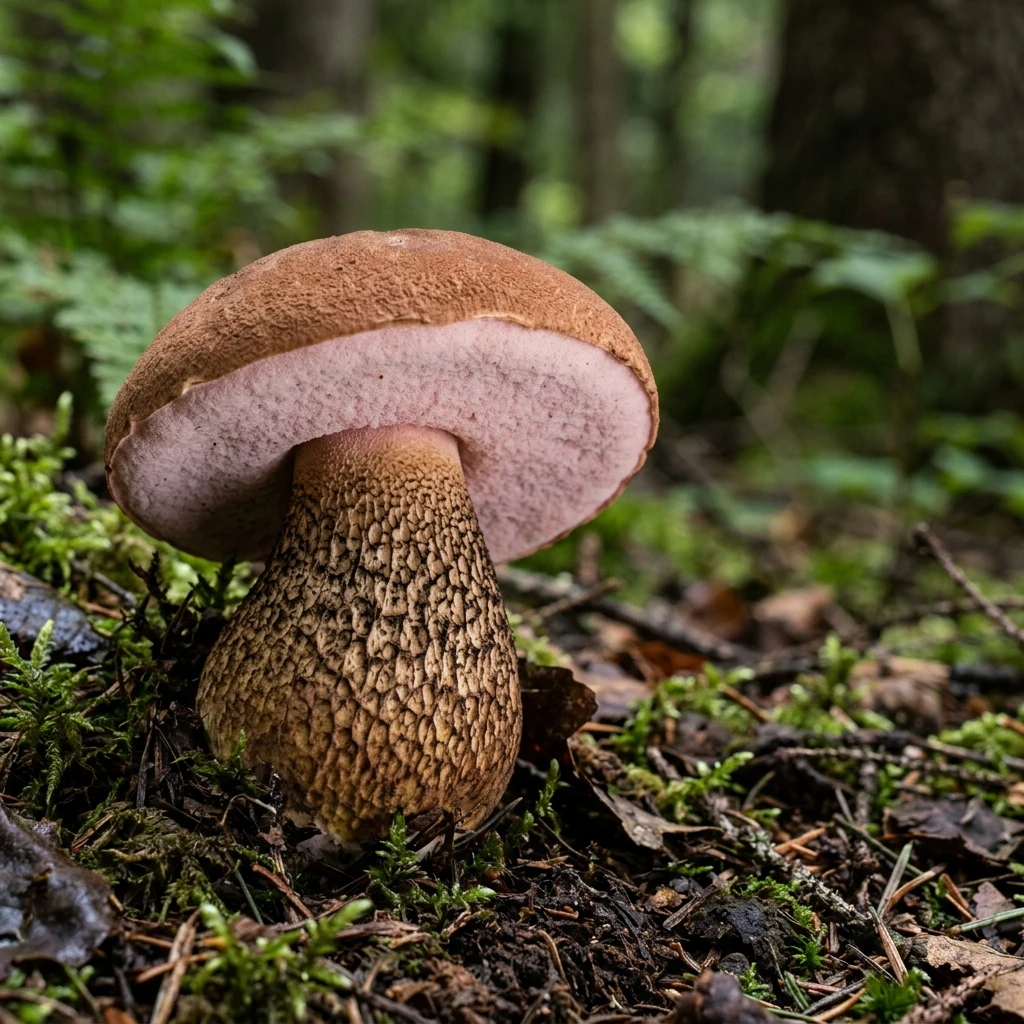
Bitter Bolete
Scientific Name: Tylopilus felleus
The Bitter Bolete is a highly common, deceptive, and completely inedible wild mushroom native to coniferous and broadleaf forests across Europe and North America. Growing on acidic soils and decaying conifer stumps, it is a legendary hazard for wild food foragers. While it looks virtually identical to the highly prized, delicious Porcini (*Boletus edulis*), it possesses two absolute diagnostic checks: its tube pores turn a distinct pale pinkish color as they mature, and its flesh has an intensely, agonizingly bitter taste. A single specimen will completely ruin an entire cooked dish.
How to Identify
A pale tan cap resembling a Porcini, but its pores turn distinct pinkish when mature, and its stem features coarse dark-brown netting, tasting extremely bitter.
- Extremely Bitter Taste: The white flesh is intensely, agonizingly bitter, tasting like bile or pharmaceutical chemicals.
- Pinkish Mature Pores: Underneath the cap is a sponge pore layer that is white when young, but turns a distinct pale pinkish color as it matures.
- Coarse Dark Netting: A thick, solid stem covered in a highly prominent, coarse, dark-brown raised net-like pattern.
Detailed Mycology Profile & Safety Guide
Click on any dimension to expand detailed field guides, substrate requirements, and safety warnings.
Is your Bitter Bolete growing moldy or decaying?
Take a photo with the Plant AI app to instantly diagnose fungal diseases, green mold, or wood decay, and get expert botanical recommendations in 1 second.
Scan Mushroom NowPinkish Pore Development (Mature)
Symptoms: The sponge pores under the cap turn from white to a distinct, soft pinkish-rose color.
Action: Action: This confirms it is the Bitter Bolete. Edible Porcini pores never turn pink; they turn yellow-green. Discard immediately.
Bitter Spoilage
Symptoms: Your cooked wild mushroom risotto or soup tastes incredibly bitter and has to be thrown away.
Action: Action: Prevention. You have accidentally cooked a Bitter Bolete. Always perform a field lick-test on every single white bolete cap you harvest to ensure zero bitter spoilers enter your basket.
Frequently Asked Questions
Is the Bitter Bolete poisonous?
It is not chemically poisonous or lethal to humans, but it is considered completely inedible and unpalatable because of its intense, bile-like bitterness, which can cause mild stomach upset if swallowed.
Why does it taste so bitter?
It contains highly concentrated bitter compounds called tylopilins. This bitterness is a natural evolutionary defense mechanism to deter mammals, slugs, and insects from eating its spores.
How do you distinguish it from a Porcini?
The Porcini (*Boletus edulis*) has a sweet, nutty taste, pores that turn yellow-green at maturity, and a stem with fine white netting. The Bitter Bolete (*Tylopilus felleus*) has a very bitter taste, pores that turn pinkish, and a stem with coarse dark-brown netting.
Does the bitterness disappear when cooked?
No. In fact, the bitterness becomes even more concentrated and soluble in water when heated, so a single bitter bolete slice will ruin an entire pot of soup or risotto.