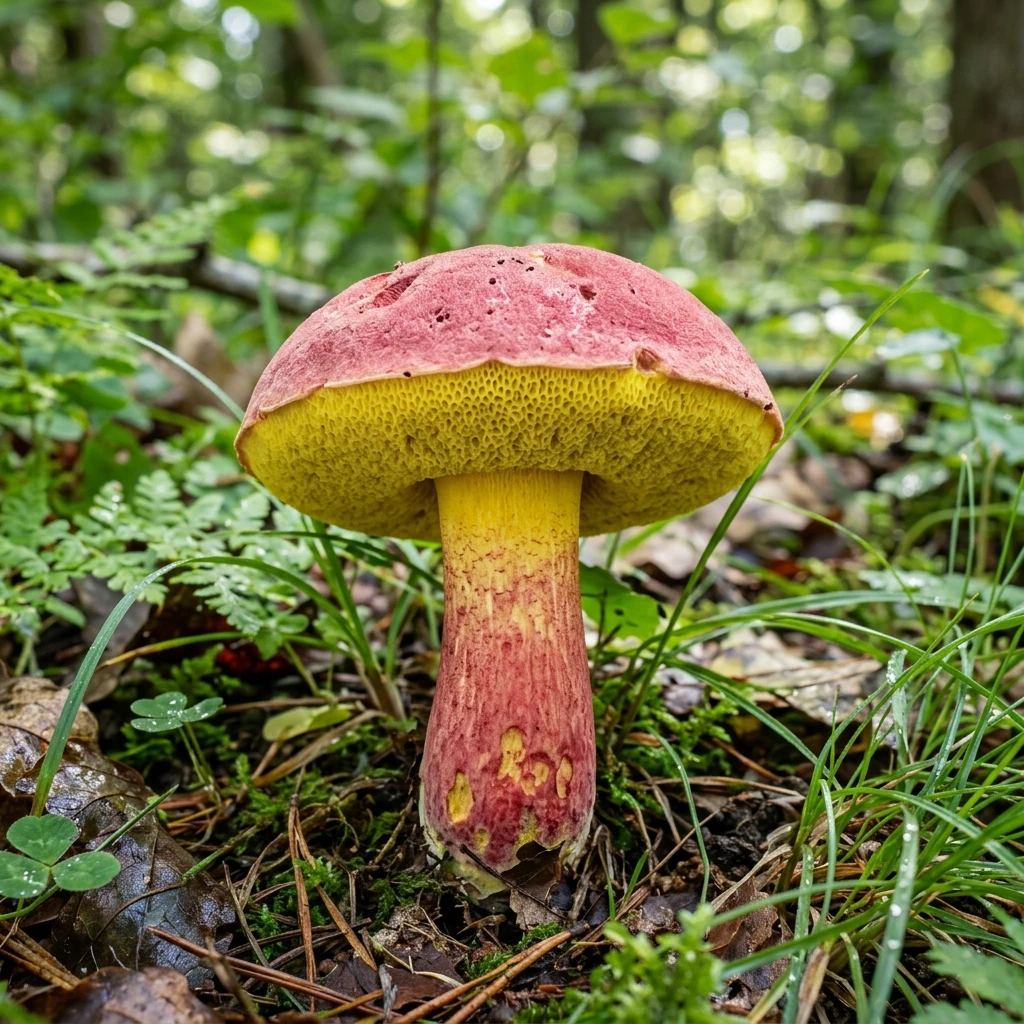
Bicolored Bolete
Scientific Name: Baorangia bicolor
The Bicolored Bolete is a highly beautiful, choice wild edible mushroom native to broadleaf forests across Eastern North America and East Asia. Celebrated for its striking, highly colorful appearance, it features a convex cap of brilliant rose-pink to deep red, resting atop a thick stem that is bright yellow at the top and transitions to rose-red at the base. Underneath, its sponge-like pore layer is bright yellow and bruises a very faint, slow blue-green when touched, representing a legendary subject in woodland foraging.
How to Identify
A gorgeous rose-pink to brick-red cap with bright yellow pores underneath that bruise very slowly and faintly blue-green.
- Rose-Pink Cap: A smooth, velvety convex cap, 5 to 15 cm, displaying brilliant shades of rose-pink, raspberry-red, or brick-red.
- Faint Slow Blueing: The bright yellow sponge pore layer bruises a very faint, slow blue-green when scratched or pressed by fingers.
- Yellow & Red Stem: A solid, smooth stem that is bright yellow at the top and turns rose-red to purple-red near the base.
Detailed Mycology Profile & Safety Guide
Click on any dimension to expand detailed field guides, substrate requirements, and safety warnings.
Is your Bicolored Bolete growing moldy or decaying?
Take a photo with the Plant AI app to instantly diagnose fungal diseases, green mold, or wood decay, and get expert botanical recommendations in 1 second.
Scan Mushroom NowInstant Deep Blueing
Symptoms: Slicing the yellow flesh turns it a brilliant, deep indigo-blue instantly in 1 second.
Action: Action: DISCARD IMMEDIATELY. This is not the Bicolored Bolete. You have harvested the toxic Boletus sensibilis or a similar poisonous species. Edible Bicolored boletes stain only very slowly and faintly.
Stem Softening (Larvae)
Symptoms: The solid red-yellow stem feels soft, spongy, and shows tiny pinholes with white larvae inside.
Action: Action: Slice away the soft base. Forest beetles love the sweet flesh. Sauté and freeze only the clean, firm cap sections.
Frequently Asked Questions
Why is it called 'Bicolored Bolete'?
It is named 'Bicolored Bolete' because of its highly distinctive, two-colored appearance: its cap is brilliant rose-pink to red, while its pores and upper stem are bright sulfur-yellow, creating a striking contrast.
Is the Bicolored Bolete safe to eat raw?
No. Like many boletes, it should never be eaten raw. Undercooked specimens can cause mild gastrointestinal upset in sensitive individuals. Always sauté or cook it thoroughly.
How do you distinguish it from the toxic Boletus sensibilis?
The toxic Boletus sensibilis is a deadly look-alike that stains a brilliant, deep indigo-blue instantly (in 1 second) when touched or cut. The edible Bicolored Bolete stains very slowly, faintly, and weakly blue-green over several minutes.
Does it grow in fairy rings?
No. It grows as a mycorrhizal partner with Oak tree roots, so it fruits in scattered groups or small patches spread across the shaded soil where oak root systems extend.