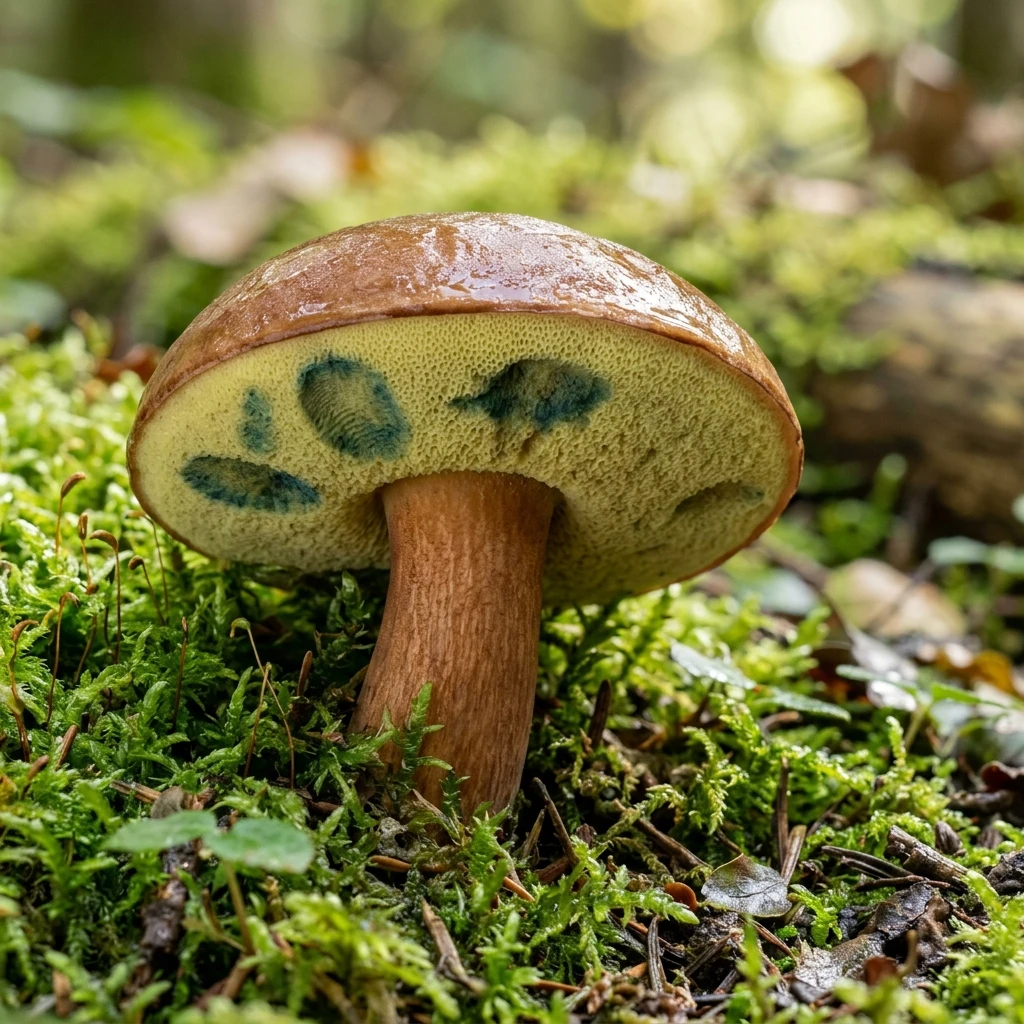
Bay Bolete
Scientific Name: Imleria badia
The Bay Bolete is an exceptionally popular, choice wild edible mushroom native to coniferous and mixed forests across Europe and North America. Highly sought after by autumn mushroom hunters, it is named for its beautiful, smooth, moist cap that resembles the rich chestnut-brown color of a bay horse. Underneath, its sponge-like pore layer is pale yellowish-green and shows a highly distinctive, slow blue-green staining in areas where it has been bruised or pressed by fingers, representing a classic entry-level wild edible.
How to Identify
A smooth, moist, chestnut-brown cap with pale yellow-green pores underneath that stain slow blue-green when bruised.
- Chestnut-Brown Cap: A smooth, velvety-to-slightly-sticky cap, 4 to 15 cm, displaying a rich bay-brown to chestnut-brown color.
- Bruising Yellow-Green Pores: Underneath the cap is a pale yellow-green sponge pore layer that slowly stains blue-green when pressed.
- Smooth Fibrous Stem: A solid, relatively slender stem that is smooth and fibrous, showing faint brown streaks but no netting.
Detailed Mycology Profile & Safety Guide
Click on any dimension to expand detailed field guides, substrate requirements, and safety warnings.
Is your Bay Bolete growing moldy or decaying?
Take a photo with the Plant AI app to instantly diagnose fungal diseases, green mold, or wood decay, and get expert botanical recommendations in 1 second.
Scan Mushroom NowSlimy Cap Cuticle (Heavy Rain)
Symptoms: The chestnut-brown cap becomes extremely sticky, slimy, and slippery after heavy autumn downpours.
Action: Action: This is natural. The cap cuticle contains gelatinous cells that absorb water. Peel the sticky cap skin off before cooking to maintain a pleasant, firm texture in the pan.
Stem Tunneling
Symptoms: The base of the smooth stem feels soft and shows small brown tunnels from insect larvae.
Action: Action: Slice away the soft bottom base. Sauté and dry only the clean, firm cap and upper stem sections.
Frequently Asked Questions
Why is it called 'Bay Bolete'?
It is named 'Bay Bolete' because its rich, warm chestnut-brown cap color resembles the classic reddish-brown coat color of a bay horse.
Is the Bay Bolete a good substitute for Porcini?
Yes. It has a very similar, sweet, nutty, and woody flavor, and its flesh remains firm when cooked. It is widely considered one of the best and most abundant edible autumn mushrooms.
Does the Bay Bolete turn blue instantly?
No. When cut or pressed, its yellow-green pores stain blue-green slowly and moderately, rather than the violent, instant deep indigo-blue seen in toxic red-pored boletes.
Can you eat the stem of the Bay Bolete?
Yes, provided the stem is young and firm. Unlike some mushrooms with woody stems, the stem of a young Bay Bolete is solid, fleshy, and highly delicious.