Bishop's Cap Care & Identification Guide
Astrophytum ornatum, widely known as the Bishop's Cap or Monk's Hood, is the tallest and fastest-growing cactus in the Astrophytum genus, native to the wild canyons of Mexico. It features a spectacular spherical to columnar body decorated with 8 sharp, spiraling ribs covered in beautiful, intricate patterns of white tufts (flocks) of hairs. Stout, sharp, amber-yellow spines protrude from the areoles, and mature specimens produce gorgeous, silky yellow flowers at the crown. It is widely celebrated by botanists for its distinct environmental adaptability and structural appeal.





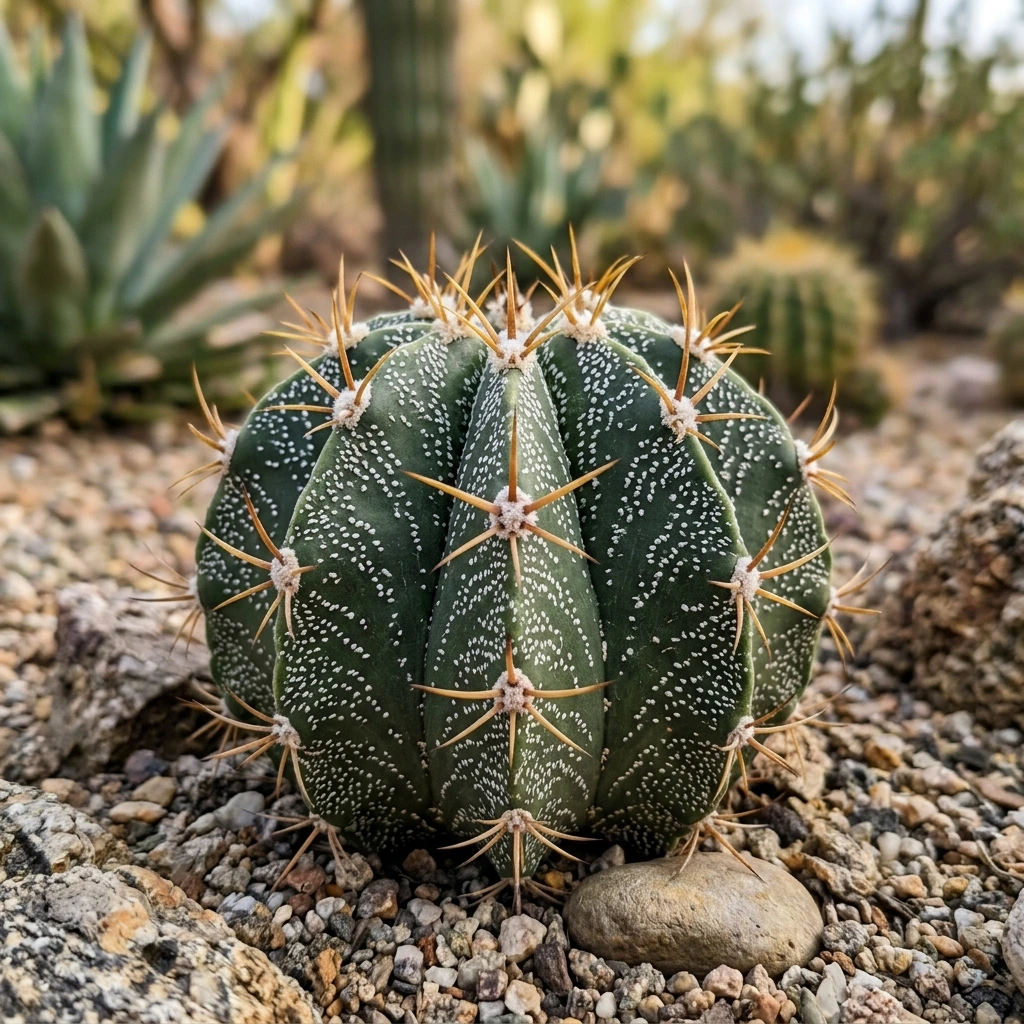
How to Identify Bishop's Cap
A striking, ribbed spherical-to-columnar cactus with spiraling ribs covered in white flecks and armed with golden spines.
-
✔
Key Visual Features: Star-shaped cross-section with 8 distinct spiraling ribs; covered in cross-bands of tiny white felt-like scales; sharp, rigid amber spines.
-
✔
Color Variations: Dark green epidermis flecked with bright white woolly tufts; amber-yellow to dark brown spines; lemon-yellow flowers.
-
✔
Common Confusions: Confused with Astrophytum myriostigma (Myriostigma is spineless, whereas Astrophytum ornatum is heavily armed with rigid spines).
Complete Care & Cultivation Guide
Follow our detailed scientific care guide to keep your Bishop's Cap thriving and gorgeous all year round.
Common Diseases & Treatment
Basal Stem Rot
Symptoms: The base of the cactus turns yellow-brown, soft, and mushy due to overwatering.
Scale Insects
Symptoms: Small, hard brown shells cluster on the cactus skin, sucking nutrients and leaving yellow scars.
Frequently Asked Questions
Why is it called Bishop's Cap?
The star-like, symmetrical spherical shape of young specimens, with their sharply angled ribs, resembles a bishop's traditional mitre hat.
Does the Bishop's Cap cactus have spines?
Yes, unlike the spineless Astrophytum myriostigma (Myriostigma is spineless, whereas Astrophytum ornatum is heavily armed with rigid spines).
How often does Bishop's Cap bloom?
It blooms throughout the hot summer months, producing beautiful funnel-shaped, shiny yellow flowers at the apex, but only once the plant reaches about 6-8 years of age.
Is Astrophytum ornatum toxic to animals?
No, it is completely non-toxic and pet-safe, though its sharp spines pose a physical injury hazard to curious dogs and cats.