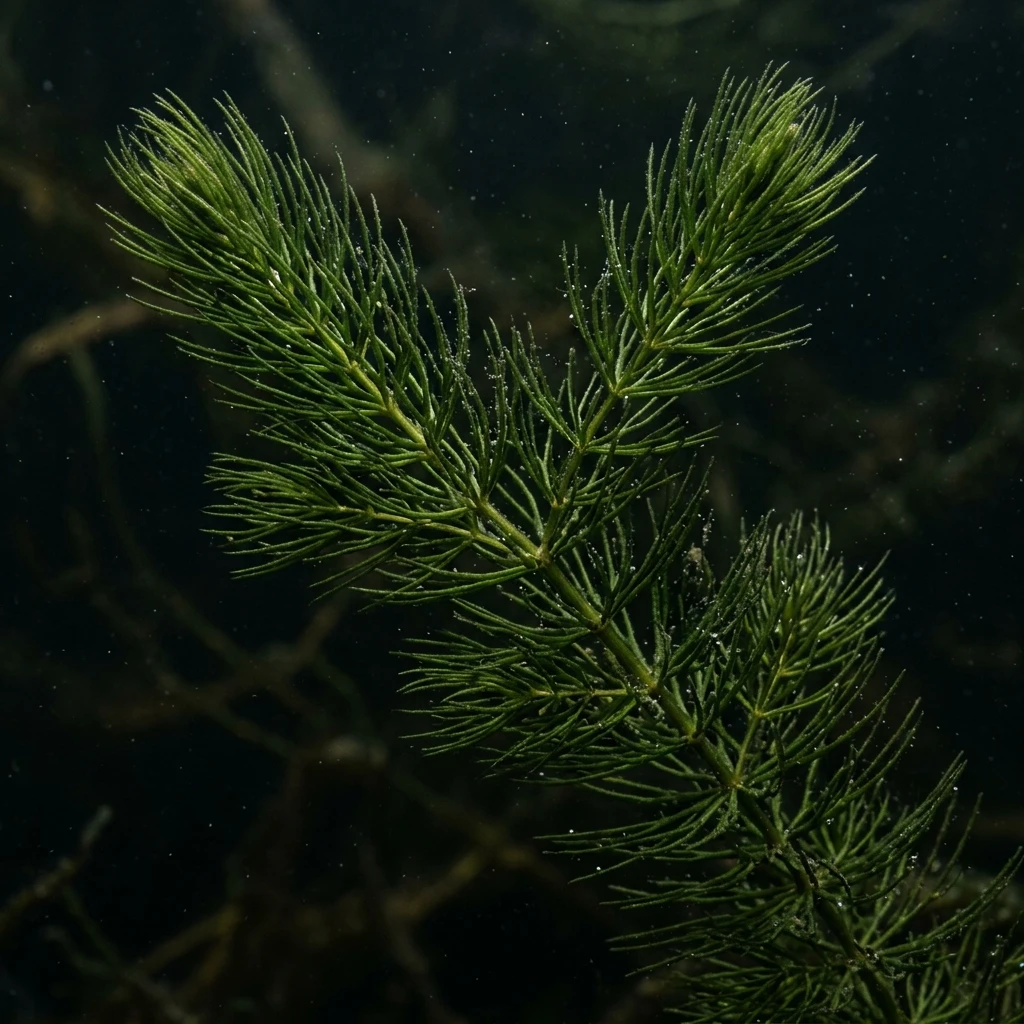
Ceratophyllum demersum

Hornwort Growing & Care Guide

Hornwort is arguably the hardiest, fastest-growing submerged plant in the world. Native to every continent except Antarctica, its fluffy, brush-like green stems can be planted in substrate or left floating. It acts as an elite oxygenator and a powerhouse at absorbing toxic nitrates and inhibiting algae.


Lighting Icon
Lighting Low to High
Water Hardness Icon
Water Hardness Aquatic (pH 6.0-8.5)
Substrate Icon
Substrate Submerged or floating
Temperature Icon
Water Temp 10°C - 28°C
Toxicity Warning Icon
Toxicity Pet Friendly (Non-toxic)
Botanical macro photography of Hornwort (Ceratophyllum demersum) - Plant AI care database

How to Identify Hornwort

Hornwort (Ceratophyllum demersum) is an iconic aquatic species. Recognizing its key structures is crucial for successful aquascaping and thriving growth.

  • Visual Shape & Growth: Long, stiff submerged stems packed with whorls of fine, fork-divided bright green needles.
  • Leaf Morphology: Stiff, dark-green needle-like leaves arranged in dense whorls of 6 to 12 along the stem.
  • Root & Anchoring Structure: Lacks true roots entirely; may grow modified, anchor-like pale leaves to hold onto gravel.
💡 Plant AI Tip: Take a photo with Plant AI to identify aquatic weeds and diagnose fungal spot diseases in 1 second.

Complete Cultivation & Spawning Guide

Follow our detailed scientific water parameters and care guides to keep your Hornwort thriving.

pH: 6.0 - 8.5, GH: 5 - 20 dGH. Incredibly tolerant of hard, alkaline water, and highly resistant to environmental shifts.
None. Grows at explosive speeds without any CO2 supplementation, absorbing dissolved carbonates from water.
Adapts to low, medium, or high lighting. High light combined with liquid fertilizer triggers explosive, bushy growth.
Regular pruning is mandatory. Cut the stems at any length and throw away the old bottom parts; the cut tops will grow rapidly.
An absolute nutrient sponge. Sucks up huge amounts of ammonium, nitrates, and phosphates, naturally starving out algae.
Can be left floating freely, or the bottom stem can be weighed down or tucked into gravel. Do not bury too deep as the buried stem will rot.
Extremely cold-hardy, surviving from 10°C to 28°C (50°F - 82°F). Perfect for indoor tanks and outdoor temperate garden ponds.
Tolerates any water flow, from stagnant ponds to high-flow streams. Helps clear suspended particles from the water column.
Dense needle whorls offer premium protection for fish fry and shrimp. The perfect spawning medium for goldfish and koi.
Secretes natural allelopathic compounds that actively inhibit the growth of cyanobacteria and green hair algae in the water.
Handle gently. Although hardy, the stems can be somewhat brittle and may snap under rough handling.

Is your Hornwort shedding its needles, turning yellow or brown?

Manage light and nutrients. Perform regular trimming and prevent major water parameter shocks.

Diagnose My Aquatics

Common Diseases & Treatment

Needle Shedding (Shock)

Symptoms: Stems suddenly shed all their green needles, leaving a bare, transparent, messy skeleton.

Action: Caused by sudden water chemistry shocks (e.g. salinity shifts, liquid carbon overdose) or extreme lack of light. Keep water stable.

Browning (Light Starvation)

Symptoms: Stems turn yellow-brown and stop growing.

Action: Usually a sign of insufficient light. Move the plant closer to the light source or let it float freely at the surface.

Frequently Asked Questions

Does Hornwort have roots?

No, Hornwort never grows true roots. If planted in gravel, it simply anchors itself using modified pale leaves. It absorbs all its water and nutrients directly through its leaves and stems.

Why is my Hornwort shedding all its needles?

Hornwort is highly sensitive to liquid carbon additives (like Seachem Excel) or sudden shifts in water parameters. Overdosing these chemicals or moving it to a vastly different tank will cause a massive needle drop.

How fast does Hornwort grow?

Under good light and rich nutrient conditions, it can grow up to 2 to 4 inches per day, rapidly reaching the surface. Regular trimming is necessary to prevent it from blocking light.

Can Hornwort survive the winter in a pond?

Yes! In cold climates, Hornwort will drop to the bottom of the pond and form dense, compact winter buds (turions) to survive under the ice, then regrow in spring.

Master advanced aquascaping. Start today!

Get Started for Free